
Constance Trescot
S. Weir (Silas Weir) Mitchell
THE CLASSIC COLLECTION · 1907
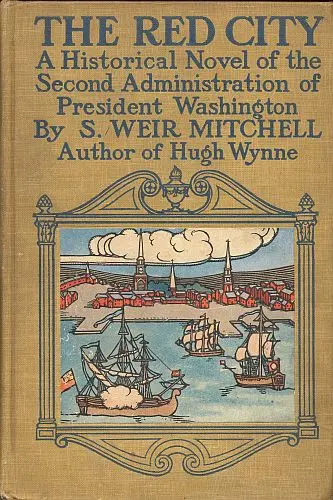
"The Red City: A Novel of the Second Administration of President Washington" by S. Weir Mitchell is a historical novel written in the early 20th century. The story is set during the early years of American democracy, focusing on the lives of émigrés from France amidst the backdrop of President Washington's administration. The main characters include René de Courval, a young French nobleman, and his mother, Madame de Courval, as they navigate their tumultuous past while seeking a new life in America. At the start of the novel, we are introduced to René and his mother aboard the brig "Morning Star", arriving in Delaware in May 1792 after fleeing the turmoil of revolutionary France. The captain of the ship and René share a light-hearted conversation about their travels. However, upon reaching land, the story takes a more serious turn as Madame de Courval reflects on their tragic past, particularly the death of her husband. This emotional revelation prompts René to recount the harrowing details that led to their escape. They arrive in Pennsylvania, filled with hopes and fears about their future in this new world, even as they are confronted with the prejudices and complexities of American society, representing both the promise and the challenges of their new beginning.
Introduction adapted from the source catalogue; source summaries may be automatically generated.
Free to read · English · 102,264 words · No account needed
MAKE TIME FOR A GOOD BOOK
On by default. Untick to stop anonymous reading totals. Each page counts after 10 seconds in view. How this works.
Anonymous counting is on unless you have switched it off.
Genet had at last been recalled, in December, but, as Du Vallon told Schmidt, Carteaux was to hold his place as charge d'affaires to Fauchet, the new minister, expected to arrive in February, 1794.
On the day following the revelations made by Schmidt, and just after breakfast, Margaret went out into the wood near by to gather autumn leaves. Seeing her disappear among the trees, De Courval presently followed her. Far in the woods he came upon her seated at the foot of a great tulip-tree. The basket at her side was full of club moss and gaily tinted toadstools. The red and yellow leaves of maple and oak, falling on her hair and her gray gown, made, as it seemed to him, a pleasant picture.
De Courval threw himself at her feet on the ground covered with autumn's
lavished colors.
"We have nothing like this in France. How wonderful it is!"
"Yes," she said; "it is finer than ever I saw it." Then, not looking up, she added, after a pause, the hands he watched still busy: "Why didst thou not bring me any goldenrod last evening? I asked thee."
"I saw none."
"Ah, but there is still plenty, or at least there are asters. I think thou must have been gathering pensees, as thy mother calls them; pansies, we say."
"Yes, thoughts, thoughts," he returned with sudden gravity--"pensees."
"They must have been of my cousin Shippen or of Fanny Cadwalader, only she is always laughing." This young woman, who still lives in all her beauty on Stuart's canvas, was to end her life in England.
"Oh, neither, neither," he said gaily, "not I. Guess better."
"Then a quiet Quaker girl like--ah--like, perhaps, Deborah Wharton."
He shook his head.
"No? Thou art hard to please," she said. "Well, I shall give them up--thy pensees. They must have been freaked with jet; for how serious thou art!"
"What is that--freaked with jet?"
She laughed merrily. "Oh, what ignorance! That is Milton, Monsieur--'Lycidas.'" She was gently proud of superior learning.
"Ah, I must ask Mr. Schmidt of it. I have much to learn."
"I would," and her hands went on with their industry of selecting the more brilliantly colored leaves. "I have given thee something to think of. Tell me, now, what were the thoughts of jet in thy pensees--the dark thoughts."
"I cannot tell thee. Some day thou wilt know, and that may be too soon, too soon"; for he thought: "If I kill that man, what will they think of revenge, of the guilt of blood, these gentle Quaker people?" Aloud he said: "You cannot think these thoughts of mine, and I am glad you cannot."
Your reading position is saved on this browser. Take it to another device with a library code. Reading pages adapt to text, rather than matching a printed edition.
S. Weir (Silas Weir) Mitchell

S. Weir (Silas Weir) Mitchell
S. Weir (Silas Weir) Mitchell
S. Weir (Silas Weir) Mitchell
BEHIND THE BOOK
This eBook is for the use of anyone anywhere in the United States and most other parts of the world at no cost and with almost no restrictions whatsoever. You may copy it, give it away or re-use it under the terms of the Project Gutenberg License included with this eBook or online at www.gutenberg.org. If you are not located in the United States, you will have to check the laws of the country where you are located before using this eBook. Read the source licence.
The original source file, including credits and licence, is retained by this library. Request an original-format copy at no charge. Please include the book title and Project Gutenberg identifier #32942.
KEEP YOUR CURIOSITY GOING
Cécile Tormay

Moritz Busch
Coulson Kernahan
John L. Ransom

Maurice Baring
Frances Wright