
Constance Trescot
S. Weir (Silas Weir) Mitchell
THE CLASSIC COLLECTION · 1907
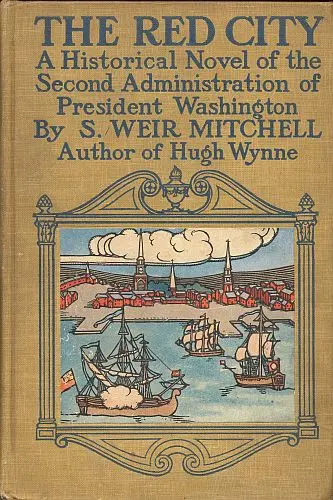
"The Red City: A Novel of the Second Administration of President Washington" by S. Weir Mitchell is a historical novel written in the early 20th century. The story is set during the early years of American democracy, focusing on the lives of émigrés from France amidst the backdrop of President Washington's administration. The main characters include René de Courval, a young French nobleman, and his mother, Madame de Courval, as they navigate their tumultuous past while seeking a new life in America. At the start of the novel, we are introduced to René and his mother aboard the brig "Morning Star", arriving in Delaware in May 1792 after fleeing the turmoil of revolutionary France. The captain of the ship and René share a light-hearted conversation about their travels. However, upon reaching land, the story takes a more serious turn as Madame de Courval reflects on their tragic past, particularly the death of her husband. This emotional revelation prompts René to recount the harrowing details that led to their escape. They arrive in Pennsylvania, filled with hopes and fears about their future in this new world, even as they are confronted with the prejudices and complexities of American society, representing both the promise and the challenges of their new beginning.
Introduction adapted from the source catalogue; source summaries may be automatically generated.
Free to read · English · 102,264 words · No account needed
MAKE TIME FOR A GOOD BOOK
On by default. Untick to stop anonymous reading totals. Each page counts after 10 seconds in view. How this works.
Anonymous counting is on unless you have switched it off.
De Courval, at first annoyed that his mother must walk, was silent, but soon, with unfailing curiosity, began to be interested and amused. When, reaching Second Street, they crossed the bridge over Dock Creek, they found as they moved northward a brisk business life, shops, and more varied costumes than are seen to-day. Here were Quakers, to madam's amazement; nun-like Quaker women in the monastic seclusion of what later was irreverently called the "coal-scuttle" bonnet; Germans of the Palatinate; men of another world in the familiar short-clothes, long, broidered waistcoat, and low beaver; a few negroes; and the gray-clad mechanic, with now and then a man from the islands, when suddenly a murmur of French startled the vicomtesse.
"What a busy life, maman," her son said; "not like that dark London, and no fog, and the sun--like the sun of home."
"We have no home," she replied, and for a moment he was silent. Then, still intent upon interesting her, he said:
"How strange! There is a sign of a likely black wench and two children for sale. 'Inquire within and see them. Sold for want of use.' And lotteries, maman. There is one for a canal between the Delaware and the Schuylkill rivers; and one to improve the Federal City. I wonder where that is." She paid little attention, and walked on, a tall, dark, somber woman, looking straight before her, with her thoughts far away.
The many taverns carried names which were echoes from the motherland, which men, long after the war, were still apt, as Washington wrote, to call "home." The Sign of the Cock, the Dusty Miller, the Pewter Plate, and--"Ah, maman," he cried, laughing, "The Inn of the Struggler. That should suit us."
The sullen clerk, stirred at last by the young fellow's gay interest, his eager questions, and his evident wish to distract and amuse a tired woman who stumbled over the loose bricks of the sidewalk, declared that was no place for them. Her tall figure in mourning won an occasional glance, but no more. It was a day of strange faces and varied costumes. "And, maman," said her son, "the streets are called for trees and the lanes for berries." Disappointed at two inns of the better class, there being no vacant rooms, they crossed High Street; the son amused at the market stands for fruit, fish, and "garden truck, too," the clerk said, with blacks crying, "Calamus! sweet calamus!" and "Pepper pot, smoking hot!" or "Hominy! samp! grits! hominy!" Then, of a sudden, as they paused on the farther corner, madam cried out, "Mon Dieu!" and her son a half-suppressed "Sacre!" A heavy landau coming down Second Street bumped heavily into a deep rut and there was a liberal splash of muddy water across madam's dark gown and the young man's clothes. In an instant the owner of the landau had alighted, hat in hand, a middle-aged man in velvet coat and knee-breeches.
Your reading position is saved on this browser. Take it to another device with a library code. Reading pages adapt to text, rather than matching a printed edition.
S. Weir (Silas Weir) Mitchell

S. Weir (Silas Weir) Mitchell
S. Weir (Silas Weir) Mitchell
S. Weir (Silas Weir) Mitchell
BEHIND THE BOOK
This eBook is for the use of anyone anywhere in the United States and most other parts of the world at no cost and with almost no restrictions whatsoever. You may copy it, give it away or re-use it under the terms of the Project Gutenberg License included with this eBook or online at www.gutenberg.org. If you are not located in the United States, you will have to check the laws of the country where you are located before using this eBook. Read the source licence.
The original source file, including credits and licence, is retained by this library. Request an original-format copy at no charge. Please include the book title and Project Gutenberg identifier #32942.
KEEP YOUR CURIOSITY GOING
Cécile Tormay

Moritz Busch
Coulson Kernahan
John L. Ransom

Maurice Baring
Frances Wright