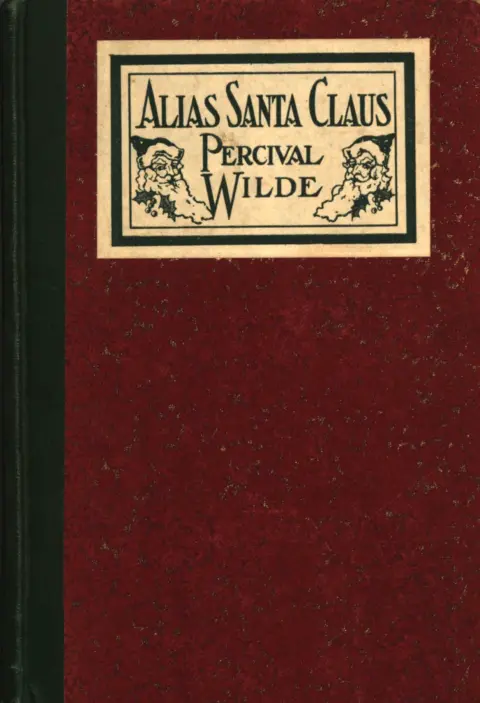
Alias Santa Claus
Percival Wilde
THE CLASSIC COLLECTION · 1922
"The Reckoning: A Play in One Act" by Percival Wilde is a one-act play written in the early 20th century. The story is set in a barber shop and revolves around a tense encounter between a barber and his customer. Thematically, the play grapples with issues of accountability, morality, and the psychological consequences of one's past actions. In this gripping play, the barber, Kilburn, is confronted with a customer, John, whom he has been following for twelve years after a traumatic event involving Kilburn's daughter, Jennie. Kilburn seizes the opportunity to exact a reckoning from John, who is now at his mercy while getting shaved. The barber highlights John's betrayal and abandonment of Jennie, who has since died. As the barber prepares to take violent action, the situation escalates with John pleading for his life and desperately trying to convince Kilburn to let him go. In a twist, it is revealed that John is not as pressed for time as he claimed, as the meeting he feared missing does not start until later. The play concludes with Kilburn's act of mercy, leaving John alive but emotionally broken, thus exploring the themes of revenge and the fragility of life.
Introduction adapted from the source catalogue; source summaries may be automatically generated.
Free to read · English · 2,725 words · No account needed
MAKE TIME FOR A GOOD BOOK
On by default. Untick to stop anonymous reading totals. Each page counts after 10 seconds in view. How this works.
Anonymous counting is on unless you have switched it off.
Produced by William Coon
The Reckoning
A Play in One Act
By PERCIVAL WILDE
The Reckoning
The scene is a barber shop. At the center is the chair, facing a mirror and washstand at the right. The tiled walls are sprinkled with the usual advertisements. At the rear, a door leads up to the street by a flight of two or three steps. A dock on the left wall indicates three.
At the rise of curtain, THE BARBER, a man of fifty, is discovered sharpening a razor, and whistling softly to himself. He finishes with the razor; seats himself in the chair, takes up a paper, and reads.
The door opens, and THE CUSTOMER, a flashily-dressed individual of forty-five, enters the shop.
THE BARBER. (Rising at once) Good afternoon, sir.
THE CUSTOMER. (Pulling out his watch) That clock right?
THE BARBER. Yes, sir; Western Union time. Corrected every hour.
THE CUSTOMER. My watch has run down. (He sets it.) Now, I've got just five minutes to spare. Can you shave me in that time?
THE BARBER. Five minutes, sir? Easy! Easy!
THE CUSTOMER. All right. Go ahead. (He takes off his hat and coat, and moves towards the chair.)
THE BARBER. Your collar also, sir.
THE CUSTOMER. (Smiling) Fussy, aren't you?
THE BARBER. Well, sir, I try to do my work well.
THE CUSTOMER. (Takes off tie and collar, putting his expensive
scarf-pin in the edge of his vest, which he does not remove)
Satisfied now?
THE BARBER. Yes, sir Thank you, sir. (He gets out sheet, towels,
etc.) In a hurry, sir?
THE CUSTOMER. Yes. Got to attend a meeting at three-ten.
THE BARBER. Oh! The auction up-stairs?
THE CUSTOMER. Yes. (He glances at the clock.) You'll have to
cut it pretty fine.
THE BARBER. Don't worry, sir. There's lots of time.... From the
country, sir?
THE CUSTOMER. (Lighting a cigar) Yes. Southerner.
THE BARBER. (Fastening the sheet) I thought so. I'm from the
country myself.
THE CUSTOMER. What part?
THE BARBER. Oh, that would be difficult to say. You see, I've moved around so much that I'm neither a Southerner nor a Northerner. I'm just an American. (He mixes the lather.) I lived in a little town near Savannah for a year.
THE CUSTOMER. Did you? Why, so did I.
THE BARBER. Yes, indeed. I used to see you--quite frequently-- though you never came into my shop. Then I went to Philadelphia.
THE CUSTOMER. What year?
THE BARBER. Let me think. It was April, twelve years ago.
THE CUSTOMER. April, twelve years ago? I went to Philadelphia
the same month!
Your reading position is saved on this browser. Take it to another device with a library code. Reading pages adapt to text, rather than matching a printed edition.
Percival Wilde
BEHIND THE BOOK
This eBook is for the use of anyone anywhere in the United States and most other parts of the world at no cost and with almost no restrictions whatsoever. You may copy it, give it away or re-use it under the terms of the Project Gutenberg License included with this eBook or online at www.gutenberg.org. If you are not located in the United States, you will have to check the laws of the country where you are located before using this eBook. Read the source licence.
The original source file, including credits and licence, is retained by this library. Request an original-format copy at no charge. Please include the book title and Project Gutenberg identifier #19931.
KEEP YOUR CURIOSITY GOING
Maurice Baring
W. B. (William Butler) Yeats
Edward Martyn

John Brougham & Charlotte Brontë
Marguerite Merington
Leonid Andreyev