THE CLASSIC COLLECTION✦Salve Venetia, gleanings from Venetian history; vol. IICLASSIC FREE BOOKS
Salve Venetia, gleanings from Venetian history; vol. II
F. Marion (Francis Marion) Crawford
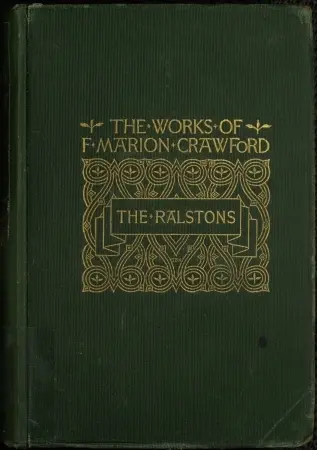
THE CLASSIC COLLECTION · 1893
"The Ralstons" by F. Marion Crawford is a novel written in the late 19th century. The story revolves around the lives and relationships of the Lauderdale family, particularly focusing on the two daughters, Charlotte and Katharine, and their father, Alexander Lauderdale, against the backdrop of wealth, societal expectations, and personal conflicts. The novel scrutinizes issues of class, morality, and the consequences of familial ties. The opening of the narrative introduces Alexander Lauderdale Jr., a man deeply concerned about the futures of his daughters, highlighting the contrasts between them: Charlotte, married to a congressman, and Katharine, who remains at home. The father's strict demeanor and unwavering religious convictions set the stage for familial tensions, particularly regarding his daughters' lives choices and the expectations he has placed upon them. As the story unfolds, a looming family crisis emerges with the impending death of the wealthy Robert Lauderdale, their uncle, which threatens to complicate existing relationships and reveal the underlying secrets and desires of the characters, especially concerning Katharine's secret marriage to John Ralston. This rich tapestry of character dynamics ensures a compelling exploration of love, duty, and the struggle for individual identity within the constraints of family and society.
Introduction adapted from the source catalogue; source summaries may be automatically generated.
Free to read · English · 157,798 words · No account needed
MAKE TIME FOR A GOOD BOOK
On by default. Untick to stop anonymous reading totals. Each page counts after 10 seconds in view. How this works.
Anonymous counting is on unless you have switched it off.
Mrs. Lauderdale was bending over a piece of work she had lately begun. All the little things she used were lying about her on the wooden table, the tiny brushes, the saucers for colours, the needle-pointed pencils. She looked up as Katharine entered, and the latter saw all the lines in the still beautiful face accentuated by the earnest attention given to the work. The eyelids were contracted and tired, the lips drawn in, one eyebrow was raised a little higher than the other, so that there were fine, arched wrinkles in the forehead immediately over it. The faces of American women of a certain age, when the complexion is fair, favour the formation of a multitude of very delicate crossing and recrossing lines, not often seen in the features of other nationalities.
“What is it, child?” asked Mrs. Lauderdale, quietly, with her soft
southern intonation.
“Mr. Wingfield’s there again,” answered Katharine, with unmistakable
disgust.
“Well, my dear, go down and see him,” said Mrs. Lauderdale, blandly. “Did you send word that you’d receive?”
“Yes. I’m going to tell him not to come any more.”
Katharine went behind the table, so that she faced her mother and looked directly into her eyes. For several seconds neither spoke.
“I hope you won’t do anything so rude,” said Mrs. Lauderdale at last, without avoiding the gaze that met hers. “We all like Mr. Wingfield very much.”
“I daresay. I’m not finding fault with him, nor his looks, nor his
manners, nor anything.”
“Well, then--I don’t see--”
“Oh, yes, you do, mother,--forgive my contradicting you,--you know very well that he wants to marry me, and that you want me to marry him. But I don’t mean to. So I shall tell him, as nicely as I can, to give up the idea, and to make his visits to you, and not to me.”
“But, Katharine, dear--nobody wishes to force you to marry him. We don’t live in the Middle Ages, you know.”
“There’s a resemblance,” answered Katharine, bitterly.
“Katharine! How can you say anything so unjust!”
“Because it’s true, mother. I’m not blind, you know, and I’m not perfectly insensible. I see, and I can feel. You don’t seem to think it’s possible to hurt me--and I don’t think you mean to hurt me, as papa does.”
Your reading position is saved on this browser. Take it to another device with a library code. Reading pages adapt to text, rather than matching a printed edition.
F. Marion (Francis Marion) Crawford
F. Marion (Francis Marion) Crawford
F. Marion (Francis Marion) Crawford
F. Marion (Francis Marion) Crawford
BEHIND THE BOOK
This eBook is for the use of anyone anywhere in the United States and most other parts of the world at no cost and with almost no restrictions whatsoever. You may copy it, give it away or re-use it under the terms of the Project Gutenberg License included with this eBook or online at www.gutenberg.org. If you are not located in the United States, you will have to check the laws of the country where you are located before using this eBook. Read the source licence.
The original source file, including credits and licence, is retained by this library. Request an original-format copy at no charge. Please include the book title and Project Gutenberg identifier #49954.
KEEP YOUR CURIOSITY GOING
Coulson Kernahan

Maurice Baring
Frances Wright
Cécile Tormay

Frederic Jesup Stimson

W. H. P. (William Henry Pope) Jarvis