THE CLASSIC COLLECTION✦Salve Venetia, gleanings from Venetian history; vol. IICLASSIC FREE BOOKS
Salve Venetia, gleanings from Venetian history; vol. II
F. Marion (Francis Marion) Crawford
THE CLASSIC COLLECTION · 1893
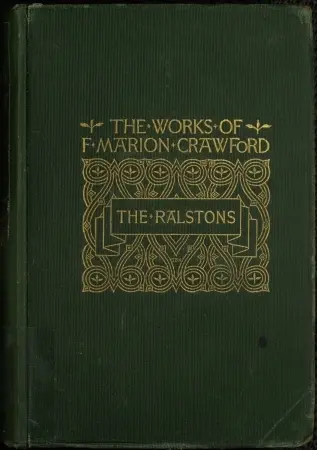
"The Ralstons" by F. Marion Crawford is a novel written in the late 19th century. The story revolves around the lives and relationships of the Lauderdale family, particularly focusing on the two daughters, Charlotte and Katharine, and their father, Alexander Lauderdale, against the backdrop of wealth, societal expectations, and personal conflicts. The novel scrutinizes issues of class, morality, and the consequences of familial ties. The opening of the narrative introduces Alexander Lauderdale Jr., a man deeply concerned about the futures of his daughters, highlighting the contrasts between them: Charlotte, married to a congressman, and Katharine, who remains at home. The father's strict demeanor and unwavering religious convictions set the stage for familial tensions, particularly regarding his daughters' lives choices and the expectations he has placed upon them. As the story unfolds, a looming family crisis emerges with the impending death of the wealthy Robert Lauderdale, their uncle, which threatens to complicate existing relationships and reveal the underlying secrets and desires of the characters, especially concerning Katharine's secret marriage to John Ralston. This rich tapestry of character dynamics ensures a compelling exploration of love, duty, and the struggle for individual identity within the constraints of family and society.
Introduction adapted from the source catalogue; source summaries may be automatically generated.
Free to read · English · 157,798 words · No account needed
MAKE TIME FOR A GOOD BOOK
On by default. Untick to stop anonymous reading totals. Each page counts after 10 seconds in view. How this works.
Anonymous counting is on unless you have switched it off.
Hester looked at her husband in surprise, and her finely chiselled lips moved and almost trembled.
“What do you mean, Walter?” she asked, in an uncertain tone.
“Oh--don’t you know? That head of poor uncle Robert, I did last night. I want to show it to Miss Lauderdale--she knew his face better than any of us.”
Katharine tried to detect a shade of irony in the words; but they were spoken quite naturally, without the least underthought.
“I should like to see it,” she answered, quietly, after an instant’s
silence.
“I’ll get it,” said Crowdie, “if you don’t mind waiting a minute. It’s in your dressing-room, isn’t it, Hester?” he asked, turning to his wife. “You were looking at it last night, just before you went to bed. I did it late in the evening,” he added, explaining to Katharine.
“Certainly,” she replied. “I’ll wait while you get it. I should really like to see it.”
Crowdie left the room, and her eyes followed him, and she disliked the undulating, feminine swing of his walk. He was badly made, having low, sloping shoulders, and being heavy about the waist, though he was not stout. He left the door open, and the two women waited in silence, not looking at one another. A moment later they heard Crowdie moving about overhead, where Hester’s dressing-room was situated, corresponding with the sitting-room in which they were. Hester listened intently, her eyes turned upwards towards the ceiling, as though they could help her to hear.
“He can’t find it,” she said. “I’d better go and help him--he’ll never find it alone.”
She made a step towards the door, paused, and listened again. The wrathful instinct grew stronger in Katharine. She imagined that Hester had thought of going upstairs in order to escape from the unpleasantness of being alone with her a little longer.
“If you’d finish buttoning my glove,” she said, calmly, “I’ll go without waiting. I’m very sorry, but I can’t do it myself.”
Hester’s eyebrows twitched irritably, but she bent over the outstretched hand, for she could not do otherwise. A moment later Crowdie’s footstep was heard on the stairs again, and he came in through the open door.
“I’ve hunted everywhere!” he exclaimed. “I can’t think where you’ve put it. I wish you’d go and find it for me, dear. It’s awfully stupid of me, I know!”
“Oh--I know just where it is,” answered Hester. “You must have seen it--why, I set it up on the toilet-table, on one side of the looking-glass, turned to the light.”
Your reading position is saved on this browser. Take it to another device with a library code. Reading pages adapt to text, rather than matching a printed edition.
F. Marion (Francis Marion) Crawford
F. Marion (Francis Marion) Crawford

F. Marion (Francis Marion) Crawford

F. Marion (Francis Marion) Crawford
BEHIND THE BOOK
This eBook is for the use of anyone anywhere in the United States and most other parts of the world at no cost and with almost no restrictions whatsoever. You may copy it, give it away or re-use it under the terms of the Project Gutenberg License included with this eBook or online at www.gutenberg.org. If you are not located in the United States, you will have to check the laws of the country where you are located before using this eBook. Read the source licence.
The original source file, including credits and licence, is retained by this library. Request an original-format copy at no charge. Please include the book title and Project Gutenberg identifier #49954.
KEEP YOUR CURIOSITY GOING
Coulson Kernahan

Maurice Baring
Frances Wright
Cécile Tormay

Frederic Jesup Stimson

W. H. P. (William Henry Pope) Jarvis