THE CLASSIC COLLECTION✦Salve Venetia, gleanings from Venetian history; vol. IICLASSIC FREE BOOKS
Salve Venetia, gleanings from Venetian history; vol. II
F. Marion (Francis Marion) Crawford
THE CLASSIC COLLECTION · 1893
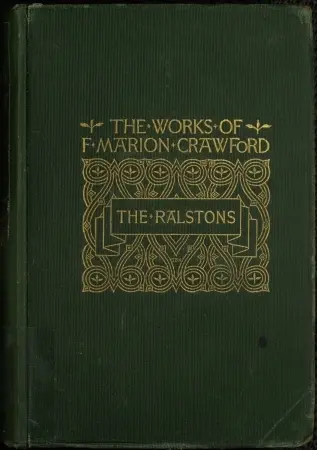
"The Ralstons" by F. Marion Crawford is a novel written in the late 19th century. The story revolves around the lives and relationships of the Lauderdale family, particularly focusing on the two daughters, Charlotte and Katharine, and their father, Alexander Lauderdale, against the backdrop of wealth, societal expectations, and personal conflicts. The novel scrutinizes issues of class, morality, and the consequences of familial ties. The opening of the narrative introduces Alexander Lauderdale Jr., a man deeply concerned about the futures of his daughters, highlighting the contrasts between them: Charlotte, married to a congressman, and Katharine, who remains at home. The father's strict demeanor and unwavering religious convictions set the stage for familial tensions, particularly regarding his daughters' lives choices and the expectations he has placed upon them. As the story unfolds, a looming family crisis emerges with the impending death of the wealthy Robert Lauderdale, their uncle, which threatens to complicate existing relationships and reveal the underlying secrets and desires of the characters, especially concerning Katharine's secret marriage to John Ralston. This rich tapestry of character dynamics ensures a compelling exploration of love, duty, and the struggle for individual identity within the constraints of family and society.
Introduction adapted from the source catalogue; source summaries may be automatically generated.
Free to read · English · 157,798 words · No account needed
MAKE TIME FOR A GOOD BOOK
On by default. Untick to stop anonymous reading totals. Each page counts after 10 seconds in view. How this works.
Anonymous counting is on unless you have switched it off.
Katharine’s eyes expressed a little astonishment in spite of herself, and the old man saw it. He hesitated a while, coughed, cleared his throat, and then seemed to make up his mind.
“It’s been my opinion for a long time,” he said, slowly, “that your father has a good deal of his own.”
“Papa!” exclaimed Katharine. “Why--he always says he’s so poor! You don’t know how economical he is, and makes us be. I’m sure he can’t be rich.”
“Rich--h’m--that’s a relative expression nowadays. He’s not rich, compared with me--but he has enough, he has quite enough.”
“Oh--enough--yes,” answered the young girl. “The house is comfortable, and we have plenty to eat.” She laughed a little. “But as for clothes, you know--well, if my mother didn’t sell her miniatures, I don’t know exactly what she and I should do--nor what Charlotte would have done, before she was married.”
Robert Lauderdale looked at her intently for several seconds.
“Do you mean to say,” he asked, at length, “that when your dear mother sells her little paintings, it’s to get money for her and you to dress on?”
“Yes--of course. What did you think?”
“I thought it was for her small charities,” he answered, bending his rough brows with an expression of mingled pain and anger. “It seemed to me a good thing that she should have that interest. If I’d known that your father kept you all so close--”
“But I really think he’s poor, uncle Robert.”
“Poor! Nonsense! He’s got a million, anyway. I know it. Don’t look at me like that--as though you didn’t believe me. I tell you, I know it. I don’t know how much more he has, but he’s got that.”
He moved restlessly on his side, with more energy than he had yet shown, for he was growing angry.
“There’s some money in the drawer of that little table,” he said, pointing with his hand, which trembled a little. “It’s open--just get what there is and bring it here, will you?”
Katharine rose.
“I don’t want any money, if you mean to give it to me,” she said, as she
crossed the room.
She brought him a roll of bills.
“Count it,” he said.
She counted carefully, turning back the crisp green notes over her delicate fingers. It was new money.
“There are three hundred and fifty dollars,” she said. “At least, I think I’ve counted right.”
Your reading position is saved on this browser. Take it to another device with a library code. Reading pages adapt to text, rather than matching a printed edition.
F. Marion (Francis Marion) Crawford
F. Marion (Francis Marion) Crawford

F. Marion (Francis Marion) Crawford

F. Marion (Francis Marion) Crawford
BEHIND THE BOOK
This eBook is for the use of anyone anywhere in the United States and most other parts of the world at no cost and with almost no restrictions whatsoever. You may copy it, give it away or re-use it under the terms of the Project Gutenberg License included with this eBook or online at www.gutenberg.org. If you are not located in the United States, you will have to check the laws of the country where you are located before using this eBook. Read the source licence.
The original source file, including credits and licence, is retained by this library. Request an original-format copy at no charge. Please include the book title and Project Gutenberg identifier #49954.
KEEP YOUR CURIOSITY GOING
Coulson Kernahan

Maurice Baring
Frances Wright
Cécile Tormay

Frederic Jesup Stimson

W. H. P. (William Henry Pope) Jarvis