THE CLASSIC COLLECTION✦Salve Venetia, gleanings from Venetian history; vol. IICLASSIC FREE BOOKS
Salve Venetia, gleanings from Venetian history; vol. II
F. Marion (Francis Marion) Crawford
THE CLASSIC COLLECTION · 1893
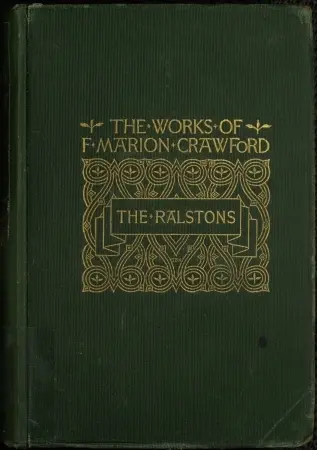
"The Ralstons" by F. Marion Crawford is a novel written in the late 19th century. The story revolves around the lives and relationships of the Lauderdale family, particularly focusing on the two daughters, Charlotte and Katharine, and their father, Alexander Lauderdale, against the backdrop of wealth, societal expectations, and personal conflicts. The novel scrutinizes issues of class, morality, and the consequences of familial ties. The opening of the narrative introduces Alexander Lauderdale Jr., a man deeply concerned about the futures of his daughters, highlighting the contrasts between them: Charlotte, married to a congressman, and Katharine, who remains at home. The father's strict demeanor and unwavering religious convictions set the stage for familial tensions, particularly regarding his daughters' lives choices and the expectations he has placed upon them. As the story unfolds, a looming family crisis emerges with the impending death of the wealthy Robert Lauderdale, their uncle, which threatens to complicate existing relationships and reveal the underlying secrets and desires of the characters, especially concerning Katharine's secret marriage to John Ralston. This rich tapestry of character dynamics ensures a compelling exploration of love, duty, and the struggle for individual identity within the constraints of family and society.
Introduction adapted from the source catalogue; source summaries may be automatically generated.
Free to read · English · 157,798 words · No account needed
MAKE TIME FOR A GOOD BOOK
On by default. Untick to stop anonymous reading totals. Each page counts after 10 seconds in view. How this works.
Anonymous counting is on unless you have switched it off.
Then Katharine came, waxen pale, her raven hair coiled loosely upon her shapely head, her creamy throat collarless, her left arm and hand free, the rest of her wrapped and draped in soft, dark things. She, too, looked up into Routh’s face with the glance of the question, ‘Life or death?’ And again the answer was, ‘Death.’
But Mrs. Deems had told her. Her eyes said that she knew, and her face told that she felt. Robert Lauderdale’s great head turned again, slowly and painfully, towards her. She bent down to him, and the doctor left the room, taking the nurse with him. He did not quite close the door. He could almost hear, beforehand, the low cry the young girl would utter when the end came.
Katharine bent down and laid her hand softly upon the old man’s brow.
“Uncle dear--you’re not going,” she said. “You’ll get well, after all.”
“I’m going to give up the ghost,” he said, as he had said to Doctor
Routh.
“No--no--” But she could not find anything to say, so she smoothed his
forehead.
She had never seen any one die, but she was not afraid. That is a matter of temperament, and neither man nor woman should be blamed who can not bear to feel a soul parting and see a body left behind. Katharine felt only that she would keep him if she could. She knelt down and took one of his hands, his left. It was cold and hard to touch, with little warmth in it, like that of a statue in a garden when the sun has gone down.
“I want to say good-bye,” said the hoarse voice, just above a whisper.
“Yes--I’m here,” answered Katharine, and there was silence again, while she gently caressed the cold hand.
“Routh said half an hour.”
The mysterious, dying eyes wandered a little, and then sought the white clock on the mantelpiece.
“Can’t see--what time it is,” said the rough whisper.
“Twenty minutes to four,” answered Katharine, glancing round quickly, and then looking again at his face.
“Poor child--little girl--ought to be in bed.” The words came indistinctly, and the breathing grew more heavy.
Then the beard moved with unspoken words, and Katharine watched, hearing nothing. She had been a little confused at first, but now she recollected that she should ask if there were anything she could do. She could not tell whence the recollection came. She had perhaps got it from a book read long ago. He might want something. He might die unsatisfied. She made anxious haste to ask the question.
Your reading position is saved on this browser. Take it to another device with a library code. Reading pages adapt to text, rather than matching a printed edition.
F. Marion (Francis Marion) Crawford
F. Marion (Francis Marion) Crawford

F. Marion (Francis Marion) Crawford

F. Marion (Francis Marion) Crawford
BEHIND THE BOOK
This eBook is for the use of anyone anywhere in the United States and most other parts of the world at no cost and with almost no restrictions whatsoever. You may copy it, give it away or re-use it under the terms of the Project Gutenberg License included with this eBook or online at www.gutenberg.org. If you are not located in the United States, you will have to check the laws of the country where you are located before using this eBook. Read the source licence.
The original source file, including credits and licence, is retained by this library. Request an original-format copy at no charge. Please include the book title and Project Gutenberg identifier #49954.
KEEP YOUR CURIOSITY GOING
Coulson Kernahan

Maurice Baring
Frances Wright
Cécile Tormay

Frederic Jesup Stimson

W. H. P. (William Henry Pope) Jarvis