THE CLASSIC COLLECTION✦Salve Venetia, gleanings from Venetian history; vol. IICLASSIC FREE BOOKS
Salve Venetia, gleanings from Venetian history; vol. II
F. Marion (Francis Marion) Crawford
THE CLASSIC COLLECTION · 1893
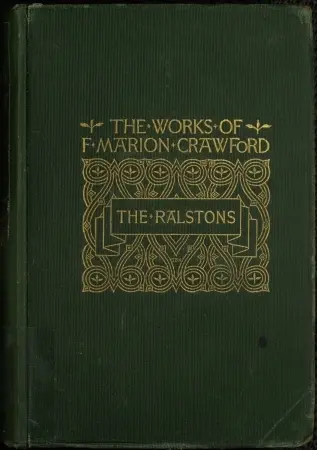
"The Ralstons" by F. Marion Crawford is a novel written in the late 19th century. The story revolves around the lives and relationships of the Lauderdale family, particularly focusing on the two daughters, Charlotte and Katharine, and their father, Alexander Lauderdale, against the backdrop of wealth, societal expectations, and personal conflicts. The novel scrutinizes issues of class, morality, and the consequences of familial ties. The opening of the narrative introduces Alexander Lauderdale Jr., a man deeply concerned about the futures of his daughters, highlighting the contrasts between them: Charlotte, married to a congressman, and Katharine, who remains at home. The father's strict demeanor and unwavering religious convictions set the stage for familial tensions, particularly regarding his daughters' lives choices and the expectations he has placed upon them. As the story unfolds, a looming family crisis emerges with the impending death of the wealthy Robert Lauderdale, their uncle, which threatens to complicate existing relationships and reveal the underlying secrets and desires of the characters, especially concerning Katharine's secret marriage to John Ralston. This rich tapestry of character dynamics ensures a compelling exploration of love, duty, and the struggle for individual identity within the constraints of family and society.
Introduction adapted from the source catalogue; source summaries may be automatically generated.
Free to read · English · 157,798 words · No account needed
MAKE TIME FOR A GOOD BOOK
On by default. Untick to stop anonymous reading totals. Each page counts after 10 seconds in view. How this works.
Anonymous counting is on unless you have switched it off.
He was clad in loose garments of white velvet--the only luxurious fancy of his old age. He got up on his feet, steadying himself by the nurse’s arm.
“Let me ring for the men, Mr. Lauderdale,” she said, rather anxiously.
“No, no! I can go so, if you’ll help me a little--oh, God! The child must be hurt! Quick, Mrs. Deems--I can walk quicker than this--hold your arm a little higher, please. Yes--we shall get along nicely so--why didn’t I have a lift in the house! I was always so strong! Quickly, Mrs. Deems--quickly.”
When Robert Lauderdale entered the drawing-room, he saw a crowd of people gathering together round something which they hid from him.
“Go away! Go away!” he cried, in his hollow, broken voice.
The servants fell back at the voice of the master, only the butler remaining at hand. Katharine was lying back in a deep arm-chair, her broken arm resting upon a little table which had been hastily pushed to her side. John Ralston was bending over it, and looking at it rather helplessly, as pale as death. Opposite him, on Katharine’s left, stood her father, his face still darkly flushed, his lips swollen and purple from Ralston’s blow.
“Clear the room--and send for Doctor Routh,” said old Lauderdale, turning his head a little towards Leek as he passed him.
“Yes, sir.”
“I’m afraid it’s broken,” Ralston was saying, and his hands trembled violently as he softly passed them over Katharine’s arm.
Mrs. Deems was already undoing the buttons of the tight sleeve which chanced to be the fashion at that time. Robert Lauderdale pushed Alexander aside, and bent down over the chair, supporting himself with his hands.
“Katharine--little girl--you’re hurt, dear,” he said, as gently as his hoarseness would let him speak. “How did it happen?”
“It won’t be anything,” she said, in answer, shaking her head and trying
to smile.
“How did it happen?” repeated the old man, standing up again, and steadying himself, as he looked anxiously at Ralston.
But Ralston did not answer at once. Across the old gentleman’s shoulder his eyes met Alexander’s for an instant.
“Are you going to tell what you did, or shall I?” he asked, fiercely.
“What? What?” asked old Robert, in surprise. “What’s this?” He looked from one to the other.
“Well--” Alexander began, “it’s rather hard to explain--”
“You’re mistaken,” interrupted Ralston, promptly. “It’s perfectly simple. You threw Katharine down, and she broke her arm.”
“You--threw Katharine--down!” repeated the old man, the first words spoken in wonder, the last in wrath.
Your reading position is saved on this browser. Take it to another device with a library code. Reading pages adapt to text, rather than matching a printed edition.
F. Marion (Francis Marion) Crawford
F. Marion (Francis Marion) Crawford

F. Marion (Francis Marion) Crawford

F. Marion (Francis Marion) Crawford
BEHIND THE BOOK
This eBook is for the use of anyone anywhere in the United States and most other parts of the world at no cost and with almost no restrictions whatsoever. You may copy it, give it away or re-use it under the terms of the Project Gutenberg License included with this eBook or online at www.gutenberg.org. If you are not located in the United States, you will have to check the laws of the country where you are located before using this eBook. Read the source licence.
The original source file, including credits and licence, is retained by this library. Request an original-format copy at no charge. Please include the book title and Project Gutenberg identifier #49954.
KEEP YOUR CURIOSITY GOING
Coulson Kernahan

Maurice Baring
Frances Wright
Cécile Tormay

Frederic Jesup Stimson

W. H. P. (William Henry Pope) Jarvis