THE CLASSIC COLLECTION✦Salve Venetia, gleanings from Venetian history; vol. IICLASSIC FREE BOOKS
Salve Venetia, gleanings from Venetian history; vol. II
F. Marion (Francis Marion) Crawford
THE CLASSIC COLLECTION · 1893
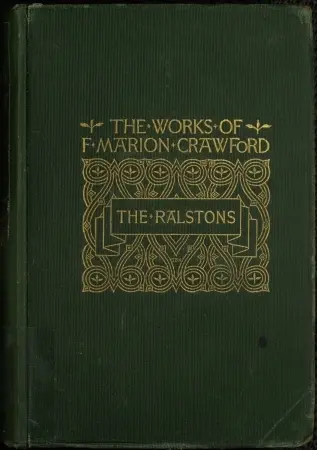
"The Ralstons" by F. Marion Crawford is a novel written in the late 19th century. The story revolves around the lives and relationships of the Lauderdale family, particularly focusing on the two daughters, Charlotte and Katharine, and their father, Alexander Lauderdale, against the backdrop of wealth, societal expectations, and personal conflicts. The novel scrutinizes issues of class, morality, and the consequences of familial ties. The opening of the narrative introduces Alexander Lauderdale Jr., a man deeply concerned about the futures of his daughters, highlighting the contrasts between them: Charlotte, married to a congressman, and Katharine, who remains at home. The father's strict demeanor and unwavering religious convictions set the stage for familial tensions, particularly regarding his daughters' lives choices and the expectations he has placed upon them. As the story unfolds, a looming family crisis emerges with the impending death of the wealthy Robert Lauderdale, their uncle, which threatens to complicate existing relationships and reveal the underlying secrets and desires of the characters, especially concerning Katharine's secret marriage to John Ralston. This rich tapestry of character dynamics ensures a compelling exploration of love, duty, and the struggle for individual identity within the constraints of family and society.
Introduction adapted from the source catalogue; source summaries may be automatically generated.
Free to read · English · 157,798 words · No account needed
MAKE TIME FOR A GOOD BOOK
On by default. Untick to stop anonymous reading totals. Each page counts after 10 seconds in view. How this works.
Anonymous counting is on unless you have switched it off.
Something in the tone of the last words attracted his attention. With a gentle touch he made her turn her face to the light, and looked at her.
“What’s happened?” he asked, suddenly. “There’s been some trouble, I know. Tell me--you’ve had more worry at home, haven’t you?”
“Oh--it’s nothing!” Katharine answered, lightly. “You see how easy it is for me to get away. What does it matter?”
“Yes--but there has been something,” insisted John, shaking his head. “I don’t like this, Katharine.”
He turned away from her, and his eyes fell upon the portrait. It
instantly fixed his attention.
“Holloa!” he exclaimed. “Why is it here? I thought it was for Hester.”
Katharine laughed.
“He brought it this morning,” she answered. “He’s changed his mind, and has given it to uncle Robert. How do you like it?”
John looked at it long, his eyelids drooping a little. When he turned his head, he looked directly at Katharine’s mouth critically.
“You haven’t got a mouth like that,” he said, suddenly. “And I never saw that expression in your eyes, either,” he added, a moment later. “What’s the fellow been doing?”
“I don’t know, Jack. But I don’t like it. I’m sure of that, at all
events.”
“Does uncle Robert like it?”
“No. He’s anything but pleased, though he thought it splendid at first. Then he saw what you and I see. It wasn’t so in the studio, it seems to me. He’s done something to it since. Never mind the picture, Jack. Sit down, and let’s talk, since we’ve got a chance at last.”
John’s eyes lingered on the portrait a moment longer, then he turned away with an impatient movement, and sat down beside Katharine. He stroked her hand gently two or three times, and neither said anything. Then he leaned back in his straight chair and crossed one knee over the other.
“Somebody’s trying to get me out of Beman’s,” he said, and his face darkened. “I wish I knew who it was.”
“Trying to get you out of the bank?” repeated Katharine, in surprise. “Oh, Jack, you must be mistaken.”
Jack laughed a little without smiling.
“There’s no mistake,” he said. “Mr. Beman as good as told me so this morning. We came near having a row.”
“Tell me all about it,” said Katharine, anxiously, and leaning forward in sympathy. “It’s outrageous--whoever has done it.”
“Yes, I’ll tell you,” said John. “It was this way. In the first place, I went to the Vanbrughs’ last night, after all.”
Your reading position is saved on this browser. Take it to another device with a library code. Reading pages adapt to text, rather than matching a printed edition.
F. Marion (Francis Marion) Crawford
F. Marion (Francis Marion) Crawford

F. Marion (Francis Marion) Crawford

F. Marion (Francis Marion) Crawford
BEHIND THE BOOK
This eBook is for the use of anyone anywhere in the United States and most other parts of the world at no cost and with almost no restrictions whatsoever. You may copy it, give it away or re-use it under the terms of the Project Gutenberg License included with this eBook or online at www.gutenberg.org. If you are not located in the United States, you will have to check the laws of the country where you are located before using this eBook. Read the source licence.
The original source file, including credits and licence, is retained by this library. Request an original-format copy at no charge. Please include the book title and Project Gutenberg identifier #49954.
KEEP YOUR CURIOSITY GOING
Coulson Kernahan

Maurice Baring
Frances Wright
Cécile Tormay

Frederic Jesup Stimson

W. H. P. (William Henry Pope) Jarvis