Reflections on the death of a porcupine and other essays
D. H. (David Herbert) Lawrence
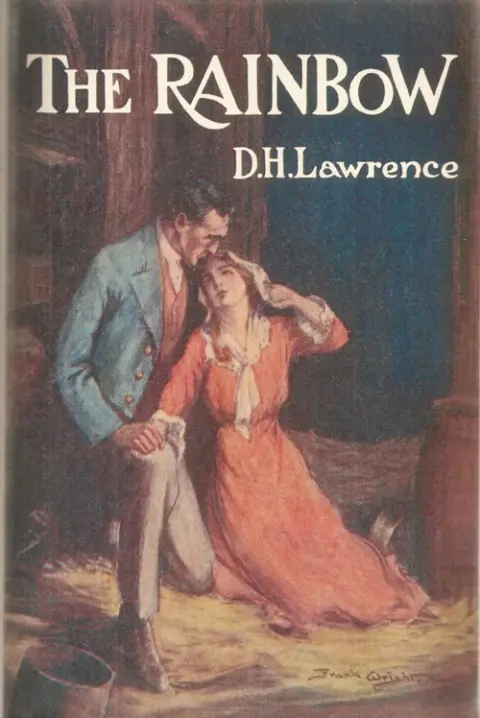
THE CLASSIC COLLECTION · 1915
"The Rainbow" by D. H. Lawrence is a novel published in 1915. It follows three generations of the Brangwen family in Nottinghamshire as they navigate love, desire, and personal fulfillment against the backdrop of England's industrial transformation. From farmer Tom Brangwen in the 1840s to his granddaughter Ursula in 1905, each generation struggles between passionate inner life and society's confining structures. Lawrence's frank treatment of sexuality sparked an obscenity trial, resulting in copies being seized and burned, banning the book in Britain for eleven years.
Introduction adapted from the source catalogue; source summaries may be automatically generated.
Free to read · English · 187,983 words · No account needed
MAKE TIME FOR A GOOD BOOK
On by default. Untick to stop anonymous reading totals. Each page counts after 10 seconds in view. How this works.
Anonymous counting is on unless you have switched it off.
This strange sense of cruelty and ugliness always imminent, ready to seize hold upon her this feeling of the grudging power of the mob lying in wait for her, who was the exception, formed one of the deepest influences of her life. Wherever she was, at school, among friends, in the street, in the train, she instinctively abated herself, made herself smaller, feigned to be less than she was, for fear that her undiscovered self should be seen, pounced upon, attacked by brutish resentment of the commonplace, the average Self.
She was fairly safe at school, now. She knew how to take her place there, and how much of herself to reserve. But she was free only on Sundays. When she was but a girl of fourteen, she began to feel a resentment growing against her in her own home. She knew she was the disturbing influence there. But as yet, on Sundays, she was free, really free, free to be herself, without fear or misgiving.
Even at its stormiest, Sunday was a blessed day. Ursula woke to it with a feeling of immense relief. She wondered why her heart was so light. Then she remembered it was Sunday. A gladness seemed to burst out around her, a feeling of great freedom. The whole world was for twenty-four hours revoked, put back. Only the Sunday world existed.
She loved the very confusion of the household. It was lucky if the children slept till seven o’clock. Usually, soon after six, a chirp was heard, a voice, an excited chirrup began, announcing the creation of a new day, there was a thudding of quick little feet, and the children were up and about, scampering in their shirts, with pink legs and glistening, flossy hair all clean from the Saturday’s night bathing, their souls excited by their bodies’ cleanliness.
As the house began to teem with rushing, half-naked clean children, one of the parents rose, either the mother, easy and slatternly, with her thick, dark hair loosely coiled and slipping over one ear, or the father, warm and comfortable, with ruffled black hair and shirt unbuttoned at the neck.
Then the girls upstairs heard the continual:
“Now then, Billy, what are you up to?” in the father’s strong, vibrating voice: or the mother’s dignified:
“I have said, Cassie, I will not have it.”
It was amazing how the father’s voice could ring out like a gong, without his being in the least moved, and how the mother could speak like a queen holding an audience, though her blouse was sticking out all round and her hair was not fastened up and the children were yelling a pandemonium.
Your reading position is saved on this browser. Take it to another device with a library code. Reading pages adapt to text, rather than matching a printed edition.
D. H. (David Herbert) Lawrence
D. H. (David Herbert) Lawrence
D. H. (David Herbert) Lawrence
D. H. (David Herbert) Lawrence
BEHIND THE BOOK
This eBook is for the use of anyone anywhere in the United States and most other parts of the world at no cost and with almost no restrictions whatsoever. You may copy it, give it away or re-use it under the terms of the Project Gutenberg License included with this eBook or online at www.gutenberg.org. If you are not located in the United States, you will have to check the laws of the country where you are located before using this eBook. Read the source licence.
The original source file, including credits and licence, is retained by this library. Request an original-format copy at no charge. Please include the book title and Project Gutenberg identifier #28948.
KEEP YOUR CURIOSITY GOING
Coulson Kernahan

Maurice Baring
Frances Wright
Cécile Tormay

Frederic Jesup Stimson

W. H. P. (William Henry Pope) Jarvis