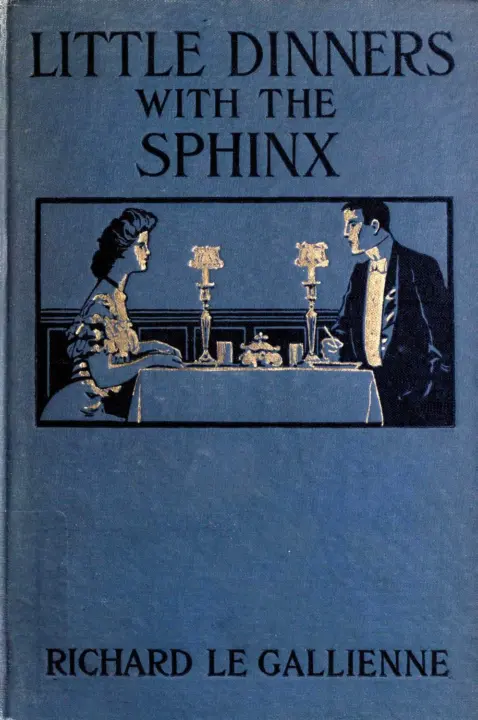
Little Dinners With the Sphinx, and Other Prose Fancies
Richard Le Gallienne
THE CLASSIC COLLECTION · 1896
"The Quest of the Golden Girl: A Romance" by Richard Le Gallienne is a novel written in the late 19th century. The story follows a thirty-year-old bachelor who, feeling the pangs of loneliness following the departure of his sister who has married, decides to embark on a whimsical pilgrimage to find his ideal woman, whom he refers to as the "Golden Girl." The narrative explores themes of love, longing, and the quest for personal fulfillment in a charming and introspective manner. The opening of the book introduces us to the protagonist's introspective musings about life and love as he reflects on his solitude in a once-happy home now bereft of joy. Following his realizations, he decides to pursue a journey, not just through the countryside but also into the depths of his own yearning for connection and romance. As he sets out, he is accompanied by whimsical thoughts about perfection in women and the memories of his first love, all while encountering picturesque landscapes that inspire his reflections. The initial chapters blend poetic observations with humor and a touch of melancholy, establishing a unique tone for the protagonist's quest.
Introduction adapted from the source catalogue; source summaries may be automatically generated.
Free to read · English · 51,546 words · No account needed
MAKE TIME FOR A GOOD BOOK
On by default. Untick to stop anonymous reading totals. Each page counts after 10 seconds in view. How this works.
Anonymous counting is on unless you have switched it off.
My sleeplessness while Nicolete slept had not been all ecstasy, for I had come to a bitter resolution; and next morning, when we were once more on our way, I took a favourable opportunity of conveying it to Nicolete.
"Nicolete," I said, as we rested awhile by the roadside, "I have something serious to say to you."
"Yes, dear," she said, looking rather frightened.
"Well, dear, it is this,--our love must end with our holiday. No good
can come of it."
"But oh, why? I love you."
"Yes, and I love you,--love you as I never thought I could love again. Yet I know it is all a dangerous dream,--a trick of our brains, an illusion of our tastes."
"But oh, why? I love you."
"Yes, you do to-day, I know; but it couldn't last. I believe I could love you for ever; but even so, it wouldn't be right. You couldn't go on loving me. I am too old, too tired, too desillusione, perhaps too selfish."
"I will love you always!" said girl Nicolete.
"Whereas you," I continued, disregarding the lovely refrain of her tear-choked voice, "are standing on the wonderful threshold of life, waiting in dreamland for the dawn. And it will come, and with it the fairy prince, with whom you shall wander hand in hand through all its fairy rose-gardens; but I, dear Nicolete,--I am not he."
Nicolete did not speak.
"I know," I continued, pressing her hand, "that I may seem young enough to talk like this, but some of us get through life quicker than others, and when we say, 'It is done,' it is no use for onlookers to say, 'Why, it is just beginning!' Believe me, Nicolete, I am not fit husband for you."
"Then shall I take no other," said Nicolete, with set face.
"Oh, yes, you will," I rejoined; "let but a month or two pass, and you will see how wise I was, after all. Besides, there are other reasons, of which there is no need to speak--"
"What reasons?"
"Well," I said, half laughing, "there is the danger that, after all, we mightn't agree. There is nothing so perilously difficult as the daily intercourse of two people who love each other. You are too young to realise its danger. And I couldn't bear to see our love worn away by the daily dropping of tears, not to speak of its being rent by the dynamite of daily quarrels. We know each other's tastes, but we know hardly anything of each other's natures."
Nicolete looked at me strangely. 'Troth, it was a strange way to make
love, I knew.
Your reading position is saved on this browser. Take it to another device with a library code. Reading pages adapt to text, rather than matching a printed edition.
Richard Le Gallienne
Richard Le Gallienne
Richard Le Gallienne
Richard Le Gallienne
BEHIND THE BOOK
This eBook is for the use of anyone anywhere in the United States and most other parts of the world at no cost and with almost no restrictions whatsoever. You may copy it, give it away or re-use it under the terms of the Project Gutenberg License included with this eBook or online at www.gutenberg.org. If you are not located in the United States, you will have to check the laws of the country where you are located before using this eBook. Read the source licence.
The original source file, including credits and licence, is retained by this library. Request an original-format copy at no charge. Please include the book title and Project Gutenberg identifier #461.
KEEP YOUR CURIOSITY GOING
Coulson Kernahan

Maurice Baring
Frances Wright
Cécile Tormay

Frederic Jesup Stimson

W. H. P. (William Henry Pope) Jarvis