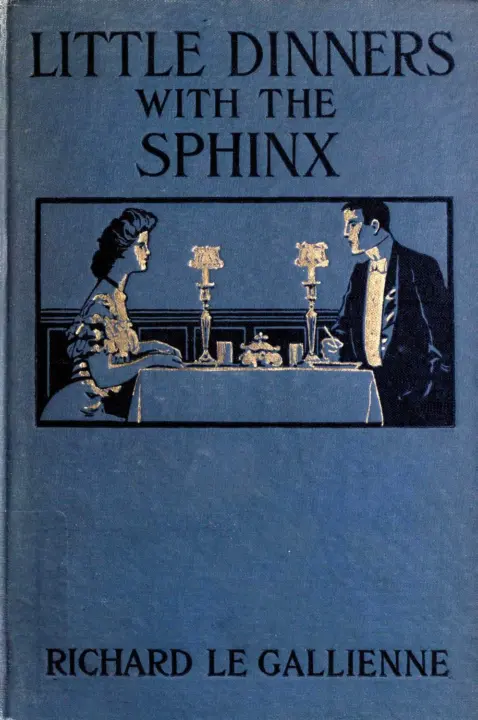
Little Dinners With the Sphinx, and Other Prose Fancies
Richard Le Gallienne
THE CLASSIC COLLECTION · 1896
"The Quest of the Golden Girl: A Romance" by Richard Le Gallienne is a novel written in the late 19th century. The story follows a thirty-year-old bachelor who, feeling the pangs of loneliness following the departure of his sister who has married, decides to embark on a whimsical pilgrimage to find his ideal woman, whom he refers to as the "Golden Girl." The narrative explores themes of love, longing, and the quest for personal fulfillment in a charming and introspective manner. The opening of the book introduces us to the protagonist's introspective musings about life and love as he reflects on his solitude in a once-happy home now bereft of joy. Following his realizations, he decides to pursue a journey, not just through the countryside but also into the depths of his own yearning for connection and romance. As he sets out, he is accompanied by whimsical thoughts about perfection in women and the memories of his first love, all while encountering picturesque landscapes that inspire his reflections. The initial chapters blend poetic observations with humor and a touch of melancholy, establishing a unique tone for the protagonist's quest.
Introduction adapted from the source catalogue; source summaries may be automatically generated.
Free to read · English · 51,546 words · No account needed
MAKE TIME FOR A GOOD BOOK
On by default. Untick to stop anonymous reading totals. Each page counts after 10 seconds in view. How this works.
Anonymous counting is on unless you have switched it off.
"Pork-pies!" said the American, with a delighted sense of discovering the country,--"why, you read about them in Dickens!" Who shall say but that this instinctive association was an involuntary severe, but not inapplicable, criticism? A nightingale suggests Keats; a pork-pie, Dickens.
Similarly with absinthe, grisettes, the Latin Quarter, and so on.
Why, you read about them in Murger, in Musset, in Balzac, and in Flaubert; and the fact of your having read about them is, I may add, their chief importance.
So rambled my after-dinner reflections as I sat that evening smoking and sipping, sipping and smoking, at the Cafe de la Paix.
Presently in my dream I became aware of English voices near me, one of which seemed familiar, and which I couldn't help overhearing. The voice of the husband said,--you can never mistake the voice of the husband,--
'T was the voice of the husband,
I heard him complain,--
the voice of the husband said: "Dora, I forbid you! I will NOT allow my wife to be seen again in the Latin Quarter. I permitted you to go once, as a concession, to the Cafe d'Harcourt; but once is enough. You will please respect my wishes!"
"But," pleaded the dear little woman, whom I had an immediate impulse, Perseus-like, to snatch from the jaws of her monster, and turning to the other lady of the party of four,--"but Mrs. ---- has never been, and she cannot well go without a chaperone. Surely it cannot matter for once. It isn't as if I were there constantly."
"No!" said the husband, with the absurd pomposity of his tribe.
"I'm very sorry. Mrs. ---- will, of course, act as she pleases; but I cannot allow you to do it, Dora."
At last the little wife showed some spirit.
"Don't talk to me like that, Will," she said. "I shall go if I please. Surely I am my own property."
"Not at all!" at once flashed out the husband, wounded in that most vital part of him, his sense of property. "There you mistake. You are my property, MY chattel; you promised obedience to me; I bought you, and you do my bidding!"
"Great heavens!" I ejaculated, and, springing up, found myself face to face with a well-known painter whom you would have thought the most Bohemian fellow in London. And Bohemian he is; but Bohemians are seldom Bohemians for any one save themselves. They are terrible sticklers for convention and even etiquette in other people.
Your reading position is saved on this browser. Take it to another device with a library code. Reading pages adapt to text, rather than matching a printed edition.
Richard Le Gallienne
Richard Le Gallienne
Richard Le Gallienne
Richard Le Gallienne
BEHIND THE BOOK
This eBook is for the use of anyone anywhere in the United States and most other parts of the world at no cost and with almost no restrictions whatsoever. You may copy it, give it away or re-use it under the terms of the Project Gutenberg License included with this eBook or online at www.gutenberg.org. If you are not located in the United States, you will have to check the laws of the country where you are located before using this eBook. Read the source licence.
The original source file, including credits and licence, is retained by this library. Request an original-format copy at no charge. Please include the book title and Project Gutenberg identifier #461.
KEEP YOUR CURIOSITY GOING
Coulson Kernahan

Maurice Baring
Frances Wright
Cécile Tormay

Frederic Jesup Stimson

W. H. P. (William Henry Pope) Jarvis