THE CLASSIC COLLECTION✦The Countess FannyCLASSIC FREE BOOKS
The Countess Fanny
Marjorie Bowen
THE CLASSIC COLLECTION · 1912
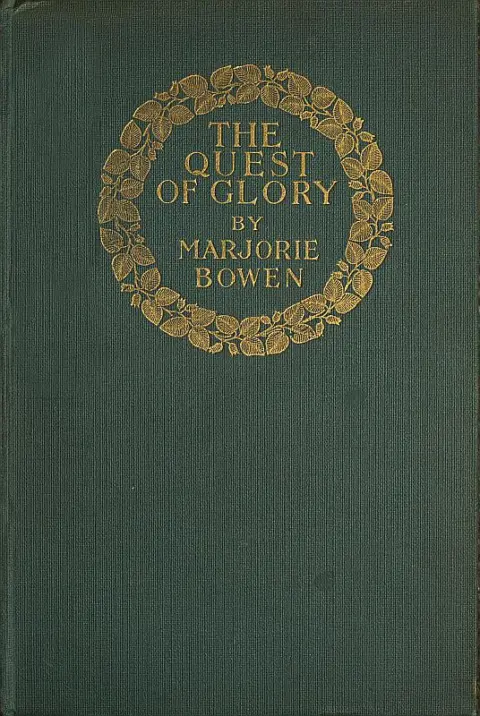
"The Quest of Glory" by Marjorie Bowen is a historical novel written in the early 20th century. Set against the backdrop of the tumultuous events of the War of the Austrian Succession in the 18th century, the story explores themes of ambition, honor, and the quest for glory through its characters. The narrative follows several French officers, particularly the passionate young lieutenant Georges d’Espagnac, as they navigate the complexities of war, aspirations, and personal relationships while stationed in Prague. The opening of "The Quest of Glory" introduces us to the bleak atmosphere of Prague during a harsh winter siege in December 1742. We meet a group of French officers, each representative of different views on honor and the meaning of glory amidst their mundane and perilous military circumstances. As they share their thoughts, the youthful idealism of Georges d'Espagnac shines through. He is fervently dedicated to the pursuit of glory for France, even as the realities of war weigh heavily on him. The story's initial chapters set the stage for the unfolding drama, emphasizing the struggles and allegiances of the characters in a setting marked by both longing for valor and the bitter hardships of war.
Introduction adapted from the source catalogue; source summaries may be automatically generated.
Free to read · English · 87,825 words · No account needed
MAKE TIME FOR A GOOD BOOK
On by default. Untick to stop anonymous reading totals. Each page counts after 10 seconds in view. How this works.
Anonymous counting is on unless you have switched it off.
The Marquis beheld a man still young, but not so young as he had at first believed, dressed in a dark grey riding-suit without ornament or jewel, wearing high boots and a plain sword with a basket shell.
His face, which was singularly attractive, was rather broad for its length and very finely shaped; it expressed wit, energy, and a great deal of humour. His eyes were dark brown, large, and powerful. His hair grew low on his brow, and was of a dull auburn, lacking in brightness and colour, but of great length and thickness.
Luc, quick at reading men, could not read this one; he only knew that there were great possibilities in that face, and that the whole personality was not one to be ignored. His wonder at the hideous ceremony in the barn increased.
The priest, with a heavy air of annoyance and displeasure, was unpacking a basket of provisions which stood on the table; Luc remembered seeing it behind his saddle the previous day.
There were a round of beef, a couple of loaves, a small cheese, and a large pie in an earthenware dish, besides three bottles of wine. M. Armand produced knives, forks, and plates from the cupboard, and invited Luc to join them; his air was one of careless good-nature.
But the Marquis could not eat; he ignored the priest, and addressed himself to M. Armand, who had seated himself on the corner of the table and was taking his supper with good appetite.
“You spoke of M. de Voltaire,” he said. “Do you know him?”
“Oh, every one in Paris knows him.”
“But you know him?” insisted Luc.
“Yes.”
“And yet you, by the aid of a Christian priest, seek to raise the Devil!” exclaimed the Marquis.
“I wanted to know something. The Devil should have entered into the heretic and answered my questions; but the fellow cheated. Faugh! Do not let us speak of it.”
Luc fixed his eyes on the handsome, pleasant face.
“What did you want to know?” he asked, with a smile.
“Something about a woman.” Monsieur Armand cut himself a slice of pie. “I had that rascal fetched from Venice on purpose. The whim cost me something.”
“I truly marvel at your folly,” said Luc calmly.
“Oh, there is a Devil,” returned the other, with a sideway glance, “and one might raise him, you know. But you have the fashionable tone of Paris.”
“I have never been there save for a day in passing,” answered Luc simply. “And I speak from conviction, not fashion.”
The priest, who had touched neither food nor wine, suddenly addressed
Luc.
“Where is your servant, Monsieur?”
Your reading position is saved on this browser. Take it to another device with a library code. Reading pages adapt to text, rather than matching a printed edition.
Marjorie Bowen
Marjorie Bowen
Marjorie Bowen
Marjorie Bowen
BEHIND THE BOOK
This eBook is for the use of anyone anywhere in the United States and most other parts of the world at no cost and with almost no restrictions whatsoever. You may copy it, give it away or re-use it under the terms of the Project Gutenberg License included with this eBook or online at www.gutenberg.org. If you are not located in the United States, you will have to check the laws of the country where you are located before using this eBook. Read the source licence.
The original source file, including credits and licence, is retained by this library. Request an original-format copy at no charge. Please include the book title and Project Gutenberg identifier #48767.
KEEP YOUR CURIOSITY GOING
Cécile Tormay

Moritz Busch
Coulson Kernahan
John L. Ransom

Maurice Baring
Frances Wright