THE CLASSIC COLLECTION✦An outlaw’s diary: the CommuneCLASSIC FREE BOOKS
An outlaw’s diary: the Commune
Cécile Tormay
THE CLASSIC COLLECTION · 1907
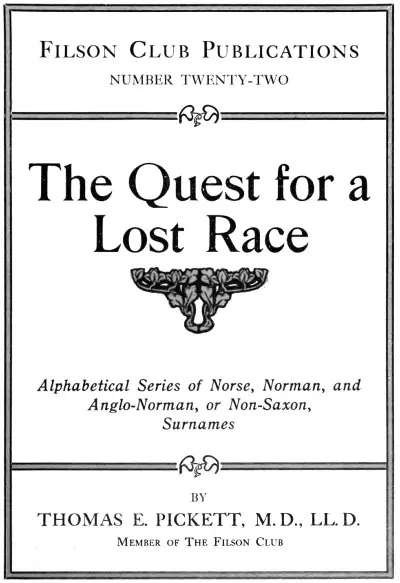
"The Quest for a Lost Race" by Thomas Edward Pickett is a historical account written in the early 20th century. This work presents the theory proposed by ethnologist Paul B. Du Chaillu, which claims that contemporary English-speaking people are more closely descended from Scandinavians than from Teutonic tribes. The author discusses the cultural, historical, and genealogical implications of this theory, particularly in relation to Kentuckians. At the start of the text, Pickett describes the welcoming atmosphere of Maysville, Kentucky, where the prominent explorer Du Chaillu was once celebrated for his discoveries. He captures the essence of this community and their deep-rooted traditions, as they participated in a heated discussion regarding their ancestry and cultural identity. The narrative explores Du Chaillu's experiences in Kentucky, drawing parallels between the social customs and traits of Kentuckians and those of their Scandinavian ancestors. Through this lens, the book sets the stage for a broader examination of race, identity, and cultural heritage in American society, particularly in the context of historical migrations.
Introduction adapted from the source catalogue; source summaries may be automatically generated.
Free to read · English · 57,017 words · No account needed
MAKE TIME FOR A GOOD BOOK
On by default. Untick to stop anonymous reading totals. Each page counts after 10 seconds in view. How this works.
Anonymous counting is on unless you have switched it off.
In reality, Blizzard is an old English surname, and is doubtless of Norman origin. In April, 1889, the writer of this note conversed with a Federal soldier, whose full name was Stephen Decatur Blizzard. He was of Anglo-Virginian stock; he was a soldier in the Civil War, and his name may still be found on the National Pension Rolls of that date. His postal address in 1889 was "Quincy, Lewis County, Kentucky."
Possibly the "snow-blast" took its name from some windy Anglo-Norman disputant, who wielded the sword of the spirit and dealt in apostolic blows and knocks.
The word "blizzard" does not appear in Worcester's dictionary, edition 1860. It is evidently of Scandinavian origin (Danish or Norman).
Blockey. The French pronunciation of Bloquet or Ploquet. Vide Denman.
Blomefield. Vide Bloomfield. Blomfield, bishop of London.
Bloomfield, armorially identified with Blomville from the lordship so named near Caen and Toques. Thomas de Blumville had custody of the estates of Earl Bigod in Suffolk.
Blossett. The Blossetts of Normandy were barons of Beneval and
Vidames.
Blount. Le Blund, or Blundus, Normandy, 1180. Frequent notices of the name, Twelfth Century, in Essex.
Blovice, for Blois, or Blesum, France. Thomas Blois, living at Norton, Suffolk, 1470, was ancestor of the baronets Blois.
Blow, for Blue or Bloy. Vide Bligh.
Blue, Blew or Blews. Etard de Bleu occurs in Kent, 1179. The name was a form of Bloi (France). The original Norman form was Le Bleu. During the Civil War there came before one of our Kentucky courts a case in which there was a very interesting introduction of names that have been long traditionally associated--Black and Blue; the former the name of a great criminal lawyer (Jeremiah S. Black), and the latter the name of his client, Blew or Blue, the perpetrator of an atrocious crime. The case showed that the criminal was sadly "off" on color. He had killed an entire family of blacks; but was finally acquitted by the ingenuity and perseverance of his great "Scandinavian" lawyer.
Black, Blake, Bleek, Bleikr (Norse). Admiral Blake was Warden of the Cinque Ports, 1651. Victor Blue, an officer in the American service, won great distinction during the Spanish-American War.
Bluett. In 1084, Bluet, Normandy; Buqueville le Blouette, the family seat. Bluet, long a name of eminence in the West of England.
Blundafield, for Blindville. Vide Blomfield.
Blundell. Vide Blunden.
Blunt. Le Blount, Normandy, 1180. Hence baronets Blunt.
Bly, for Bloi. Vide Bligh.
Boag, for Bogne.
Boase, for Bowes. (Vide Lower.)
Boat, from Buat. The Castle of Buat, near Falaise. Sexus de Bue,
Surry, 1180. Vide Bowett.
Boax, for Boase.
Bobart, N. Popart, Normandy, 1180.
Bockerfield, from Bocherville or Bucheville, Normandy.
Bockett. Originally Bouquet, Normandy, 1198.
Bodel, for Budell.
Bodelly, for Botelly, or Batelly. Vide Battey.
Your reading position is saved on this browser. Take it to another device with a library code. Reading pages adapt to text, rather than matching a printed edition.
BEHIND THE BOOK
This eBook is for the use of anyone anywhere in the United States and most other parts of the world at no cost and with almost no restrictions whatsoever. You may copy it, give it away or re-use it under the terms of the Project Gutenberg License included with this eBook or online at www.gutenberg.org. If you are not located in the United States, you will have to check the laws of the country where you are located before using this eBook. Read the source licence.
The original source file, including credits and licence, is retained by this library. Request an original-format copy at no charge. Please include the book title and Project Gutenberg identifier #47627.
KEEP YOUR CURIOSITY GOING
Cécile Tormay

Moritz Busch
John L. Ransom
Frances Wright
Cécile Tormay

Mabel Potter Daggett