THE CLASSIC COLLECTION✦An outlaw’s diary: the CommuneCLASSIC FREE BOOKS
An outlaw’s diary: the Commune
Cécile Tormay
THE CLASSIC COLLECTION · 1907
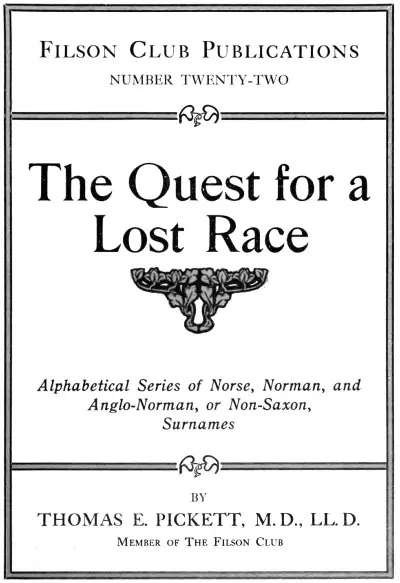
"The Quest for a Lost Race" by Thomas Edward Pickett is a historical account written in the early 20th century. This work presents the theory proposed by ethnologist Paul B. Du Chaillu, which claims that contemporary English-speaking people are more closely descended from Scandinavians than from Teutonic tribes. The author discusses the cultural, historical, and genealogical implications of this theory, particularly in relation to Kentuckians. At the start of the text, Pickett describes the welcoming atmosphere of Maysville, Kentucky, where the prominent explorer Du Chaillu was once celebrated for his discoveries. He captures the essence of this community and their deep-rooted traditions, as they participated in a heated discussion regarding their ancestry and cultural identity. The narrative explores Du Chaillu's experiences in Kentucky, drawing parallels between the social customs and traits of Kentuckians and those of their Scandinavian ancestors. Through this lens, the book sets the stage for a broader examination of race, identity, and cultural heritage in American society, particularly in the context of historical migrations.
Introduction adapted from the source catalogue; source summaries may be automatically generated.
Free to read · English · 57,017 words · No account needed
MAKE TIME FOR A GOOD BOOK
On by default. Untick to stop anonymous reading totals. Each page counts after 10 seconds in view. How this works.
Anonymous counting is on unless you have switched it off.
GREEN, Colonel Thomas M., author of "The Spanish Conspiracy," 9
GREEN, Thomas Marshall, an accomplished speaker, introduces M. Du
Chaillu to the audience, 9
HAMLET. A psychological epitome of his race (Danish).--The historic or legendary basis of the character.--The "original" of the character in its intellectual aspects was afamous French scholar and essayist.--His character and tastes.--His literary work.--The favorite writer of Shakespeare, 96 advice to Kentuckians who take themselves "too seriously" from a philosophic observer who sometimes, it is thought, did not take things seriously enough.--Essentially a modern thinker, 97, 98
HARDY, THOMAS, the novelist, 23
his views in "Tess," a powerful work of fiction, 23
INEZ. An allusion to Hood's poem, "O saw ye not Fair Inez?"
(foot-note), 7
ISAAC LE BON and a Virginian "cross."--The differentiating
quality, 105, 129
KENTON, Pioneer.--Commissioner of Roads for Mason County, 2 a famous hunter.--Name in State enactments spelled Canton, no doubt as then pronounced, 2
KENTUCKIAN, the. Loves a "good cross," 129
Kentuckians and Normans; points of resemblance between the derivative
and the original stocks, 133
not a weak vessel, 130
transmission of characteristic traits, 130
KENTUCKY. Lawless elements.--Origin and distribution, 59 Anglo-Norman juries.--A technical defense, 60 political assassination.--Murder as an administrative art, 60 statecraft; enterprise in war.--"A little nation," 106
"KING'S MOUNTAIN," The Man of, 25
LAMARCK, the famous French savant; referred to in conjunction with Taine and Sainte-Beuve, naturaliste des esprits.--"I began my intellectual life," says Sainte-Beuve, "with Lamarck and the physiologists," 51
LANFRANC, the scholar, 36
effects of his work still visible, 36
restrains William Rufus and Odo of Bayeux, 36
LAW. The Norman of Malaterra and "the forms of law," 28
LEE, LIONEL, accompanies Richard of the Lion-Heart in Third Crusade, at the head of a company of gentilhommes, 46
LEXICON OF NAMES. A marvelous number and variety of facts. What theory best explains these facts in their relations? A clear judicial faculty required to recognize the force of the cumulative verification, 136
LIBRARY, FREE, Newcastle, 13
a group of savants, 13
Anthropological Section meets at, 13
personal description of, 13
LIMESTONE CLUB, entertainment by, 3
LIMESTONE, phosphatic; basis of Bluegrass region, 2
LONDON TIMES. A contemporary estimate of Du Chaillu's views. An organ that forms, reflects, and fixes opinion.--Question of the origin and migration of races.--"Time ripe for a new investigation," 39 letter from Du Chaillu to Times containing challenge to skeptical archæologists, 39, 40
LONGFELLOW, the poet, 12
Kentucky racer, 12
Norwegian barque named, 12
LOPEZ at Cardenas, 27, 28
LOUIS NAPOLEON. Places an Austrian Prince on the Mexican throne to unify the Latin race.--Its effect, 106
MACKINTOSH, DOCTOR JOHN. "The man of King's Mountain," 25
MALATERRA, Geoffrey. Describes the Norman in his original habitat, 27
MANNEN, Major Thomas H., 9
MARSHALL, General Humphrey. Notably large head, 123 his aide and secretary Captain Guerrant, 124
Your reading position is saved on this browser. Take it to another device with a library code. Reading pages adapt to text, rather than matching a printed edition.
BEHIND THE BOOK
This eBook is for the use of anyone anywhere in the United States and most other parts of the world at no cost and with almost no restrictions whatsoever. You may copy it, give it away or re-use it under the terms of the Project Gutenberg License included with this eBook or online at www.gutenberg.org. If you are not located in the United States, you will have to check the laws of the country where you are located before using this eBook. Read the source licence.
The original source file, including credits and licence, is retained by this library. Request an original-format copy at no charge. Please include the book title and Project Gutenberg identifier #47627.
KEEP YOUR CURIOSITY GOING
Cécile Tormay

Moritz Busch
John L. Ransom
Frances Wright
Cécile Tormay

Mabel Potter Daggett