THE CLASSIC COLLECTION✦An outlaw’s diary: the CommuneCLASSIC FREE BOOKS
An outlaw’s diary: the Commune
Cécile Tormay
THE CLASSIC COLLECTION · 1907
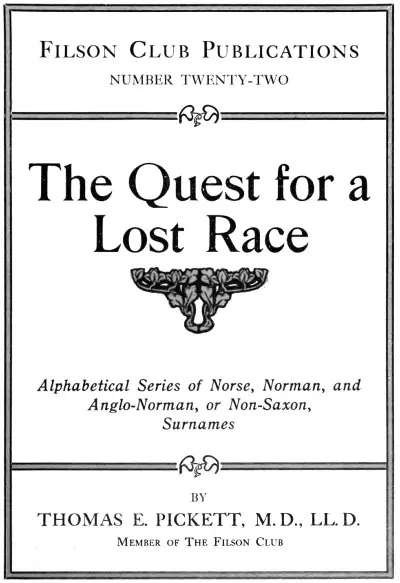
"The Quest for a Lost Race" by Thomas Edward Pickett is a historical account written in the early 20th century. This work presents the theory proposed by ethnologist Paul B. Du Chaillu, which claims that contemporary English-speaking people are more closely descended from Scandinavians than from Teutonic tribes. The author discusses the cultural, historical, and genealogical implications of this theory, particularly in relation to Kentuckians. At the start of the text, Pickett describes the welcoming atmosphere of Maysville, Kentucky, where the prominent explorer Du Chaillu was once celebrated for his discoveries. He captures the essence of this community and their deep-rooted traditions, as they participated in a heated discussion regarding their ancestry and cultural identity. The narrative explores Du Chaillu's experiences in Kentucky, drawing parallels between the social customs and traits of Kentuckians and those of their Scandinavian ancestors. Through this lens, the book sets the stage for a broader examination of race, identity, and cultural heritage in American society, particularly in the context of historical migrations.
Introduction adapted from the source catalogue; source summaries may be automatically generated.
Free to read · English · 57,017 words · No account needed
MAKE TIME FOR A GOOD BOOK
On by default. Untick to stop anonymous reading totals. Each page counts after 10 seconds in view. How this works.
Anonymous counting is on unless you have switched it off.
Mainwaring. Mesnil, Larin, a well-known Norman family.
Major. Normandy, 1198.
Maltby. (Scandinavian.)
Malby. For Malbiæ, Normandy, 1180.
Man, or Mann.
Manning. From Maignon, Normandy, 1180.
March. From Marchie, Normandy.
Markland. An old Scandinavian name. It was given by Eric in his voyage of exploration (year 1000) to the "wooded" coast of Cape Breton, or Nova Scotia.
Marsh. DeMarisco, Normandy, 1180.
Marshall. There are 62 coats of arms of this name, generally Normans, the principal of these being the Earls of Pembroke. Colonel Thomas Marshall of Virginia, the father of the great Chief Justice, lived near Washington, Mason County, Ky. He died in 1802. His grave in the family burying-ground near the old home ("The Hill") has attracted many visitors of late years, and the family homestead near Washington was once visited by the Chief Justice himself. John Marshall was probably the greatest American lawyer of Anglo-Norman descent; and certainly, as Mr. Barrett Wendell says, "the most eminent Chief Justice of the Supreme Court of the United States."
Judge Thomas A. Marshall, who recently passed away at Salt Lake City, a grandson of old Colonel Thomas Marshall, was also a "pioneer." He became the greatest mining lawyer in the West, and President of the Central Pacific Railroad. Lytleton, Coke, Chitty, Denman, and other great English lawyers were derived from that same learned, astute, and litigious Norman race.
Martin. Ralph, John, William, Normandy, 1198; William Martin,
England, 1178.
Mason. William Le Mazon, Normandy, 1198; Hugh Le Maun, England, 1198. Mason County, named after the famous Virginian, George Mason, by the Legislature of Virginia in 1788, and not (as recently proclaimed) after a Governor of Michigan, who in all likelihood was not born when the county was named.
Massey.
Massie.
Massy. A well-known Norman family, Macy, whence the name is derived, was seated near Coutances and Avranches, Normandy.
May. From De Mai, Normandy, 1180; De May, England, 1272. Maysville, Ky., named after John May.
Mayhew, for Mayo.
Mead, or Meade. The English form of De Prato, Normandy, 1180.
Menzies, or De Maners, or later in Scotland, Manners.
Mercer, Mercier; Normandy.
Merrill.
Miall, Miel, Mihell, Mighell (the last a mediæval form of Michael). Lower also derives Mitchell from Michael through the French form Michel.
Miles.
Your reading position is saved on this browser. Take it to another device with a library code. Reading pages adapt to text, rather than matching a printed edition.
BEHIND THE BOOK
This eBook is for the use of anyone anywhere in the United States and most other parts of the world at no cost and with almost no restrictions whatsoever. You may copy it, give it away or re-use it under the terms of the Project Gutenberg License included with this eBook or online at www.gutenberg.org. If you are not located in the United States, you will have to check the laws of the country where you are located before using this eBook. Read the source licence.
The original source file, including credits and licence, is retained by this library. Request an original-format copy at no charge. Please include the book title and Project Gutenberg identifier #47627.
KEEP YOUR CURIOSITY GOING
Cécile Tormay

Moritz Busch
John L. Ransom
Frances Wright
Cécile Tormay

Mabel Potter Daggett