
The Writing of News A Handbook with Chapters on Newspaper Correspondence and Copy Reading
Charles G. (Charles Griffith) Ross
THE CLASSIC COLLECTION · 1921
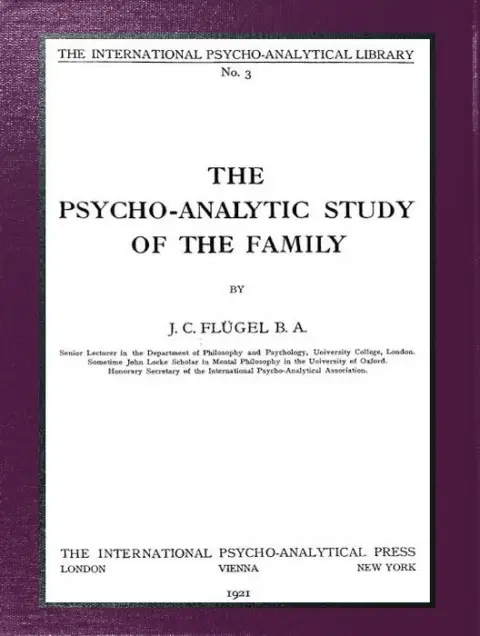
"The Psycho-Analytic Study of the Family" by J. C. Flugel is a scientific publication written in the early 20th century. This work explores the psychological dynamics within family relationships, particularly through the lens of psycho-analysis, offering insights on the roles of love, hate, and unconscious motivations that shape family interactions and individual development. The text promises to illuminate how these early familial ties influence personality formation and potentially affect broader social relationships. The opening of this work introduces the reader to the fundamental relationship between psychological development and family dynamics. Flugel outlines the need for a comprehensive understanding of the emotions and conflicts that arise in family settings, suggesting that these elements not only influence individual character but also shape societal norms. The author emphasizes the significance of early attachments, such as those between parents and children, and introduces key psycho-analytic concepts like repression and the Oedipus complex, indicating their relevance to normal and abnormal psychological development. This initial section sets the stage for a deeper exploration of psychological processes, arguing that understanding family dynamics is crucial for addressing larger moral and social challenges of the time.
Introduction adapted from the source catalogue; source summaries may be automatically generated.
Free to read · English · 98,844 words · No account needed
MAKE TIME FOR A GOOD BOOK
On by default. Untick to stop anonymous reading totals. Each page counts after 10 seconds in view. How this works.
Anonymous counting is on unless you have switched it off.
[Sidenote: Re-marriage after divorce]
All that we have here said as regards the feelings of children to their step-parents holds good to an even greater extent than usual in the case of the re-marriage of parents after a divorce or on their acquiring a fresh sexual partner after separation from their lawful husband or wife. Here indeed the feelings and emotions aroused are apt to be still further intensified by the fact that the children have been, in the nature of the case, more or less compelled to take sides in the previous struggle or disagreement that has taken place between the parents. A child's feelings of love and hate towards his parents are usually intensely stirred by all manifestations on their part of conjugal unhappiness or infidelity and when the barriers which prevent the full expression of these feelings towards the child's real parents are removed by the substitution of a step-parent, this new parent will often receive the full force of the love or hate which had hitherto been pent up.
In this chapter we have been concerned with the displacement of the parent-regarding emotions and tendencies on to persons who resemble the parents in that they are connected with the child by some close tie of family relationship. In the next chapter we shall proceed to discuss some of the other associative mechanisms through the operation of which this displacement may be effected.
[Footnote 86: See e. g. Frazer, "Totemism and Exogamy" II, 145.]
[Footnote 87: Ancient Society, 385 ff.]
[Footnote 88: See especially W. H. R. Rivers, "On the Origin of the Classificatory System of Relationship." Anthropological Essays, presented to E. B. Tylor, p. 310 ff.]
[Footnote 89: Frazer, "Totemism and Exogamy," II, 638.]
[Footnote 90: Frazer, op. cit. III, 576.]
[Footnote 91: L. Fernandez de Piedrahita, "Historia de las Conquistas del Nuevo Reyno de Granada," 1688, 113.]
[Footnote 92: Journal of the Asiatic Society of Bengal, VII, 856.]
[Footnote 93: F. S. Clavigero, "The History of Mexico." Trans. 1787, I,
319.]
[Footnote 94: Book. III, 31.]
[Footnote 95: Sir Gaston Maspero, quoted by Miss R. E. White, "Women in Ptolemaic Egypt", Journal of Hellenic Studies, 1898, XVIII, 244. Cp. Frazer, "Adonis, Attis and Osiris." II, 214, who also quotes the above.]
[Footnote 96: Cimon.]
[Footnote 97: Ch. XXII, ii.]
[Footnote 98: Cp. e. g. W. Ellis. "Tour through Hawaii," 414.]
[Footnote 99: "Totemism and Exogamy," I, 273 ff.]
[Footnote 100: See e. g. Frazer, "Totemism and Exogamy," II, 189.]
[Footnote 101: "Das Inzestmotiv in Dichtung und Sage," 443 ff.]
[Footnote 102: See especially K. Abraham, "Die Stelle der Verwandtenehe in der Psychologie der Neurosen," Jahrbuch für Psychoanalytische und Psychopathologische Forschungen, I, 1909, 110.]
[Footnote 103: See e. g. Frazer, "Totemism and Exogamy," I, 346, 439, 449 ff., 475, 483, II, 75 ff., 233 ff., III 552.]
[Footnote 104: See e. g. Frazer, "Totemism and Exogamy," I, 180 ff. II
65.]
[Footnote 105: See e. g. Frazer, "Totemism and Exogamy," II, 525, III
575, IV 316.]
Your reading position is saved on this browser. Take it to another device with a library code. Reading pages adapt to text, rather than matching a printed edition.
BEHIND THE BOOK
This eBook is for the use of anyone anywhere in the United States and most other parts of the world at no cost and with almost no restrictions whatsoever. You may copy it, give it away or re-use it under the terms of the Project Gutenberg License included with this eBook or online at www.gutenberg.org. If you are not located in the United States, you will have to check the laws of the country where you are located before using this eBook. Read the source licence.
The original source file, including credits and licence, is retained by this library. Request an original-format copy at no charge. Please include the book title and Project Gutenberg identifier #58654.
KEEP YOUR CURIOSITY GOING
Charles G. (Charles Griffith) Ross
Hannah Webster Foster

Emily Lawless
Edwin Hamlin Carr

Charles De Lano Hine
Andrew Ure