
The Writing of News A Handbook with Chapters on Newspaper Correspondence and Copy Reading
Charles G. (Charles Griffith) Ross
THE CLASSIC COLLECTION · 1921
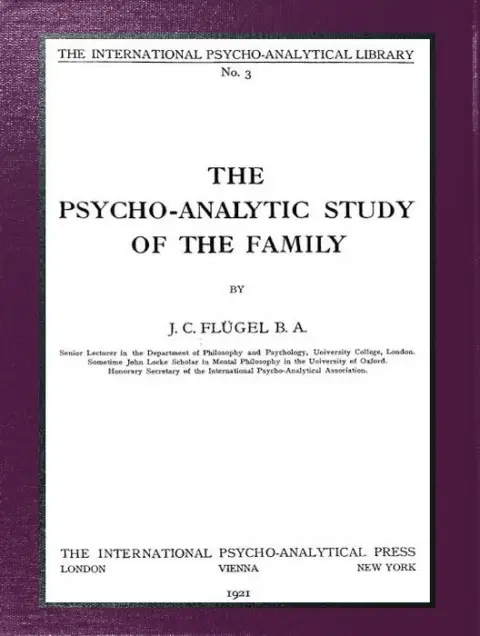
"The Psycho-Analytic Study of the Family" by J. C. Flugel is a scientific publication written in the early 20th century. This work explores the psychological dynamics within family relationships, particularly through the lens of psycho-analysis, offering insights on the roles of love, hate, and unconscious motivations that shape family interactions and individual development. The text promises to illuminate how these early familial ties influence personality formation and potentially affect broader social relationships. The opening of this work introduces the reader to the fundamental relationship between psychological development and family dynamics. Flugel outlines the need for a comprehensive understanding of the emotions and conflicts that arise in family settings, suggesting that these elements not only influence individual character but also shape societal norms. The author emphasizes the significance of early attachments, such as those between parents and children, and introduces key psycho-analytic concepts like repression and the Oedipus complex, indicating their relevance to normal and abnormal psychological development. This initial section sets the stage for a deeper exploration of psychological processes, arguing that understanding family dynamics is crucial for addressing larger moral and social challenges of the time.
Introduction adapted from the source catalogue; source summaries may be automatically generated.
Free to read · English · 98,844 words · No account needed
MAKE TIME FOR A GOOD BOOK
On by default. Untick to stop anonymous reading totals. Each page counts after 10 seconds in view. How this works.
Anonymous counting is on unless you have switched it off.
[Sidenote: Recapitulation]
The descriptive portion of our task is now completed. We have traced, with such degree of detail as the scope of this book has permitted, the growth within the individual mind of some of the more important of those feelings and tendencies which owe their origin and development to the relations of the individual to the other members of his family. We have seen how these feelings and tendencies are of fundamental importance in the formation of individual character and how they have also exercised a vast influence on social life and social institutions. We have seen also that, throughout their multitudinous transformations and ramifications, the tendencies originally connected with the family preserve some likeness to their primitive character, being ultimately reducible upon analysis to a series of displacements of a very few original trends and impulses. These original impulses fall naturally into two main groups:--those which bind the individual to the family (or to one or more of its members) through a relationship of love, esteem or dependence; and those which are based on a relationship of hate or fear; the trends falling within each of these groups being manifested either in a direct and positive, or in a reactionary and negative form; the latter being assumed as the result of a conflict between one of the trends in question and some other trend of an opposite, or at any rate a different, character (very often one of the family trends belonging to the opposite group).
[Sidenote: The theoretical treatment of our subject and its difficulties]
Since these groups of impulses have shown themselves to play a part of such importance in human mind and human conduct, it is not unnatural that, having completed our review of their manifestations, we should feel some curiosity as to the manner in which they have come to play this part in the course of the past history of the human race and as to the nature of the influence which they have exerted on this history. Unfortunately in the present state of our knowledge it would not seem possible to gratify this curiosity except in a very partial, unsatisfactory and uncertain manner. The psychological mechanisms with which we have been dealing have themselves, for the most part, been too recently discovered to have as yet been adequately correlated, or brought into connection, with the relevant facts of anthropological, ethnographical or biological science. The data from these latter sources are moreover, in spite of much diligent research in recent years, still in many important respects too incomplete to afford a satisfactory basis for such correlation. As a consequence of these conditions, it is to be feared that any attempt that we may make to exhibit the psychical tendencies with which we have been concerned, in their bearings upon early human history, or to explain their origin in the light of this history or of the general conditions of human life and mind, will result in little more than a restatement of our psychological principles from a slightly different point of view. Nevertheless the attempt may be worth making. A summary of some of the main implications of our psychological knowledge in this field may perhaps not seem amiss--especially in view of the astonishing and unlooked-for character of much of this knowledge--and if we succeed in establishing a few connections between our psychological data and the related facts of anthropology or biology, these may perhaps serve as starting points--to be either proved or else corrected--for subsequent enquiries based on a more sound foundation. The reader will understand therefore that, in so far as in the present and the two succeeding chapters there is anything that is not--explicitly or implicitly--contained in what we have already said, we shall have left the region of comparative certainty afforded by the results of observation and induction, and shall be travelling for the most part on the unsure ground of speculation--speculation that can be justified only on the plea of natural curiosity, and by the hope of opening up a few vistas which may be more fully surveyed by better equipped workers in the future.
Your reading position is saved on this browser. Take it to another device with a library code. Reading pages adapt to text, rather than matching a printed edition.
BEHIND THE BOOK
This eBook is for the use of anyone anywhere in the United States and most other parts of the world at no cost and with almost no restrictions whatsoever. You may copy it, give it away or re-use it under the terms of the Project Gutenberg License included with this eBook or online at www.gutenberg.org. If you are not located in the United States, you will have to check the laws of the country where you are located before using this eBook. Read the source licence.
The original source file, including credits and licence, is retained by this library. Request an original-format copy at no charge. Please include the book title and Project Gutenberg identifier #58654.
KEEP YOUR CURIOSITY GOING
Charles G. (Charles Griffith) Ross
Hannah Webster Foster

Emily Lawless
Edwin Hamlin Carr

Charles De Lano Hine
Andrew Ure