
The Writing of News A Handbook with Chapters on Newspaper Correspondence and Copy Reading
Charles G. (Charles Griffith) Ross
THE CLASSIC COLLECTION · 1921
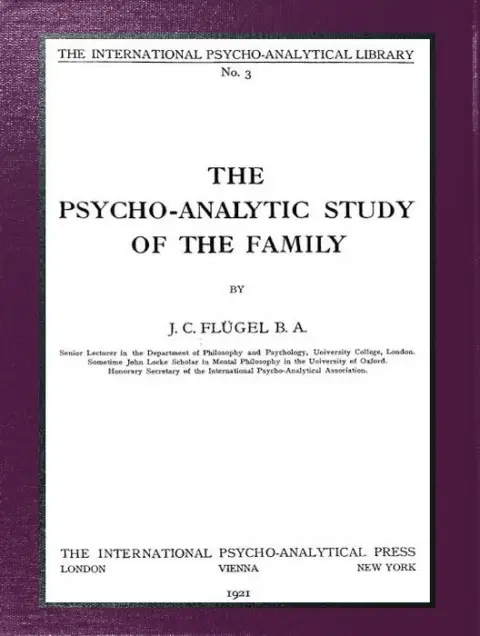
"The Psycho-Analytic Study of the Family" by J. C. Flugel is a scientific publication written in the early 20th century. This work explores the psychological dynamics within family relationships, particularly through the lens of psycho-analysis, offering insights on the roles of love, hate, and unconscious motivations that shape family interactions and individual development. The text promises to illuminate how these early familial ties influence personality formation and potentially affect broader social relationships. The opening of this work introduces the reader to the fundamental relationship between psychological development and family dynamics. Flugel outlines the need for a comprehensive understanding of the emotions and conflicts that arise in family settings, suggesting that these elements not only influence individual character but also shape societal norms. The author emphasizes the significance of early attachments, such as those between parents and children, and introduces key psycho-analytic concepts like repression and the Oedipus complex, indicating their relevance to normal and abnormal psychological development. This initial section sets the stage for a deeper exploration of psychological processes, arguing that understanding family dynamics is crucial for addressing larger moral and social challenges of the time.
Introduction adapted from the source catalogue; source summaries may be automatically generated.
Free to read · English · 98,844 words · No account needed
MAKE TIME FOR A GOOD BOOK
On by default. Untick to stop anonymous reading totals. Each page counts after 10 seconds in view. How this works.
Anonymous counting is on unless you have switched it off.
Of particular interest in this connection is the displacement of feelings originally directed to the parents towards relatives in law. Since by marriage one partner in the marriage is supposed to have entered into the family of the other, and, in virtue of the partial identification of the two partners through common ties of interest and affection, may really be said to have in some measure effected such an entrance, it is not altogether surprising to find much the same conflict of tendencies centering about the new relatives acquired by marriage as that which formerly centred round the relatives by blood. Thus on the one hand we find among primitive peoples the same taboos and avoidances practised in the one case as in the other. In some places, for instance, a man may have no dealings with some or all of the members of his wife's family, nor a wife with those of her husband's[106]. On the other hand a number of practices indicate that connections of an intimate kind between relatives by marriage are, under certain circumstances at any rate, regarded as permissible and appropriate. Such, for instance, is the widespread custom of the Levirate[107], whereby a man is expected to take unto himself his deceased brother's wife or the scarcely less frequent usage of the Sororate[108] whereby a man marries his deceased wife's sister--practices which seem to have made their influence felt (negatively) in our own table of relatives with whom wedlock is forbidden, including, as this does, not only blood relatives but relatives by marriage[109].
[Sidenote: Parent-in-law and child-in-law]
[Sidenote: Difficulties caused by parent fixation on the part of husband
or wife]
In recent times the relationship by marriage which has attracted most attention is that of parent-in-law and child-in-law. In view of the complex nature of the relations between parent and child and of the elaborate process of re-adjustment in these relations which takes place in the course of normal development, it is only to be expected that, when a person suddenly acquires, as it were, new parents by the act of marriage, he should experience some difficulty in establishing a satisfactory relationship with these new parents, with whom, unlike his own original parents, he may have had but little time or opportunity to grow acquainted. To this general cause tending to make the relationship between children-in-law and parents-in-law one of difficulty, there are often added at least three further special sources of embarrassment, to the consideration of which we may perhaps profitably devote a few words here. In the first place, husbands and wives are not free to adjust their relations to their parents-in-law according to the inclinations of the two parties directly concerned, but must (if they are to be successful) also bring these relations into some degree of harmony with those of their partners in marriage towards these same parents (in this case parents by blood): this is often far from easy, especially if, as so often happens, either husband or wife or both have not entirely freed themselves from their original infantile attitude towards their parents. Thus let us suppose that a young woman at the time of her marriage still retains a large amount of veneration and (unconscious) love towards her father. This may cause her even after marriage to look to her father rather than her husband as the source of her ideals and aspirations, to mould her life according to his, rather than her husband's, precept and example, and generally to adopt an attitude towards her father, which her husband (who does not altogether share her--probably exaggerated--views as to her father's admirable qualities) can scarcely be expected to imitate or to approve. A very similar difficulty may be brought about in the case of daughter-in-law and mother-in-law, where a son has retained an unduly infantile attitude towards his mother; while in still other cases the trouble may be due to an exaggerated dependence of husband or wife upon the parent of his or her own sex, i. e., the husband upon his father, or the wife upon her mother respectively. It is obvious that a fixation of this kind on the side of either partner in a marriage may (quite apart from its influence on the harmony of the marriage itself) be sufficient to bring about a very considerable degree of difficulty in the relationship between one partner and the parents of the other.
Your reading position is saved on this browser. Take it to another device with a library code. Reading pages adapt to text, rather than matching a printed edition.
BEHIND THE BOOK
This eBook is for the use of anyone anywhere in the United States and most other parts of the world at no cost and with almost no restrictions whatsoever. You may copy it, give it away or re-use it under the terms of the Project Gutenberg License included with this eBook or online at www.gutenberg.org. If you are not located in the United States, you will have to check the laws of the country where you are located before using this eBook. Read the source licence.
The original source file, including credits and licence, is retained by this library. Request an original-format copy at no charge. Please include the book title and Project Gutenberg identifier #58654.
KEEP YOUR CURIOSITY GOING
Charles G. (Charles Griffith) Ross
Hannah Webster Foster

Emily Lawless
Edwin Hamlin Carr

Charles De Lano Hine
Andrew Ure