
The Writing of News A Handbook with Chapters on Newspaper Correspondence and Copy Reading
Charles G. (Charles Griffith) Ross
THE CLASSIC COLLECTION · 1921
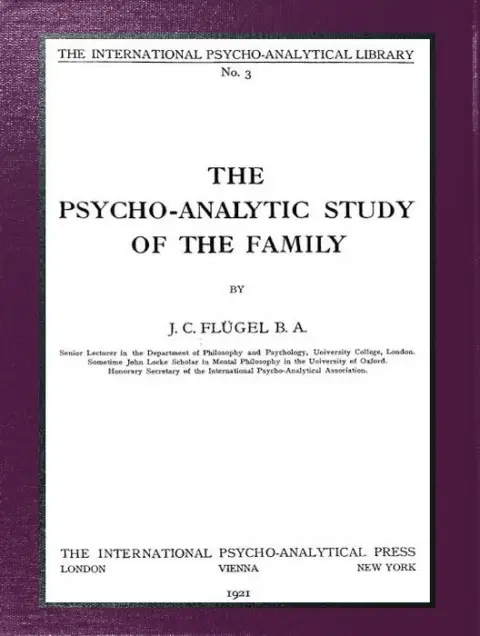
"The Psycho-Analytic Study of the Family" by J. C. Flugel is a scientific publication written in the early 20th century. This work explores the psychological dynamics within family relationships, particularly through the lens of psycho-analysis, offering insights on the roles of love, hate, and unconscious motivations that shape family interactions and individual development. The text promises to illuminate how these early familial ties influence personality formation and potentially affect broader social relationships. The opening of this work introduces the reader to the fundamental relationship between psychological development and family dynamics. Flugel outlines the need for a comprehensive understanding of the emotions and conflicts that arise in family settings, suggesting that these elements not only influence individual character but also shape societal norms. The author emphasizes the significance of early attachments, such as those between parents and children, and introduces key psycho-analytic concepts like repression and the Oedipus complex, indicating their relevance to normal and abnormal psychological development. This initial section sets the stage for a deeper exploration of psychological processes, arguing that understanding family dynamics is crucial for addressing larger moral and social challenges of the time.
Introduction adapted from the source catalogue; source summaries may be automatically generated.
Free to read · English · 98,844 words · No account needed
MAKE TIME FOR A GOOD BOOK
On by default. Untick to stop anonymous reading totals. Each page counts after 10 seconds in view. How this works.
Anonymous counting is on unless you have switched it off.
We have already in Chapter III studied some of the ways in which the displacement of the original love from parents to other persons takes place. If the displacement remains at a stage in which the associative link between the original and the later object of love is a very firm or close one, we may say that the development is incomplete, inasmuch as the individual's love is still to an undue extent on an infantile fixation. Of the various associative links which we have enumerated as being those of most frequent occurrence--mental or physical characteristics, age, circumstances of life, past history, family relationship etc., the last named is apt to play an especially important part in cases of arrested or regressive development. The displacement of love from parent to brother or sister may probably, as we have seen, be regarded as a normal transitory phase. The intensity of the attachment frequently aroused and the sexual nature which it often retains in the Unconscious right on into adolescent and adult life are vouched for, on the negative side, by the strength of the repressions raised against incestuous tendencies of this kind--repressions which are scarcely less severe than those directed against parent incest. Similarly, on the positive side, the true nature of the brother-sister relationship is often startlingly revealed by the process of psycho-analysis and is also shown by the study of legend, of literature and of the habits and customs of primitive peoples.
[Sidenote: Cases where brother-sister incest has been permitted]
We have already seen (p. 86) that on occasions of special licence connection between brother and sister, though otherwise strictly tabooed, may be temporarily permitted. It seems to be pretty generally agreed among anthropologists that these occasions are of the nature of reversions to a condition of affairs that was once comparatively frequent, if not indeed quite general[86]. There are in fact numerous indications that such brother-sister connections were, among certain peoples at any rate, the rule rather than the exception. H. L. Morgan, to whose credit lies the discovery of the so-called classificatory system of relationship, thinks indeed that a group marriage between own brothers and sisters was the earliest kind of restriction upon absolute promiscuity and constituted the basis of the oldest form of the human family[87]. The evidence for the really primitive character of any such family has been seriously disputed in more recent writings[88]; but the frequent occurrence of temporary or permanent brother-sister unions among both primitive and more advanced peoples would seem to be beyond dispute. Thus the incest of brother and sister is said to be, or to have been, common among the Antambahoaka of South East Madagascar[89], among many tribes of Brazil[90], in Cali[91] (Colombia), Tenasserim[92] (Burma), Mexico[93] and many other places. The ancient Persians seem to have permitted incest of this kind, though Herodotus remarks with reference to the marriage of Cambyses to his sister that this was not a usual procedure[94]. In Egypt, however, such connections were not only admitted but approved, marriage between brother and sister being there regarded as the "best of marriages" and acquiring "an ineffable degree of sanctity when the brother and sister who contracted it were themselves born of a brother and sister, who had in their turn also sprung from a union of the same sort"[95]. Even in Greece a similar practice does not seem to have been unusual, for, if we may believe Cornelius Nepos[96], no disgrace attached to Cimon's marriage with his sister Elpinice, since his fellow-citizens had the same custom. Among the Jews too, the prophet Ezekiel[97] complains of the occurrence of this form of incest. Primitive customs, it is now generally agreed, are apt to persist in the case of royal families long after they have ceased to be observed by the common people; and the persistent brother and sister marriages among the Ptolemies of Egypt and the Incas of Peru, as well as the existence of similar practices among reigning families in primitive peoples of recent times[98], afford further evidence of the former widespread occurrence of brother-sister unions.
Your reading position is saved on this browser. Take it to another device with a library code. Reading pages adapt to text, rather than matching a printed edition.
BEHIND THE BOOK
This eBook is for the use of anyone anywhere in the United States and most other parts of the world at no cost and with almost no restrictions whatsoever. You may copy it, give it away or re-use it under the terms of the Project Gutenberg License included with this eBook or online at www.gutenberg.org. If you are not located in the United States, you will have to check the laws of the country where you are located before using this eBook. Read the source licence.
The original source file, including credits and licence, is retained by this library. Request an original-format copy at no charge. Please include the book title and Project Gutenberg identifier #58654.
KEEP YOUR CURIOSITY GOING
Charles G. (Charles Griffith) Ross
Hannah Webster Foster

Emily Lawless
Edwin Hamlin Carr

Charles De Lano Hine
Andrew Ure