
The Writing of News A Handbook with Chapters on Newspaper Correspondence and Copy Reading
Charles G. (Charles Griffith) Ross
THE CLASSIC COLLECTION · 1921
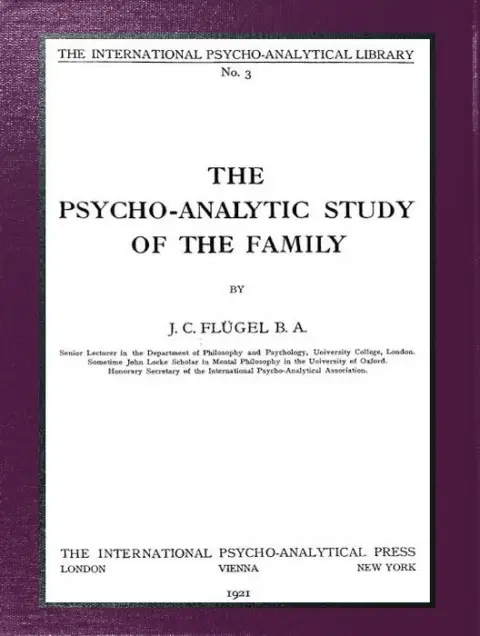
"The Psycho-Analytic Study of the Family" by J. C. Flugel is a scientific publication written in the early 20th century. This work explores the psychological dynamics within family relationships, particularly through the lens of psycho-analysis, offering insights on the roles of love, hate, and unconscious motivations that shape family interactions and individual development. The text promises to illuminate how these early familial ties influence personality formation and potentially affect broader social relationships. The opening of this work introduces the reader to the fundamental relationship between psychological development and family dynamics. Flugel outlines the need for a comprehensive understanding of the emotions and conflicts that arise in family settings, suggesting that these elements not only influence individual character but also shape societal norms. The author emphasizes the significance of early attachments, such as those between parents and children, and introduces key psycho-analytic concepts like repression and the Oedipus complex, indicating their relevance to normal and abnormal psychological development. This initial section sets the stage for a deeper exploration of psychological processes, arguing that understanding family dynamics is crucial for addressing larger moral and social challenges of the time.
Introduction adapted from the source catalogue; source summaries may be automatically generated.
Free to read · English · 98,844 words · No account needed
MAKE TIME FOR A GOOD BOOK
On by default. Untick to stop anonymous reading totals. Each page counts after 10 seconds in view. How this works.
Anonymous counting is on unless you have switched it off.
[Footnote 47: To the same cause is probably due the use of four-poster beds in which the sleeper is completely enclosed by curtains and of those oldfashioned beds (still to be seen in some parts of the world) which could be entirely shut off from the rest of the room by a wooden partition or sliding door containing only one very small circular aperture for the admission of air.]
[Footnote 48: Ferenczi, "Contributions to Psycho-Analysis," 189. Freud, "Vorlesungen zur Einführung in die Psychoanalyse," 486.]
[Footnote 49: Op. cit., 181 ff.]
[Footnote 50: Cp. the striking emotional effect of Böcklin's well known picture "The Island of the Dead." In Sir J. M. Barrie's remarkable play "Mary Rose" (which is full of interest in connection with our present subject) this piece of symbolism is duplicated--the "island that likes to be visited" being situated in a lake on a larger island.]
[Footnote 51: Rank, "Die Lohengrinsage," 46 ff.]
[Footnote 52: Freud, "Interpretations of Dreams," 243. Rank, op. cit.,
27 ff.]
[Footnote 53: Freud, op. cit. 243 ff. C. G. Jung, "Psychology of the
Unconscious," 233 ff.]
[Footnote 54: O. Rank, "The Myth of the Birth of the Hero."]
[Footnote 55: "Vorlesungen zur Einführung in die Psychoanalyse," 461.]
[Footnote 56: "Psychology of the Unconscious," 297.]
[Footnote 57: Especially Silberer, "Problems of Mysticism and its
Symbolism," 307 ff.]
[Footnote 58: Cp. Jung and Silberer as above.]
[Footnote 59: For an important discussion of certain further aspects of baptism from the psycho-analytical point of view, see Ernest Jones, "Die Bedeutung des Salzes in Sitte und Brauch der Völker", Imago. 1912, I. 463 ff.]
[Footnote 60: "Psychology of the Unconscious," 233 ff.]
[Footnote 61: "Spirits of the Corn and of the Wild."]
[Footnote 62: Silberer, op. cit.]
[Footnote 63: Cp. Ernest Jones, "Papers on Psycho-Analysis," 129 ff.]
[Footnote 64: Thus in a case known to the present writer a boy frequently indulged in phantasies of entering into the bodies of women and girls whom he admired, the ideas of effecting an entrance into the body, of being carried therein and of re-emerging therefrom, being all accompanied by voluptuous feelings of a sexual character.]
[Footnote 65: A striking example of this is to be found in Sir J. M. Barrie's "Mary Rose", in which a grown up son, on returning after many years to the home of his childhood, is earnestly warned and entreated by the housekeeper in charge of the (now empty) house not to enter his former nursery (womb symbol), a small room which is approached by a short passage (vagina symbol). He eventually overcomes his fears and boldly enters the forbidden apartment with a lighted candle (phallic symbol) in his hand. At that moment the ghost of his mother appears!
Your reading position is saved on this browser. Take it to another device with a library code. Reading pages adapt to text, rather than matching a printed edition.
BEHIND THE BOOK
This eBook is for the use of anyone anywhere in the United States and most other parts of the world at no cost and with almost no restrictions whatsoever. You may copy it, give it away or re-use it under the terms of the Project Gutenberg License included with this eBook or online at www.gutenberg.org. If you are not located in the United States, you will have to check the laws of the country where you are located before using this eBook. Read the source licence.
The original source file, including credits and licence, is retained by this library. Request an original-format copy at no charge. Please include the book title and Project Gutenberg identifier #58654.
KEEP YOUR CURIOSITY GOING
Charles G. (Charles Griffith) Ross
Hannah Webster Foster

Emily Lawless
Edwin Hamlin Carr

Charles De Lano Hine
Andrew Ure