
The Writing of News A Handbook with Chapters on Newspaper Correspondence and Copy Reading
Charles G. (Charles Griffith) Ross
THE CLASSIC COLLECTION · 1921
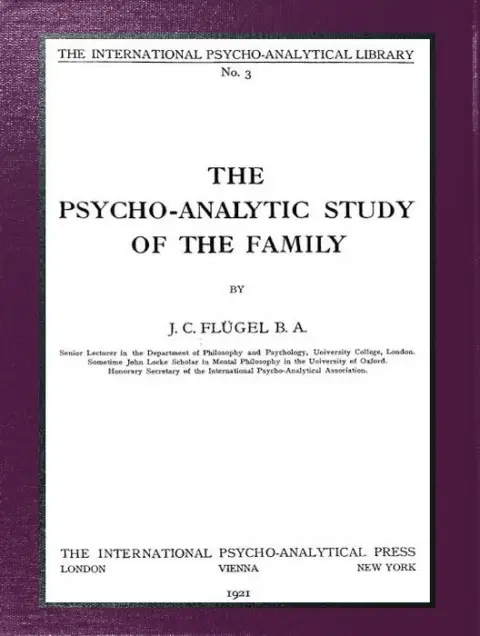
"The Psycho-Analytic Study of the Family" by J. C. Flugel is a scientific publication written in the early 20th century. This work explores the psychological dynamics within family relationships, particularly through the lens of psycho-analysis, offering insights on the roles of love, hate, and unconscious motivations that shape family interactions and individual development. The text promises to illuminate how these early familial ties influence personality formation and potentially affect broader social relationships. The opening of this work introduces the reader to the fundamental relationship between psychological development and family dynamics. Flugel outlines the need for a comprehensive understanding of the emotions and conflicts that arise in family settings, suggesting that these elements not only influence individual character but also shape societal norms. The author emphasizes the significance of early attachments, such as those between parents and children, and introduces key psycho-analytic concepts like repression and the Oedipus complex, indicating their relevance to normal and abnormal psychological development. This initial section sets the stage for a deeper exploration of psychological processes, arguing that understanding family dynamics is crucial for addressing larger moral and social challenges of the time.
Introduction adapted from the source catalogue; source summaries may be automatically generated.
Free to read · English · 98,844 words · No account needed
MAKE TIME FOR A GOOD BOOK
On by default. Untick to stop anonymous reading totals. Each page counts after 10 seconds in view. How this works.
Anonymous counting is on unless you have switched it off.
[Sidenote: Family influences]
It is to the consideration of one of the most potent of these influences that the present pages are devoted. Even on a superficial view it is fairly obvious that, under existing social conditions the psychological atmosphere of the home life with the complex emotions and sentiments aroused by, and dependent on, the various family relationships must exercise a very considerable effect on human character and development. Recent advances in the study of human conduct indicate that this effect is even greater than has been generally supposed: it would seem that, in adopting his attitude towards the members of his family circle, a child is at the same time determining to a large extent some of the principal aspects of his relations to his fellow men in general; and that an individual's outlook and point of view in dealing with many of the most important questions of human existence can be expressed in terms of the position he has taken up with regard to the problems and difficulties arising within the relatively narrow world of the family.
[Sidenote: their importance, difficulty, and complexity]
Besides showing the importance for mental development of the problems connected with family life, modern psychological research has also revealed something of the nature of these problems. It is true that of the results obtained in this field there are as yet few, if any, which can be regarded as definitely settled; many, no doubt, will, in the light of future work, be seen to require more or less extensive revision, qualification or addition; some perhaps may have to be rejected altogether. Nevertheless it would appear that, as a consequence of the work already done, certain main principles at least have emerged so clearly as to justify, if not indeed to demand, the serious attention of all those who, at this critical period of human history, have to deal directly or indirectly with questions affecting family life in one or more of its numerous aspects. The sociologist, the moralist, the spiritual adviser, the teacher, the family physician and the parent are all intimately concerned with such questions; and it is primarily with the needs of such as these in view that the present brief exposition of the subject has been undertaken. After what has been already said, it is perhaps unnecessary to offer any further warning against accepting all the results of psychological investigation which are here set forth as claiming equal validity or as being equally capable of generalisation or application on a large scale. No dogmatic enunciation of facts or principles is here attempted or desired, even where, owing to the endeavour to avoid entering upon the discussion of matters too intricate or controversial to fall within the scope of our present treatment, the statements may possibly appear somewhat dogmatic in form. Our aim is rather to produce a more widespread realisation of the immense and far-reaching significance of the psychological problems connected with family life; to indicate some of the ways in which psychological knowledge has thrown light upon the solutions of these problems; and perhaps, by these means, to be of some assistance to that very large class of persons who, at one time or another during their lives, find themselves compelled to deal with such problems--whether as entering into their own lives, as affecting others for whom they are responsible, or as forming part of larger questions, social, religious, medical or pedagogic, in which they have an interest. To those who have once realised the complexity, the obscurity, and above all the tremendous intensity of the psychic factors entering into these problems, there can be little doubt that in so far as Psychology is able to afford some reasonably sure guidance as to their solution, it will have achieved one of the most successful and valuable of all applications of science to social and ethical phenomena. The time for such application on a large scale has not yet come. But the progress that has been already made would seem to indicate that the expectation of some very real assistance in these matters from the science of Psychology is no longer hopeless.
Your reading position is saved on this browser. Take it to another device with a library code. Reading pages adapt to text, rather than matching a printed edition.
BEHIND THE BOOK
This eBook is for the use of anyone anywhere in the United States and most other parts of the world at no cost and with almost no restrictions whatsoever. You may copy it, give it away or re-use it under the terms of the Project Gutenberg License included with this eBook or online at www.gutenberg.org. If you are not located in the United States, you will have to check the laws of the country where you are located before using this eBook. Read the source licence.
The original source file, including credits and licence, is retained by this library. Request an original-format copy at no charge. Please include the book title and Project Gutenberg identifier #58654.
KEEP YOUR CURIOSITY GOING
Charles G. (Charles Griffith) Ross
Hannah Webster Foster

Emily Lawless
Edwin Hamlin Carr

Charles De Lano Hine
Andrew Ure