
The Writing of News A Handbook with Chapters on Newspaper Correspondence and Copy Reading
Charles G. (Charles Griffith) Ross
THE CLASSIC COLLECTION · 1921
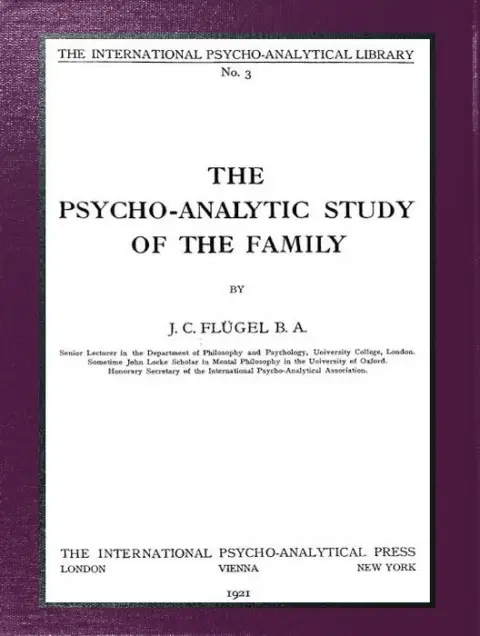
"The Psycho-Analytic Study of the Family" by J. C. Flugel is a scientific publication written in the early 20th century. This work explores the psychological dynamics within family relationships, particularly through the lens of psycho-analysis, offering insights on the roles of love, hate, and unconscious motivations that shape family interactions and individual development. The text promises to illuminate how these early familial ties influence personality formation and potentially affect broader social relationships. The opening of this work introduces the reader to the fundamental relationship between psychological development and family dynamics. Flugel outlines the need for a comprehensive understanding of the emotions and conflicts that arise in family settings, suggesting that these elements not only influence individual character but also shape societal norms. The author emphasizes the significance of early attachments, such as those between parents and children, and introduces key psycho-analytic concepts like repression and the Oedipus complex, indicating their relevance to normal and abnormal psychological development. This initial section sets the stage for a deeper exploration of psychological processes, arguing that understanding family dynamics is crucial for addressing larger moral and social challenges of the time.
Introduction adapted from the source catalogue; source summaries may be automatically generated.
Free to read · English · 98,844 words · No account needed
MAKE TIME FOR A GOOD BOOK
On by default. Untick to stop anonymous reading totals. Each page counts after 10 seconds in view. How this works.
Anonymous counting is on unless you have switched it off.
[Footnote 140: Cp. Ernest Jones, "Papers on Psycho-Analysis," 2nd. ed. 540 ff. for a study of the manner in which restraint of the child in one particular respect--with regard to the excretory functions--may lead to a hostile attitude of this kind on the part of the child.]
[Footnote 141: Thus, as Mr. Burt has suggested to me, the influence of displaced father-hatred is probably in large measure responsible for the fact that strikes and other crude forms of rebellion against authority in industry occur principally among the working classes, where the tyranny of the father is often of a primitive and repressive type. For the same reason the number of delinquents from these classes is almost certainly relatively larger than that from the upper and middle classes, quite apart from the influence of economic and educational factors. Cp. too in this connection p. 128 below.]
[Footnote 142: Cp. Ernest Jones, "Papers on Psycho-Analysis," 2nd. ed.,
318 ff.]
[Footnote 143: "Contributions to Psycho-Analysis," trans. by Ernest Jones, Ch. II, especially 57 ff.]
[Footnote 144: Ernest Jones, "Papers on Psycho-Analysis," 2nd. ed. 301.]
[Footnote 145: In technical psycho-analytic literature, the term "Transference" is, as a rule, used to denote this particular kind of displacement only.]
[Footnote 146: "Vorlesungen zur Einführung in die Psychoanalyse," 526 ff.]
[Footnote 147: O. Rank, "Um Städte werben," Zeitschrift für Ärztliche Psychoanalyse, 1914, II, 50. B. Dattner, "Die Stadt als Mutter," Zeitschrift für Ärztliche Psychoanalyse, 1914, II, 59.]
[Footnote 148: "War and Individual Psychology," Sociological Review,
1915, p. 1.]
[Footnote 149: "Das Inzestmotiv in Dichtung und Sage," 83.]
[Footnote 150: "Papers on Psycho-Analysis," 143.]
[Footnote 151: Ernest Jones, loc. cit.]
[Footnote 152: Ernest Jones, loc. cit.]
[Footnote 153: "War and Individual Psychology," Sociological Review,
1915, p. 10.]
[Footnote 154: "Das Inzestmotiv in Dichtung und Sage," 414 ff.]
[Footnote 155: Ernest Jones, loc. cit.]
[Footnote 156: "Totem and Taboo," 70 ff.]
[Footnote 157: For a brief general account of projection cp. Bernard Hart, "The Psychology of Insanity," 117 ff.]
[Footnote 158: A certain priestly king in West Africa may not even quit his chair, in which he has to sleep sitting. Frazer, "Taboo and the Perils of the Soul," 123.]
[Footnote 159: Frazer, op. cit., 124.]
[Footnote 160: Frazer, op. cit., 18.]
[Footnote 161: We may briefly mention here a few of the main lines along which the evidence for the identification of regicide and parricide proceeds:--
(1) The very person who performs the deed of murder is frequently the one who succeeds to the throne; taking this in combination with the fact that it is usually the son or some other near relative who is the recognised successor, it is evident that there exists a natural tendency for the murderer to belong to the murdered king's own family.
Your reading position is saved on this browser. Take it to another device with a library code. Reading pages adapt to text, rather than matching a printed edition.
BEHIND THE BOOK
This eBook is for the use of anyone anywhere in the United States and most other parts of the world at no cost and with almost no restrictions whatsoever. You may copy it, give it away or re-use it under the terms of the Project Gutenberg License included with this eBook or online at www.gutenberg.org. If you are not located in the United States, you will have to check the laws of the country where you are located before using this eBook. Read the source licence.
The original source file, including credits and licence, is retained by this library. Request an original-format copy at no charge. Please include the book title and Project Gutenberg identifier #58654.
KEEP YOUR CURIOSITY GOING
Charles G. (Charles Griffith) Ross
Hannah Webster Foster

Emily Lawless
Edwin Hamlin Carr

Charles De Lano Hine
Andrew Ure