Fortune
J. C. (John Collis) Snaith
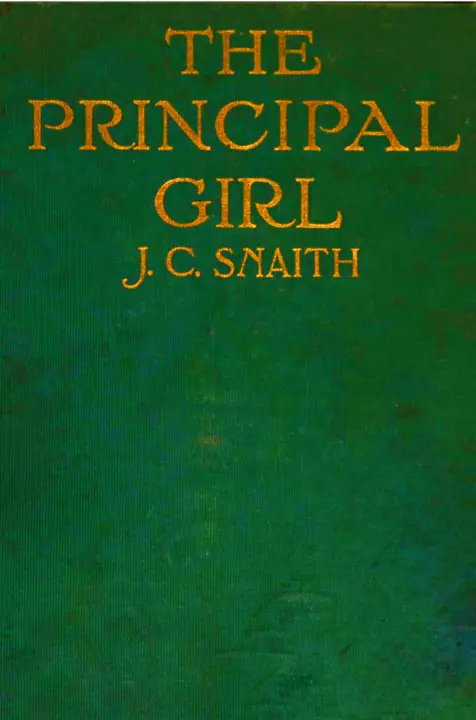
THE CLASSIC COLLECTION · 1912
"The Principal Girl" by J. C. Snaith is a novel written in the early 20th century. The story is set in the context of British high society, focusing on themes of class distinction, societal expectations, and romantic entanglements. The narrative's primary character is the young heir to a barony, Philip Shelmerdine, who becomes entangled with the ambitious and talented actress Mary Caspar, who plays the titular role of Cinderella in a pantomime. The opening of the novel introduces readers to Philip Shelmerdine, who is described as the quintessential upper-class young gentleman, navigating the complexities of societal expectations and his own desires amidst the backdrop of London's elite circles. The first chapter establishes the setting in Grosvenor Square, introducing the character of Shelmerdine and his connection to the public through a controversial letter regarding dog privileges, which leads to his social unpopularity. As he struggles with his newfound role as a public figure and grapples with personal relationships, notably with the charismatic Mary Caspar, the stage is set for a humorous yet poignant exploration of love, social standing, and personal identity in a rapidly transforming society.
Introduction adapted from the source catalogue; source summaries may be automatically generated.
Free to read · English · 65,960 words · No account needed
MAKE TIME FOR A GOOD BOOK
On by default. Untick to stop anonymous reading totals. Each page counts after 10 seconds in view. How this works.
Anonymous counting is on unless you have switched it off.
“Why am I bound to be?” inquired the Uncrowned Queen, whose good gray eye had begun to play the dickens with the second Olympian.
“Oh, you are, you know. Isn’t she, Toddles?”
Toddles was strongly of opinion that she was.
“Well, of course, if you both really think that--”
But in the secret recesses of his nature, Toddles was even more strongly of opinion that if she persisted in looking at him in that way he would be bound to kiss her.
“Are you and Mr. Wilbraham any good at snooker? Yes, I can see it in your eyes. Well, Phil-ipp and Johnny and I will play the three of you for a sovereign.”
“Done with you, Mrs. Shel,” said the Olympians with promptitude.
And then Mrs. Shelmerdine looked very demurely at Horace Allwright, and imposed the condition that the stakes should be deposited with the marker, as her success in life was entirely due to the fact that she never trusted on principle a man who came from Leeds.
“But I come from Leeds myself,” said Toddles, who, of course, was none other than the popular Yorkshire cricketer when he had time to spare for the game.
“Why not?”
“Yes; why not? But how could you tell I came from Leeds, Mrs.
Shelmerdine?”
“By your trousers.”
Horace and Johnny roared long and loud at this brilliant sally. The natural insight of those famous comedians had taught them already that if Toddles had a weakness, it was an undue pride in his trousers, which of course the young man was quite entitled to have, since they were the work of Mr. F-ster of London and Oxford.
“Now, don’t let her pull your leg, old man,” said Philip, who, as usual a little behind in the uptake, had only just begun his roar. “She’ll rag the life out of you if you’ll let her.”
Without further preface or apology, an adjournment was made to the billiard saloon, which was down a very long corridor. En route, Mr. Wilbraham, whose name in athletic circles was Weary William, because he was never in a hurry, confided to Toddles that she was every bit as nice off the stage as she was on it.
To which Toddles, in whose cognomen a meaning has yet to be discovered, rejoined that “He was always a far-seein’ old swine.”
Mary liked a light cue, and used it in a manner which did not suggest the novice. By what means she had gained her skill, it would be best, perhaps, not to inquire. At least, it is hardly likely that Grandma had taught her.
Your reading position is saved on this browser. Take it to another device with a library code. Reading pages adapt to text, rather than matching a printed edition.
J. C. (John Collis) Snaith
J. C. (John Collis) Snaith
J. C. (John Collis) Snaith
J. C. (John Collis) Snaith
BEHIND THE BOOK
This eBook is for the use of anyone anywhere in the United States and most other parts of the world at no cost and with almost no restrictions whatsoever. You may copy it, give it away or re-use it under the terms of the Project Gutenberg License included with this eBook or online at www.gutenberg.org. If you are not located in the United States, you will have to check the laws of the country where you are located before using this eBook. Read the source licence.
The original source file, including credits and licence, is retained by this library. Request an original-format copy at no charge. Please include the book title and Project Gutenberg identifier #68069.
KEEP YOUR CURIOSITY GOING
Coulson Kernahan

Maurice Baring
Frances Wright
Cécile Tormay

Frederic Jesup Stimson

W. H. P. (William Henry Pope) Jarvis