
Last letters from the living dead man
David Patterson (Spirit) Hatch
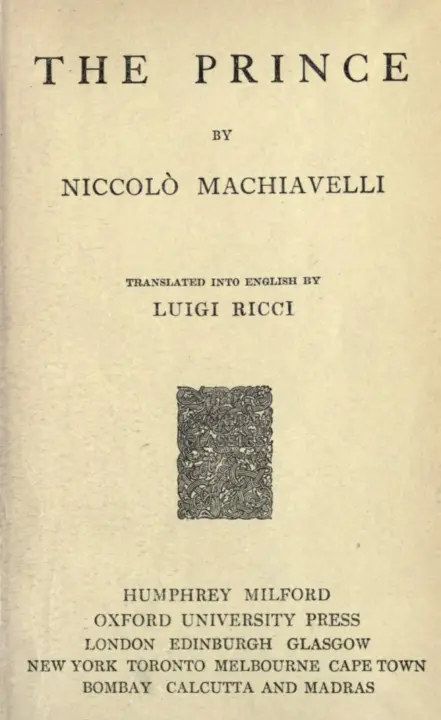
THE CLASSIC COLLECTION · 1515
"The Prince" by Niccolò Machiavelli is a political treatise written in 1513. Designed as an instruction guide for new rulers, it boldly argues that immoral acts may sometimes be necessary to achieve political power and glory. Written in Italian rather than Latin, this controversial work breaks from traditional advice literature by focusing on practical effectiveness over abstract ideals. Its unflinching examination of power and leadership challenged the dominant Catholic doctrines of its time and gave birth to the term "Machiavellian."
Introduction adapted from the source catalogue; source summaries may be automatically generated.
Free to read · English · 30,945 words · No account needed
MAKE TIME FOR A GOOD BOOK
On by default. Untick to stop anonymous reading totals. Each page counts after 10 seconds in view. How this works.
Anonymous counting is on unless you have switched it off.
But as there are still two ways of becoming prince which cannot be attributed entirely either to fortune or to ability, they must not be passed over, although one of them could be more fully discussed if we were treating of republics. These are when one becomes prince by some nefarious or villainous means, or when a private citizen becomes the prince of his country through the favour of his fellow-citizens. And in speaking of the former means, I will give two examples, one ancient, the other modern, without entering further into the merits of this method, as I judge them to be sufficient for any one obliged to imitate them. Agathocles the Sicilian rose not only from private life but from the lowest and most abject position to be King of Syracuse. The son of a potter, he led a life of the utmost wickedness through all the stages of his fortune. Nevertheless, his wickedness was accompanied by such vigour of mind and body that, having joined the militia, he rose through all its grades to be prætor of Syracuse. Having been appointed to this position, and having decided to become prince, and to hold with violence and without the support of others that which had been granted him; and having imparted his design to Hamilcar the Carthaginian, who with his armies was fighting in Sicily, he called together one morning the people and senate of Syracuse, as if he had to deliberate on matters of importance to the republic, and at a given signal had all the senators and the richest men of the people killed by his soldiers; after their death he occupied and held rule over the city without any civil disorders. And although he was twice beaten by the Carthaginians and ultimately besieged, he was able not only to defend the city, but leaving a portion of his forces for its defence, with the remainder he invaded Africa, and in a short time liberated Syracuse from the siege and brought the Carthaginians to great extremities, so that they were obliged to come to terms with him, and remain contented with the possession of Africa, leaving Sicily to Agathocles. Whoever considers, therefore, the actions and qualities of this man, will see few if any things which can be attributed to fortune; for, as above stated, it was not by the favour of any person, but through the grades of the militia, which he had gained with a thousand hardships and perils, that he arrived at the position of prince, which he afterwards maintained by so many courageous and perilous expedients. It cannot be called a virtue to kill one's fellow-citizens, betray one's friends, be without faith, without pity, and without religion, by which methods one may indeed gain an empire, but not glory. For if the virtues of Agathocles in braving and overcoming perils, and his greatness of soul in supporting and surmounting obstacles be considered, one sees no reason for holding him inferior to any of the most renowned captains. Nevertheless his barbarous cruelty and inhumanity, together with his countless atrocities, do not permit of his being named among the most famous men. We cannot attribute to fortune or merit that which he achieved without either. In our own times, during the reign of Alexander VI., Oliverotto du Fermo had been left a young boy under the care of his maternal uncle, Giovanni Fogliani, who brought him up, and sent him in early youth to fight under Paolo Vitelli, in order that he might, under that discipline, obtain a good military position. On the death of Paolo he fought under his brother Vitellozzo, and in a very short time, being of great intelligence, and active in mind and body, he became one of the leaders of his troops. But deeming it servile to be under others, he resolved, with the help of some citizens of Fermo, who preferred servitude to the liberty of their country, and with the favour of the Vitellis, to occupy Fermo; he therefore wrote to Giovanni Fogliani, how, having been for many years away from home, he wished to come to see him and his city, and in some measure to revisit his estates. And as he had only laboured to gain honour, in order that his fellow-citizens might see that he had not spent his time in vain, he wished to come honourably accompanied by one hundred horsemen, his friends and followers, and prayed him that he would be pleased to order that he should be received with honour by the citizens of Fermo, by which he would honour not only him, Oliverotto, but also himself, as he had been his pupil. Giovanni did not fail in any duty towards his nephew; he caused him to be honourably received by the people of Fermo, and lodged him in his own houses. After waiting some days to arrange all that was necessary to his villainous projects, Oliverotto invited Giovanni Fogliani and all the principal men of Fermo to a grand banquet. After the dinner and the entertainments usual at such feasts, Oliverotto artfully introduced certain important matters of discussion, speaking of the greatness of Pope Alexander, and of his son Cesare, and of their enterprises. To which discourses Giovanni and others having replied, he all at once rose, saying that these matters should be spoken of in a more secret place, and withdrew into a room where Giovanni and the other citizens followed him. They were no sooner seated than soldiers rushed out of hiding-places and killed Giovanni and all the others. After which massacre Oliverotto mounted his horse, rode through the town and besieged the chief magistrate in his palace, so that through fear they were obliged to obey him and form a government, of which he made himself prince. And all those being dead who, if discontented, could injure him, he fortified himself with new orders, civil and military, in such a way that within the year that he held the principality he was not only safe himself in the city of Fermo, but had become formidable to all his neighbours. And his overthrow would have been difficult, like that of Agathocles, if he had not allowed himself to be deceived by Cesare Borgia, when he besieged the Orsinis and Vitellis at Sinigaglia, as already related, where he also was taken, one year after the parricide he had committed, and strangled, together with Vitellozzo, who had been his teacher in ability and atrocity. Some may wonder how it came about that Agathocles, and others like him, could, after infinite treachery and cruelty, live secure for many years in their country and defend themselves from external enemies without being conspired against by their subjects; although many others have, through their cruelty, been unable to maintain their position in times of peace, not to speak of the uncertain times of war.
Your reading position is saved on this browser. Take it to another device with a library code. Reading pages adapt to text, rather than matching a printed edition.
BEHIND THE BOOK
This eBook is for the use of anyone anywhere in the United States and most other parts of the world at no cost and with almost no restrictions whatsoever. You may copy it, give it away or re-use it under the terms of the Project Gutenberg License included with this eBook or online at www.gutenberg.org. If you are not located in the United States, you will have to check the laws of the country where you are located before using this eBook. Read the source licence.
The original source file, including credits and licence, is retained by this library. Request an original-format copy at no charge. Please include the book title and Project Gutenberg identifier #57037.
KEEP YOUR CURIOSITY GOING
David Patterson (Spirit) Hatch
Cécile Tormay

Moritz Busch
Coulson Kernahan
John L. Ransom

Ralph Waldo Emerson