
Last letters from the living dead man
David Patterson (Spirit) Hatch
THE CLASSIC COLLECTION · 1515
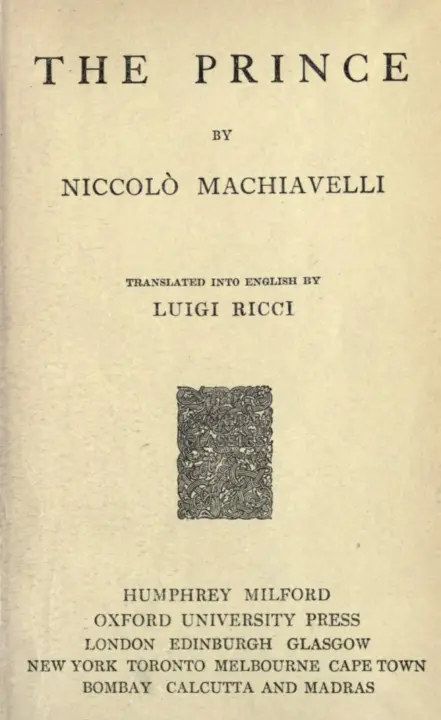
"The Prince" by Niccolò Machiavelli is a political treatise written in 1513. Designed as an instruction guide for new rulers, it boldly argues that immoral acts may sometimes be necessary to achieve political power and glory. Written in Italian rather than Latin, this controversial work breaks from traditional advice literature by focusing on practical effectiveness over abstract ideals. Its unflinching examination of power and leadership challenged the dominant Catholic doctrines of its time and gave birth to the term "Machiavellian."
Introduction adapted from the source catalogue; source summaries may be automatically generated.
Free to read · English · 30,945 words · No account needed
MAKE TIME FOR A GOOD BOOK
On by default. Untick to stop anonymous reading totals. Each page counts after 10 seconds in view. How this works.
Anonymous counting is on unless you have switched it off.
Francesco, by appropriate means and through great abilities, from citizen became Duke of Milan, and what he had attained after a thousand difficulties he maintained with little trouble. On the other hand, Cesare Borgia, commonly called Duke Valentine, acquired the state through the fortune of his father and by the same means lost it, and that although every measure was adopted by him and everything done that a prudent and capable man could do to establish himself firmly in that state that the arms and the favours of others had given him. For, as we have said, he who does not lay his foundations beforehand may by great abilities do so afterwards, although with great trouble to the architect and danger to the building. If, then, one considers the progress made by the duke, it will be seen how firm were the foundations he had laid to his future power, which I do not think it superfluous to examine, as I know of no better precepts for a new prince to follow than the example of his actions; and if his measures were not successful, it was through no fault of his own but only by the most extraordinary malignity of fortune. In wishing to aggrandise the duke his son, Alexander VI. had to meet very great difficulties both present and future. In the first place, he saw no way of making him ruler of any state that was not a possession of the Church. And in attempting to take that of the Church, he knew that the Duke of Milan and the Venetians would not consent, because Faenza and Rimini were already under the protection of the Venetians. He saw, moreover, that the arms of Italy, especially of those who might have served him, were in the hands of those who would fear the greatness of the pope, and therefore he could not depend upon them, being all under the Orsinis and Colonnas and their adherents. It was, therefore, necessary to disturb the existing condition and bring about disorders in the states of Italy in order to obtain secure mastery over a part of them; this was easy, for he found the Venetians, who, actuated by other motives, had invited the French into Italy, which he not only did not oppose, but facilitated by dissolving the marriage of King Louis. The king came thus into Italy with the aid of the Venetians and the consent of Alexander, and had hardly arrived at Milan before the pope obtained troops from him for his enterprise in the Romagna, which he carried out by means of the reputation of the king. The duke having thus obtained the Romagna and defeated the Colonnas, was hindered in maintaining it and proceeding further by two things: the one, his forces, of which he doubted the fidelity; the other the will of France, that is to say, he feared lest the arms of the Orsini of which he had availed himself should fail him, and not only hinder him in obtaining more but take from him what he had already conquered, and he also feared that the king might do the same. He had evidence of this as regards the Orsini when, after taking Faenza, he assaulted Bologna and observed their backwardness in the assault. And as regards the king, he perceived his designs when, after taking the dukedom of Urbino, he attacked Tuscany, and the king made him desist from that enterprise; whereupon the duke decided to depend no longer on the fortunes and arms of others. The first thing he did was to weaken the parties of the Orsinis and Colonnas in Rome by gaining all their adherents who were gentlemen and making them followers of himself, by granting them large pensions, and appointing them to commands and offices according to their rank, so that their attachment to their parties was extinguished in a few months, and entirely concentrated on the duke. After this he awaited an opportunity for crushing the Orsinis, having dispersed the adherents of the Colonna family, and when the opportunity arrived he made good use of it, for the Orsini seeing at length that the greatness of the duke and of the Church meant their own ruin, convoked a diet at Magione in the Perugino. Hence sprang the rebellion of Urbino and the tumults in Romagna and infinite dangers to the duke, who overcame them all with the help of the French; and having regained his reputation, neither trusting France nor other foreign forces in order not to have to oppose them, he had recourse to stratagem. He dissembled his aims so well that the Orsini, through the mediation of Signor Pavolo, made their peace with him, which the duke spared no efforts to make secure, presenting them with robes, money, and horses, so that in their simplicity they were induced to come to Sinigaglia and fell into his hands. Having thus suppressed these leaders and made their partisans his friends, the duke had laid a very good foundation to his power, having all the Romagna with the duchy of Urbino, and having gained the favour of the inhabitants, who began to feel the benefit of his rule. And as this part is worthy of note and of imitation by others, I will not omit mention of it. When he took the Romagna, it had previously been governed by weak rulers, who had rather despoiled their subjects than governed them, and given them more cause for disunion than for union, so that the province was a prey to robbery, assaults, and every kind of disorder. He, therefore, judged it necessary to give them a good government in order to make them peaceful and obedient to his rule. For this purpose he appointed Messer Remiro d' Orco, a cruel and able man, to whom he gave the fullest authority. This man, in a short time, was highly successful in rendering the country orderly and united, whereupon the duke, not deeming such excessive authority expedient, lest it should become hateful, appointed a civil court of justice in the middle of the province under an excellent president, to which each city appointed its own advocate. And as he knew that the harshness of the past had engendered some amount of hatred, in order to purge the minds of the people and to win them over completely, he resolved to show that if any cruelty had taken place it was not by his orders, but through the harsh disposition of his minister. And taking him on some pretext, he had him placed one morning in the public square at Cesena, cut in half, with a piece of wood and blood-stained knife by his side. The ferocity of this spectacle caused the people both satisfaction and amazement. But to return to where we left off.
Your reading position is saved on this browser. Take it to another device with a library code. Reading pages adapt to text, rather than matching a printed edition.
BEHIND THE BOOK
This eBook is for the use of anyone anywhere in the United States and most other parts of the world at no cost and with almost no restrictions whatsoever. You may copy it, give it away or re-use it under the terms of the Project Gutenberg License included with this eBook or online at www.gutenberg.org. If you are not located in the United States, you will have to check the laws of the country where you are located before using this eBook. Read the source licence.
The original source file, including credits and licence, is retained by this library. Request an original-format copy at no charge. Please include the book title and Project Gutenberg identifier #57037.
KEEP YOUR CURIOSITY GOING
David Patterson (Spirit) Hatch
Cécile Tormay

Moritz Busch
Coulson Kernahan
John L. Ransom

Ralph Waldo Emerson