
Europe and elsewhere
Mark Twain
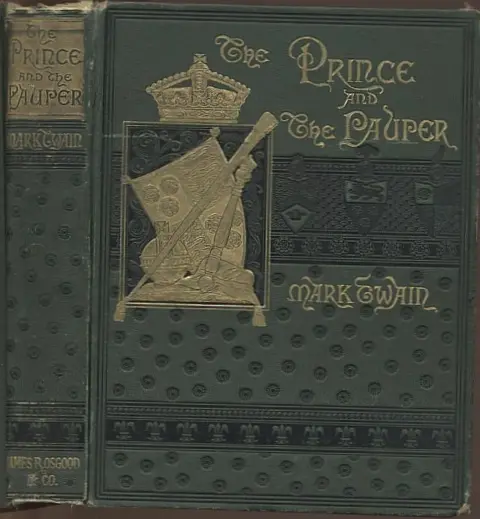
THE CLASSIC COLLECTION · 1881
"The Prince and the Pauper" by Mark Twain is a novel first published in 1881. Two identical boys—Prince Edward Tudor and pauper Tom Canty—meet by chance and swap clothes, only to find themselves trapped in each other's lives. As Edward experiences the brutal reality of poverty and injustice firsthand, Tom struggles to maintain the royal charade. This tale of mistaken identity explores class inequality and the harsh English judicial system, while both boys discover what it truly means to walk in another's shoes.
Introduction adapted from the source catalogue; source summaries may be automatically generated.
Free to read · English · 70,649 words · No account needed
MAKE TIME FOR A GOOD BOOK
On by default. Untick to stop anonymous reading totals. Each page counts after 10 seconds in view. How this works.
Anonymous counting is on unless you have switched it off.
Yes, King Edward VI. lived only a few years, poor boy, but he lived them worthily. More than once, when some great dignitary, some gilded vassal of the crown, made argument against his leniency, and urged that some law which he was bent upon amending was gentle enough for its purpose, and wrought no suffering or oppression which any one need mightily mind, the young King turned the mournful eloquence of his great compassionate eyes upon him and answered--
“What dost thou know of suffering and oppression? I and my people
know, but not thou.”
The reign of Edward VI. was a singularly merciful one for those harsh times. Now that we are taking leave of him, let us try to keep this in our minds, to his credit.
{1} For Mark Twain’s note see below under the relevant chapter heading.
{2} He refers to the order of baronets, or baronettes; the barones minores, as distinct from the parliamentary barons--not, it need hardly be said, to the baronets of later creation.
{3} The lords of Kingsale, descendants of De Courcy, still enjoy this
curious privilege.
{4} Hume.
{5} Ib.
{6} Leigh Hunt’s ‘The Town,’ p.408, quotation from an early tourist.
{7} Canting terms for various kinds of thieves, beggars and vagabonds, and their female companions.
{8} From ‘The English Rogue.’ London, 1665.
{9} Hume’s England.
{10} See Dr. J. Hammond Trumbull’s Blue Laws, True and False, p. 11.
NOTE 1, Chapter IV. Christ’s Hospital Costume.
It is most reasonable to regard the dress as copied from the costume of the citizens of London of that period, when long blue coats were the common habit of apprentices and serving-men, and yellow stockings were generally worn; the coat fits closely to the body, but has loose sleeves, and beneath is worn a sleeveless yellow under-coat; around the waist is a red leathern girdle; a clerical band around the neck, and a small flat black cap, about the size of a saucer, completes the costume.--Timbs’ Curiosities of London.
NOTE 2, Chapter IV.
It appears that Christ’s Hospital was not originally founded as a school; its object was to rescue children from the streets, to shelter, feed, clothe them.--Timbs’ Curiosities of London.
NOTE 3, Chapter V. The Duke of Norfolk’s Condemnation commanded.
The King was now approaching fast towards his end; and fearing lest Norfolk should escape him, he sent a message to the Commons, by which he desired them to hasten the Bill, on pretence that Norfolk enjoyed the dignity of Earl Marshal, and it was necessary to appoint another, who might officiate at the ensuing ceremony of installing his son Prince of Wales.--Hume’s History of England, vol. iii. p. 307.
Your reading position is saved on this browser. Take it to another device with a library code. Reading pages adapt to text, rather than matching a printed edition.
BEHIND THE BOOK
This eBook is for the use of anyone anywhere in the United States and most other parts of the world at no cost and with almost no restrictions whatsoever. You may copy it, give it away or re-use it under the terms of the Project Gutenberg License included with this eBook or online at www.gutenberg.org. If you are not located in the United States, you will have to check the laws of the country where you are located before using this eBook. Read the source licence.
The original source file, including credits and licence, is retained by this library. Request an original-format copy at no charge. Please include the book title and Project Gutenberg identifier #1837.
KEEP YOUR CURIOSITY GOING
Cécile Tormay

Moritz Busch
Coulson Kernahan
John L. Ransom

Maurice Baring
Frances Wright


