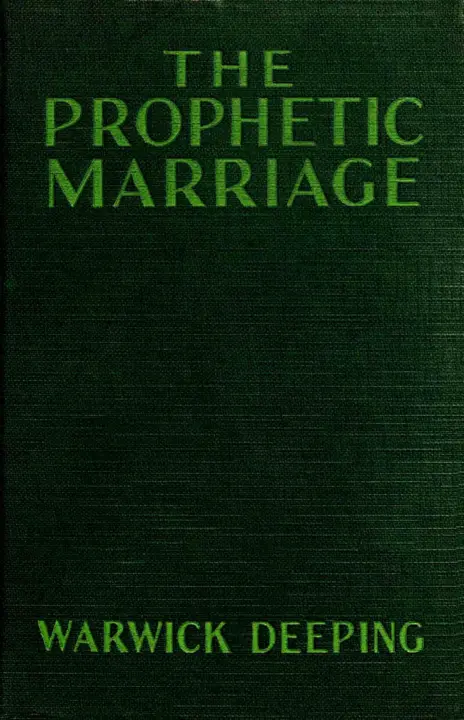
The prophetic marriage
Warwick Deeping
THE CLASSIC COLLECTION · 1928
"The Pride of Eve" by Warwick Deeping is a novel written in the early 20th century. The story centers around the lives of James Canterton, a talented rose breeder, and his wife, Gertrude, who is preoccupied with social ambitions and community projects. Their contrasting interests highlight themes of artistic passion and the struggles of domestic life, setting the stage for tensions that may arise in their marriage. The opening of the novel introduces James Canterton as he eagerly awaits the blooming of his newly created rose, named "Guinevere," in his beautiful garden at Fernhill. As he sits in the serene rosery, his character is depicted as a patient and meditative artist, deeply connected to nature. The narrative shifts when his wife, Gertrude, interrupts his tranquil moment, revealing the strain in their relationship—while he finds joy in the subtle wonders of life, she is caught up in her social endeavors, often to the detriment of their domestic harmony. The contrast between their lives is further emphasized through the playful interactions with their daughter, Lynette, suggesting a familial bond that may serve as a counterbalance to the couple's disconnection.
Introduction adapted from the source catalogue; source summaries may be automatically generated.
Free to read · English · 106,423 words · No account needed
MAKE TIME FOR A GOOD BOOK
On by default. Untick to stop anonymous reading totals. Each page counts after 10 seconds in view. How this works.
Anonymous counting is on unless you have switched it off.
Those who saw Lynette’s swoop towards her heroine attached no esoteric meaning to its publicity. A sage green frock and a bronze gold head went darting between the figures on the Fernhill lawn.
Mrs. Brocklebank, who could stop most people in full career, as a policeman halts the traffic in the city, discovered that it was possible for her largeness to be ignored.
“Lynette, my dear, come and show me——”
Lynette whisked past her unheedingly. Mrs. Brocklebank tilted her
glasses.
“Dear me, how much too impetuous that child is. I am always telling Gertrude that she is far too wild and emotional.”
Mrs. Lankhurst, who was Mrs. Brocklebank’s companion for the moment,
threw back an echo.
“A little neurotic, I think.”
Mrs. Lankhurst was a typical hard-faced, raddled, cut-mouthed Englishwoman, a woman who had ceased to trouble about her appearance simply because she had been married for fifteen years and felt herself comfortably and sexually secure. An unimaginative self-complacency seems to be the chief characteristic of this type of Englishwoman. She appears to regard marriage as a release from all attempts at subtilising the charm of dress, lets her complexion go, her figure slacken, her lips grow thin. “George” is serenely and lethargically constant, so why trouble about hats? So the good woman turns to leather, rides, gardens, plays golf, and perhaps reads questionable novels. The sex problem does not exist for her, yet Mrs. Lankhurst’s “George” was notorious and mutable behind her back. She thought him cased up in domestic buckram, and never the lover of some delightful little dame aux Camellias, who kept her neck white, and her sense of humour unimpaired.
Lynette’s white legs flashed across the grass.
“Oh, Miss Eve!”
Eve Carfax had stepped out through the open drawing-room window, a slim and sensitive figure that carried itself rather proudly in the face of a crowd.
“Lynette!”
“I knew you’d come! I knew you’d come!”
She held out hands that had to be taken and held, despite the formal
crowd on the lawn.
“I’m so glad you’re back.”
A red mouth waited to be kissed.
“We have missed you—daddy and I.”
“My dear——”
Mrs. Brocklebank was interested. So was her companion.
“Who is that girl?”
Mrs. Lankhurst had a way of screwing up her eyes, and wrinkling her
forehead.
“A Miss Carfax. She lives with her mother near here. Retired tradespeople, I imagine. The girl paints. She is doing work for Mr. Canterton—illustrating catalogues, I suppose.”
“The child seems very fond of her.”
“Children have a habit of making extraordinary friendships. It is the dustman, or an engine-driver, or something equally primitive.”
Your reading position is saved on this browser. Take it to another device with a library code. Reading pages adapt to text, rather than matching a printed edition.
Warwick Deeping
Warwick Deeping
Warwick Deeping
Warwick Deeping
BEHIND THE BOOK
This eBook is for the use of anyone anywhere in the United States and most other parts of the world at no cost and with almost no restrictions whatsoever. You may copy it, give it away or re-use it under the terms of the Project Gutenberg License included with this eBook or online at www.gutenberg.org. If you are not located in the United States, you will have to check the laws of the country where you are located before using this eBook. Read the source licence.
The original source file, including credits and licence, is retained by this library. Request an original-format copy at no charge. Please include the book title and Project Gutenberg identifier #50176.
KEEP YOUR CURIOSITY GOING
Coulson Kernahan

Maurice Baring
Frances Wright
Cécile Tormay

Frederic Jesup Stimson

W. H. P. (William Henry Pope) Jarvis