
The Writing of News A Handbook with Chapters on Newspaper Correspondence and Copy Reading
Charles G. (Charles Griffith) Ross
THE CLASSIC COLLECTION · 1920
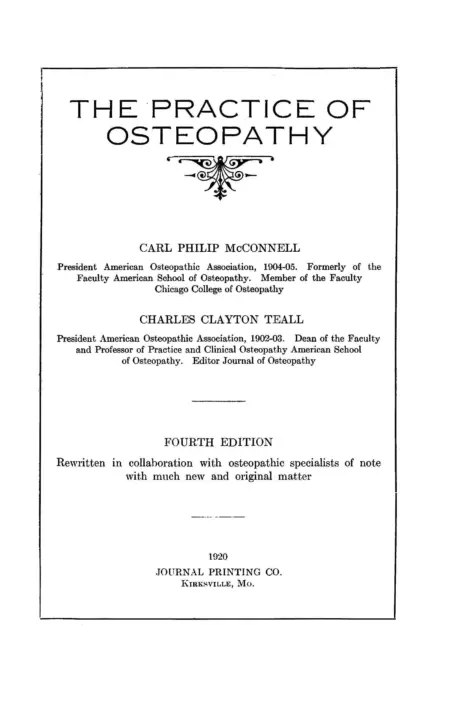
"The Practice of Osteopathy" by Carl Philip McConnell and Charles Clayton Teall is a scientific publication written in the early 20th century. The work serves as a comprehensive textbook on osteopathic medicine, providing both foundational theory and practical instruction for students and practitioners in the field. Its primary focus is the explanation, diagnosis, and treatment of disease according to osteopathic principles, particularly emphasizing anatomical causes and manual correction over pharmaceutical or primarily surgical interventions. The opening of this work introduces the philosophy and historical context of osteopathy, highlighting Andrew Taylor Still as the founder and his revolutionary departure from conventional medicine. The authors stress that osteopathy is defined by its unique approach to the causes of disease—specifically the identification and correction of structural lesions (malalignments and dysfunctions in bones, muscles, ligaments, and other tissues) believed to impede nerve and blood flow, thus leading to illness. The text details the types of lesions, their etiological significance, and their systemic impact, setting the stage for how osteopaths diagnose through meticulous physical examination, particularly of the spine and related musculoskeletal structures. The beginning also establishes the rigorous diagnostic and philosophical distinctions between osteopathy and other forms of manual therapy or drug-based medicine, positioning it as an integrative, holistic discipline grounded in anatomy, physiology, and respect for the body's natural healing capabilities.
Introduction adapted from the source catalogue; source summaries may be automatically generated.
Free to read · English · 323,560 words · No account needed
MAKE TIME FOR A GOOD BOOK
On by default. Untick to stop anonymous reading totals. Each page counts after 10 seconds in view. How this works.
Anonymous counting is on unless you have switched it off.
Inhibition of various regions along the spinal column is frequently given by the osteopath to lessen pain. It is only a temporary or palliative treatment, but many times gives great relief. One should inhibit usually over tender points and contracted muscles. These (tender points and contracted muscles) are signs to the osteopath that disturbances exist at these points. The following table is taken from Quain, which is Head’s classification:
=Heart.=—First, second and third dorsals.
=Lungs.=—First, second, third, fourth and fifth dorsals.
=Stomach.=—Sixth, seventh, eighth and ninth dorsals. Cardiac end from sixth and seventh. Pyloric end from ninth.
=Intestines.=—(a) Down to upper part of rectum, ninth, tenth, eleventh and twelfth dorsals. (b) Rectum, second, third and fourth sacrals.
=Liver and Gall-bladder.=—Sixth, seventh, eighth, ninth and tenth
dorsals.
=Kidney and Ureter.=—Tenth, eleventh and twelfth dorsals. Upper part of ureter, tenth dorsal. At lower end of ureter, first lumbar tends to appear.
=Bladder.=—(a) Mucous membrane and neck of bladder; (first) second, third and fourth sacrals; (b) over distension and ineffectual contraction, eleventh and twelfth dorsals, and first lumbar.
=Prostate.=—Tenth, eleventh (twelfth) dorsals. First, second and third sacrals, and fifth lumbar.
=Epididymis.=—Eleventh and twelfth dorsals and first lumbar.
=Testis.=—Tenth dorsal.
=Ovary.=—Tenth dorsal.
=Appendages, etc.=—Eleventh and twelfth dorsals, first lumbar.
=Uterus.=—(a) In contraction, tenth, eleventh and twelfth dorsals, and first lumbar. (b) Os uteri; (first) second, third and fourth sacrals (fifth lumbar very rarely).
Other points are used by the osteopath to relieve pain of certain regions, for such the reader is referred to the article on neuralgia; besides many tender points are found along the spine by the osteopath, where inhibition gives relief to the patient, provided such points have a connection with the case in question.
Hot fomentations if property applied, through reciprocal relationship of the nervous system, are of value in relieving pain, releasing spastic musculature and normalizing visceral function. Frequently, in both acute and chronic cases, this is an excellent preparatory measure, to be followed by careful adjustment. It will be recalled that the functional test, movement of a vertebral lesion is of primary consideration.[39]
[33] Burns—Partial Report of Experiments upon Visceral Reflexes. The Osteopathic World, Aug., 1905.
[34] Pearce—Some Laboratory Demonstrations of Osteopathic Principles. The Osteopathic Physician, Nov., 1905.
[35] Stimulation—Leslie E. Cherry, Journal of the American Osteopathic Association, Feb., 1905.
[36] McConnell—The Osteopathic Lesion,—Journal of the American
Osteopathic Association.
[37] See also Gaskell, The Involuntary Nervous System; Pattenger,
Symptoms of Visceral Disease; Mackenzie, Symptoms and Their
Interpretation.
[38] MacLeod, Physiology and Biochemistry in Modern Medicine.
[39] See Luciani, Human Physiology, Vol. III; MacLeod, Physiology and Biochemistry in Modern Medicine.
Your reading position is saved on this browser. Take it to another device with a library code. Reading pages adapt to text, rather than matching a printed edition.
BEHIND THE BOOK
This eBook is for the use of anyone anywhere in the United States and most other parts of the world at no cost and with almost no restrictions whatsoever. You may copy it, give it away or re-use it under the terms of the Project Gutenberg License included with this eBook or online at www.gutenberg.org. If you are not located in the United States, you will have to check the laws of the country where you are located before using this eBook. Read the source licence.
The original source file, including credits and licence, is retained by this library. Request an original-format copy at no charge. Please include the book title and Project Gutenberg identifier #75696.
KEEP YOUR CURIOSITY GOING
Charles G. (Charles Griffith) Ross
Hannah Webster Foster

Emily Lawless
Edwin Hamlin Carr

Charles De Lano Hine
Andrew Ure