
The Writing of News A Handbook with Chapters on Newspaper Correspondence and Copy Reading
Charles G. (Charles Griffith) Ross
THE CLASSIC COLLECTION · 1920
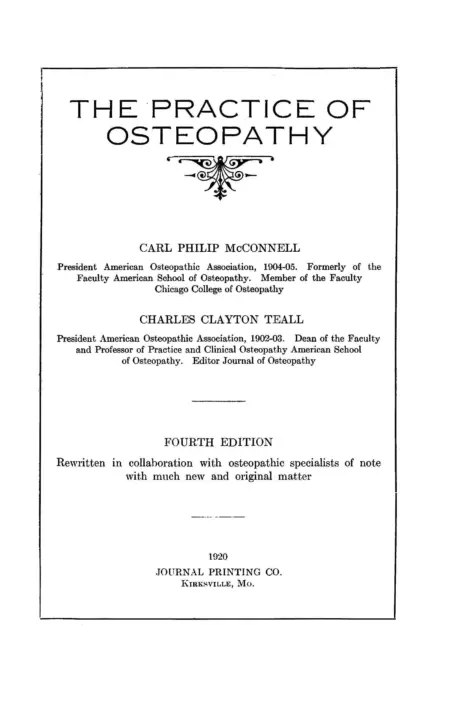
"The Practice of Osteopathy" by Carl Philip McConnell and Charles Clayton Teall is a scientific publication written in the early 20th century. The work serves as a comprehensive textbook on osteopathic medicine, providing both foundational theory and practical instruction for students and practitioners in the field. Its primary focus is the explanation, diagnosis, and treatment of disease according to osteopathic principles, particularly emphasizing anatomical causes and manual correction over pharmaceutical or primarily surgical interventions. The opening of this work introduces the philosophy and historical context of osteopathy, highlighting Andrew Taylor Still as the founder and his revolutionary departure from conventional medicine. The authors stress that osteopathy is defined by its unique approach to the causes of disease—specifically the identification and correction of structural lesions (malalignments and dysfunctions in bones, muscles, ligaments, and other tissues) believed to impede nerve and blood flow, thus leading to illness. The text details the types of lesions, their etiological significance, and their systemic impact, setting the stage for how osteopaths diagnose through meticulous physical examination, particularly of the spine and related musculoskeletal structures. The beginning also establishes the rigorous diagnostic and philosophical distinctions between osteopathy and other forms of manual therapy or drug-based medicine, positioning it as an integrative, holistic discipline grounded in anatomy, physiology, and respect for the body's natural healing capabilities.
Introduction adapted from the source catalogue; source summaries may be automatically generated.
Free to read · English · 323,560 words · No account needed
MAKE TIME FOR A GOOD BOOK
On by default. Untick to stop anonymous reading totals. Each page counts after 10 seconds in view. How this works.
Anonymous counting is on unless you have switched it off.
Osteopathy, definitions of, 18.
includes many measures, 62.
not massage, 19.
not passive exercise, 129.
not Swedish movements, 19, 63, 68.
Otitis media, acute suppurative, 239.
chronic suppurative, 243.
differential diagnosis, 244.
non-suppurative, 246.
Ovarian examination, 56.
Ovary, prolapse of, 144.
sensory nerves to, 95.
Oxyuris vermicularis, 154.
Pachymeningitis, cervical, differentiated from syringomyelia, 762.
Packing, nasal, 267, 268.
Pains, location of reflex, 499.
Palpation, educated, 60.
practice in, 87.
Palpitation, 662.
Pannus, 224.
Panophthalmitis, 227.
Papillae in rectum, 174.
Paralysis, acute ascending, 753.
Paralysis agitans, 723.
differential diagnosis, 724.
bulbar, 765.
Paralysis, infantile, 750.
Paranephritic abscess differentiated from pyelitis, 628.
Paranoia, 287.
Paraplegia, ataxic, 761.
spastic, 760.
Parasites, animal, 151.
Parathyroid glands, diseases of, 699.
Paratyphoid fever, 344.
Paris, plaster of, 795.
Parotiditis, epidemic, 449.
differential diagnosis of, 451.
Parotitis, epidemic, 449.
Patheticus nerves, lesions affecting, 716.
Pathologies, osteopathy recognizes two distinct, 489.
Pathology, osteopathic, 31.
Patient’s receptivity to treatment, 61.
Pearls, Lænnec’s, 591.
Pelvic examination, 52.
prolapse caused by abdominal prolapse, 128.
technic, 78.
Pendulous abdomen, 127.
Pericarditis, 638.
complicating pneumonia, 600.
Pericardium, diseases of, 638.
Peristalsis explained, 494.
reversed, normal in parts of colon, 497.
technic to affect, 495.
Peritonsillar abscess, 278.
Pernicious anemia, 678.
Pertussis, 452.
Petit mal, 730, 733.
Pharyngitis, 274.
Pharynx complications in typhoid, 332.
technic, 67.
Phenol-glycerine formula, 263.
Phlebitis, 167.
post-operative, 313.
Phlegmasia alba dolens, 167.
Phlyctenular keratitis, 224.
Phrenic nerve, lesions affecting, 720.
Phthisis, see tuberculosis.
Piles, 171.
Pin-worm, 154.
Plaster of Paris, 795.
Pleura, diseases of, 611.
Pleurisy, 611.
complicating pneumonia, 600.
differentiated from pneumonia, 601.
post-operative, 314.
Pleurodynia, 465, 466, 712.
Pneumogastric nerve, lesions affecting, 718.
Pneumonia, acute lobar, 597.
aspiration, 605.
alcohol not indicated in, 319.
associated with endocarditis, 644.
bronchial, 605.
caused by tubercle bacillus, 606.
catarrhal, 605.
complication of typhoid, 332.
chronic interstitial, 609.
croupous, 597.
differential diagnosis of, 609.
deglutition, 605.
differential diagnosis of, 601.
post-operative, 314.
Pneumonia, strychnine not indicated in, 320.
Pneumonic phthisis, 388.
Poliomyelitis, 750.
causing scoliosis, 770.
differentiated from myelitis, 749.
Polyuria, 476.
Portal system, vasomotors to, 94.
Posterior spine technic, 101.
thoracic nerve, lesions affecting, 721.
Post-operative treatment, 312.
Postural curves of spine, 128.
defects, 120.
Posture, correct, 127, 128.
Pott’s disease, 102, 788.
differentiated from kyphosis, 97.
from scoliosis, 773.
treatment, 102.
Proctitis, 170.
Prognosis and diagnosis, osteopathic, 38.
osteopathic, 56.
Progressive muscular atrophy, 764.
differentiated from syringomyelitis, 762.
Prolapse—See also ptosis.
Prolapsed hepatic flexure, 139.
intestines, 139, 170.
kidney, 136.
liver, 138.
organs, 127, 133, 521.
ovaries, 144.
rectum, 171.
sigmoid flexure, 141, 170.
stomach, 134.
uterus, 143.
Prominent hip, 125.
Prostate gland, 175.
technic, 637.
sensory nerves to, 95.
Prostatitis, 175.
Prostatorrhea, 176.
Pseudo-angina pectoris, 667.
appendicitis, 550.
croup, 572.
leukemia, 684.
Psychalgia, 293, 296.
Psychosis, involutional, 295.
Ptosis—See also prolapse.
of abdominal organs, 127.
of eyelids, 201.
Pulmonary regurgitation, 650.
stenosis, 650.
Punctum proximum, 192.
remotum, 192.
Purpura, 483.
variolosa, 420.
Pyelitis, 627.
differential diagnosis, 628, 636.
Pyelonephritis, 627.
Pyemia, 356.
Quinsy, 278.
Radial nerve, lesions affecting, 739.
Rash, differentiate scarlet fever from drug or septic, 431.
Receptaculum chyli, vasomotor nerves to, 94.
Rectal conditions requiring surgery, 174.
disorders, brief discussion, 141.
examination, 55, 56, 169.
Rectum, 169.
to dilate, 170.
technic, 169.
Reflex gastric troubles, 509.
pains, location of various, 499.
Reflexes, somatic, Burns experiments, 189.
Regions of body should form basis of disease classification, 586.
Regurgitation, aortic, 649.
mitral, 648.
pulmonary, 650.
tricuspid, 650.
Remittent fever, 350.
differentiate from yellow fever, 375.
Renal calculus, 631.
Renal colic—see colic.
differentiate from appendicitis, 551.
Respiratory diseases, 569.
reflex inefficiency, 264.
Retina, diseases of, 230, 715.
Retinitis, 230.
Retrobulbar neuritis, 231.
Rheumatic fever, 457.
Rheumatism, abdominal, 466, 467.
cause of heart valve defects, 645.
chronic articular, 460.
differential diagnosis, 459.
and brachial neuritis, 125.
gonorrheal, 459.
inflammatory, 457.
muscular, 465.
subacute, 459.
Rheumatoid arthritis, 462.
differentiated from rheumatic fever, 459.
Rhinitis, acute, 257.
atrophic, 261.
chronic hypertrophic, 259.
hyperesthetic, 263.
purulent, 259.
Your reading position is saved on this browser. Take it to another device with a library code. Reading pages adapt to text, rather than matching a printed edition.
BEHIND THE BOOK
This eBook is for the use of anyone anywhere in the United States and most other parts of the world at no cost and with almost no restrictions whatsoever. You may copy it, give it away or re-use it under the terms of the Project Gutenberg License included with this eBook or online at www.gutenberg.org. If you are not located in the United States, you will have to check the laws of the country where you are located before using this eBook. Read the source licence.
The original source file, including credits and licence, is retained by this library. Request an original-format copy at no charge. Please include the book title and Project Gutenberg identifier #75696.
KEEP YOUR CURIOSITY GOING
Charles G. (Charles Griffith) Ross
Hannah Webster Foster

Emily Lawless
Edwin Hamlin Carr

Charles De Lano Hine
Andrew Ure