
The Writing of News A Handbook with Chapters on Newspaper Correspondence and Copy Reading
Charles G. (Charles Griffith) Ross
THE CLASSIC COLLECTION · 1920
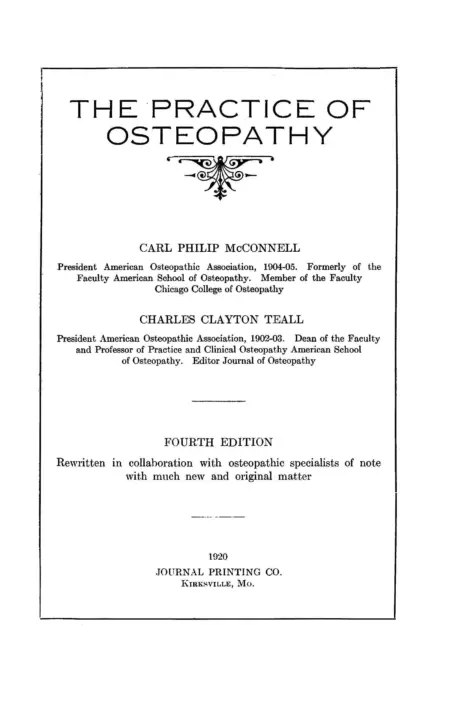
"The Practice of Osteopathy" by Carl Philip McConnell and Charles Clayton Teall is a scientific publication written in the early 20th century. The work serves as a comprehensive textbook on osteopathic medicine, providing both foundational theory and practical instruction for students and practitioners in the field. Its primary focus is the explanation, diagnosis, and treatment of disease according to osteopathic principles, particularly emphasizing anatomical causes and manual correction over pharmaceutical or primarily surgical interventions. The opening of this work introduces the philosophy and historical context of osteopathy, highlighting Andrew Taylor Still as the founder and his revolutionary departure from conventional medicine. The authors stress that osteopathy is defined by its unique approach to the causes of disease—specifically the identification and correction of structural lesions (malalignments and dysfunctions in bones, muscles, ligaments, and other tissues) believed to impede nerve and blood flow, thus leading to illness. The text details the types of lesions, their etiological significance, and their systemic impact, setting the stage for how osteopaths diagnose through meticulous physical examination, particularly of the spine and related musculoskeletal structures. The beginning also establishes the rigorous diagnostic and philosophical distinctions between osteopathy and other forms of manual therapy or drug-based medicine, positioning it as an integrative, holistic discipline grounded in anatomy, physiology, and respect for the body's natural healing capabilities.
Introduction adapted from the source catalogue; source summaries may be automatically generated.
Free to read · English · 323,560 words · No account needed
MAKE TIME FOR A GOOD BOOK
On by default. Untick to stop anonymous reading totals. Each page counts after 10 seconds in view. How this works.
Anonymous counting is on unless you have switched it off.
On clothing you will find it best to allow the plaster to dry before removing, while on furniture or the hands it is readily removed by washing off in warm water. The water in which the bandages were immersed contains, of course, considerable plaster, and under no circumstances should this be emptied into a sink or waste pipe for it will certainly demand the services of a plumber. The water may be poured out on the ground and the paste shaken into a refuse barrel or ash pile. The best way to remove a cast is to moisten it with water or vinegar along the path of the knife. I might add that all patients are in constant fear of being cut either while you are trimming, cutting windows, or removing the cast, but because of the cotton padding underneath you will find that it is almost an impossibility. Care, of course, should be taken that the knife does not slip in any of these procedures and come in contact with the unprotected parts.
In general, for fractures of the extremities it is best to apply the plaster with the patient in the recumbent position to secure complete muscular relaxation, and the part to be cast should be supported by an assistant. It is also a general rule that in fractures of the shaft of the long bones, especially of the lower extremities, the plaster bandage should be applied to include the adjacent articulation and extend well beyond the joints.
Abbott treatment, 98, 774, 778.
Abdomen pendulous, 127.
Abdominal examination, 51.
rheumatism, 466, 467.
technic, 77, 536, 539.
dangers of, 87, 540.
Abducens nerve, lesions affecting, 717.
Abscess of rectum, 174.
perinephritic, differentiate pyelitis, 628.
peritonsillar, 278.
Achylia gastrica, differential diagnosis, 508.
Acne, 150.
Accommodation in the eye, 192.
Acetabulum, migration of, 791.
Addison’s disease, 704.
differentiated from jaundice, 559.
Adenitis, tubercular, 384.
Adenoids, 273.
Adhesions, broken up after sprains, 108.
Adjustment, osteopathic, 90.
Adrenal glands, diseases of, 703.
Aged, spine of the, 101.
Agitans, paralysis, 723.
Agitata, melancholia, 297.
Ague, 347.
Alcohol in post-operative pneumonia, 319.
Amentia, 290, 307.
Amyloid kidney, 626.
liver, 562.
Amyotrophic lateral sclerosis, 762.
Angina pectoris, 666.
differential diagnosis, 667.
pathology in, 308.
Anemias, the, 672.
Anemia, costogenic, 673.
Burns, 673.
pernicious, 678.
Aneurism, cardiac, 660.
Animal experiments, 91, 490.
parasites, 151.
Ankle, 56.
sprain, 112.
Ankylostomiasis, 155.
Anterior dorsal lesions technic, 76.
Antidotes may be necessary, 62.
Antiseptics may be necessary, 62.
Aortic regurgitation, 649.
stenosis, 551.
Aphonia, 571.
Aphthous stomatitis, 488.
Appendectomy, colitis following, 552.
Appendicitis, 547.
differential diagnosis, 550.
Appendicitis from ileo-cecal trouble, 141.
pseudo, 550.
Appendix innervation, 498.
Arch supporters, 114.
Arhythmia, 665.
Arm affected by rib lesions, 740.
Arm examination, 56.
technic, 80.
vasomotor nerves to, 94.
Arteries, diseases of, 669.
Arteriosclerosis, 669.
Artery complications from typhoid, 332.
Arthritis deformans, 462.
rheumatoid, 462.
differentiated from inflammatory rheumatism, 459.
septic, differentiated from inflammatory rheumatism, 459.
Articular rheumatism, acute, 460.
Ascaris lumbricoides, 153.
Aspiration pneumonia, 605.
Asthenopia, 232.
Asthma bronchial, 589.
caused by rib lesions, 94.
Ataxia, Friedreich’s, 759.
hereditary, 759.
differentiate chorea, 726.
locomotor, 754.
Ataxic paraplegia, 761.
Atheroma, 669.
in heart, 647.
Atlas examination, 44.
lesions, 44.
Atrophy of optic nerve, 231.
progressive muscular, 762, 764.
Auditory—See also ear.
Your reading position is saved on this browser. Take it to another device with a library code. Reading pages adapt to text, rather than matching a printed edition.
BEHIND THE BOOK
This eBook is for the use of anyone anywhere in the United States and most other parts of the world at no cost and with almost no restrictions whatsoever. You may copy it, give it away or re-use it under the terms of the Project Gutenberg License included with this eBook or online at www.gutenberg.org. If you are not located in the United States, you will have to check the laws of the country where you are located before using this eBook. Read the source licence.
The original source file, including credits and licence, is retained by this library. Request an original-format copy at no charge. Please include the book title and Project Gutenberg identifier #75696.
KEEP YOUR CURIOSITY GOING
Charles G. (Charles Griffith) Ross
Hannah Webster Foster

Emily Lawless
Edwin Hamlin Carr

Charles De Lano Hine
Andrew Ure