
The Writing of News A Handbook with Chapters on Newspaper Correspondence and Copy Reading
Charles G. (Charles Griffith) Ross
THE CLASSIC COLLECTION · 1920
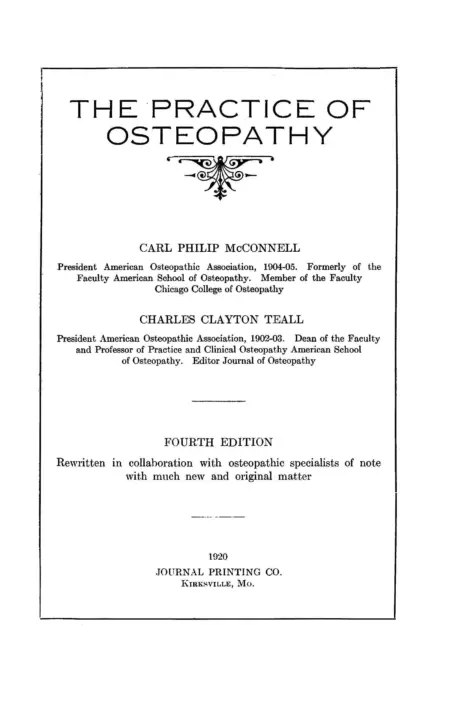
"The Practice of Osteopathy" by Carl Philip McConnell and Charles Clayton Teall is a scientific publication written in the early 20th century. The work serves as a comprehensive textbook on osteopathic medicine, providing both foundational theory and practical instruction for students and practitioners in the field. Its primary focus is the explanation, diagnosis, and treatment of disease according to osteopathic principles, particularly emphasizing anatomical causes and manual correction over pharmaceutical or primarily surgical interventions. The opening of this work introduces the philosophy and historical context of osteopathy, highlighting Andrew Taylor Still as the founder and his revolutionary departure from conventional medicine. The authors stress that osteopathy is defined by its unique approach to the causes of disease—specifically the identification and correction of structural lesions (malalignments and dysfunctions in bones, muscles, ligaments, and other tissues) believed to impede nerve and blood flow, thus leading to illness. The text details the types of lesions, their etiological significance, and their systemic impact, setting the stage for how osteopaths diagnose through meticulous physical examination, particularly of the spine and related musculoskeletal structures. The beginning also establishes the rigorous diagnostic and philosophical distinctions between osteopathy and other forms of manual therapy or drug-based medicine, positioning it as an integrative, holistic discipline grounded in anatomy, physiology, and respect for the body's natural healing capabilities.
Introduction adapted from the source catalogue; source summaries may be automatically generated.
Free to read · English · 323,560 words · No account needed
MAKE TIME FOR A GOOD BOOK
On by default. Untick to stop anonymous reading totals. Each page counts after 10 seconds in view. How this works.
Anonymous counting is on unless you have switched it off.
=Treatment.=—The treatment of Landry’s disease consists principally of thorough treatment of the spine, especially of the lower dorsal and lumbar regions, and attention to the underlying toxic condition. The treatment should be most thorough; the vertebræ and ribs found disordered should be corrected and each vertebra should be carefully separated (if conditions permit) from its neighbor. When the paralysis has extended to the trunk and neck, a thorough treatment all along the spinal column should be given with a view to relaxing the contracted muscles and to render flexible the entire spinal column, so that the cord may be properly nourished and the progress of the disease checked. Careful relaxation of the contracted spinal muscles unquestionably has a potent effect upon the cord circulation, which tends to check and retard degenerative processes. Treatment of the limbs directly will be found a help, as well as direct treatment of all tissues paralyzed. If swallowing is impossible, the patient should be fed through the rectum, or by the stomach or nasal tube. See that the patient is carefully nursed. Massage is beneficial.
Locomotor Ataxia
=Locomotor Ataxia= is frequently met with. It is a disease of the spinal cord wherein the ultimate effect is a sclerosis of a progressive character of the nerve courses of the posterior column. It is claimed that the origin is in the protoplasmic processes of the posterior spinal ganglion. The characteristic symptoms are incoordination, Argyll Robertson pupil, lightning pains and loss of knee-jerk.
=Osteopathic Etiology= and =Pathology=.—Most cases develop between the ages of thirty and forty, although it is occasionally seen in young men, and rarely in children from hereditary syphilis. Males are much more frequently affected than females (10 to 1, Osler), and the disease is much more frequent in cities. Predisposing causes are given as syphilis, prolonged exposure to wet and cold, and sexual excesses, although there is a disposition on the part of neurologists to confine the cause of true tabes to syphilis, some records showing as high as 90 per cent. of the cases from that cause. Tabetic symptoms develop in from five to fifteen years after syphilitic infection. There are no data to show the probable proportion of syphilitic cases which later develop tabes, but it is undoubtedly small. As all cases of tabes examined by osteopaths show spinal lesions, it is reasonable to suppose that by interfering with the nutrition to the spinal cord, they allow consequent degeneration. It is also quite probable that osteopathic treatment for syphilis would, for the same reason, prevent sclerosis and resultant tabes. That syphilis is not the only cause, is also held by some authorities. Starr cites a true case from a severe blow in the dorsal region. Osteopathic observation would lead to a differentiation of tabes, according to the cause. Cases have been recorded, which simulated true tabes in most symptoms, which did not have a history of syphilis. J. Knowles makes the point that probably certain cases simulating tabes have reached what might be called an irritation stage (pathologically) of the nerves and their centers, sclerotic changes not having taken place; and he believes these cases would naturally yield to osteopathic treatment. Teall confirms this view by being of the opinion that these cases are the ones largely due to traumatism, exhaustion or exposure, and the probabilities are that in time sclerotic changes would take place, resulting in true tabes. In such cases there can be no question as to the osteopathic lesion, which would be sufficient to materially interfere with the peripheral sensory nerves and disturb the protoplasmic processes to the spinal ganglia and sensory tract. As a rule they are in the lower dorsal and lumbar regions. Cases are reported which had marked sacral and coccygeal lesions.
Your reading position is saved on this browser. Take it to another device with a library code. Reading pages adapt to text, rather than matching a printed edition.
BEHIND THE BOOK
This eBook is for the use of anyone anywhere in the United States and most other parts of the world at no cost and with almost no restrictions whatsoever. You may copy it, give it away or re-use it under the terms of the Project Gutenberg License included with this eBook or online at www.gutenberg.org. If you are not located in the United States, you will have to check the laws of the country where you are located before using this eBook. Read the source licence.
The original source file, including credits and licence, is retained by this library. Request an original-format copy at no charge. Please include the book title and Project Gutenberg identifier #75696.
KEEP YOUR CURIOSITY GOING
Charles G. (Charles Griffith) Ross
Hannah Webster Foster

Emily Lawless
Edwin Hamlin Carr

Charles De Lano Hine
Andrew Ure