
The Writing of News A Handbook with Chapters on Newspaper Correspondence and Copy Reading
Charles G. (Charles Griffith) Ross
THE CLASSIC COLLECTION · 1920
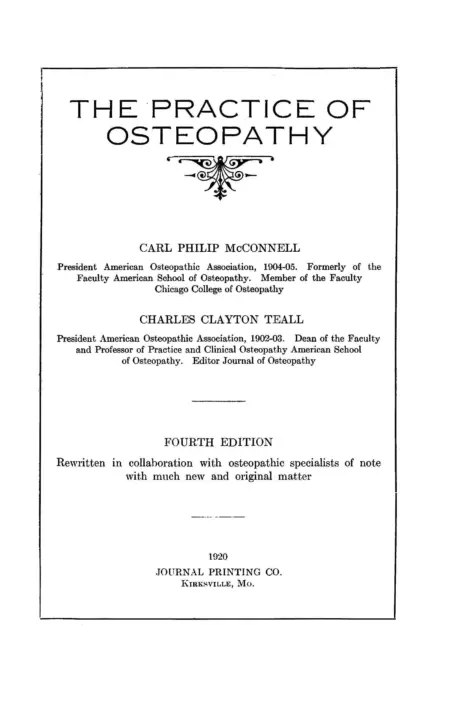
"The Practice of Osteopathy" by Carl Philip McConnell and Charles Clayton Teall is a scientific publication written in the early 20th century. The work serves as a comprehensive textbook on osteopathic medicine, providing both foundational theory and practical instruction for students and practitioners in the field. Its primary focus is the explanation, diagnosis, and treatment of disease according to osteopathic principles, particularly emphasizing anatomical causes and manual correction over pharmaceutical or primarily surgical interventions. The opening of this work introduces the philosophy and historical context of osteopathy, highlighting Andrew Taylor Still as the founder and his revolutionary departure from conventional medicine. The authors stress that osteopathy is defined by its unique approach to the causes of disease—specifically the identification and correction of structural lesions (malalignments and dysfunctions in bones, muscles, ligaments, and other tissues) believed to impede nerve and blood flow, thus leading to illness. The text details the types of lesions, their etiological significance, and their systemic impact, setting the stage for how osteopaths diagnose through meticulous physical examination, particularly of the spine and related musculoskeletal structures. The beginning also establishes the rigorous diagnostic and philosophical distinctions between osteopathy and other forms of manual therapy or drug-based medicine, positioning it as an integrative, holistic discipline grounded in anatomy, physiology, and respect for the body's natural healing capabilities.
Introduction adapted from the source catalogue; source summaries may be automatically generated.
Free to read · English · 323,560 words · No account needed
MAKE TIME FOR A GOOD BOOK
On by default. Untick to stop anonymous reading totals. Each page counts after 10 seconds in view. How this works.
Anonymous counting is on unless you have switched it off.
As has been stated, the lesions are usually found in the upper spinal region; still lesions are occasionally located in the lower spinal region, especially in female sufferers, when the pelvic organs are disturbed. The many mental symptoms, as inability to concentrate the mind, insomnia, vertigo, headache, etc., are best treated through the cervical region, with attention to the heart’s action and the excretory organs. Careful attention should be paid to the deep posterior muscles between the atlas and occipital bones.
=Rest= is very necessary. Changes of scene and occupation, attention to the surroundings, careful dieting, hydrotherapeutic measures, pleasant companions, relief from responsibility, bathing, etc., should receive careful attention and consideration by the osteopath. Set rules cannot be given. The details of treatment that should be adopted are dependent upon the individual case. Every well trained osteopath will be familiar with such measures.
Careful attention must be given to the secretions, excretory organs and the circulation. A study of each case will bring out the various irregularities that may exist.
When the nervous involvement is extensive, a “general treatment” may be given. Such a treatment would affect the entire nervous and muscular system, and tend to equalize disturbed nerve force. Bringing the muscular system into play and relaxing contracted muscles calls for more blood and nerve force, and consequently a nutritious diet.
The “rest cure,” as introduced by Weir Mitchell, may be employed to considerable advantage in many cases. Yeo says: “It is in certain cases of this disease that the ‘rest cure,’ devised by Weir Mitchell, has proved so remarkably successful. But there can be no sort of doubt that it has been applied far too indiscriminately, and that for this, as indeed for any special method of treatment, a careful selection of suitable cases is needful.” The diet should consist principally of milk at first, followed in a few days by soft boiled eggs, boiled rice, lamb chops, graham bread, stewed fruits and butter, and a little later by roast beef, vegetables and light puddings. Porter’s system of milk diet has proved effective in many cases. Tea, coffee and alcohol should be avoided.
During the entire course of the treatment, care should be taken to correct any lesion that may bear directly upon the cervical sympathetic, the solar plexus and the hypogastric plexus, as they are the great reflex centers of the body.
[119] A. O. A. Case Reports, Series IV.
[120] See A. O. A. Case Reports, Series II., III., IV., V.
[121] See A. O. A. Case Reports, Series I., III., V.
[122] Practice of Osteopathy.
[123] Manual of Medical Treatment.
[124] Cosmopolitan Osteopath, October, 1903.
[125] Journal of Osteopathy, January, 1904.
Acute Myelitis
Your reading position is saved on this browser. Take it to another device with a library code. Reading pages adapt to text, rather than matching a printed edition.
BEHIND THE BOOK
This eBook is for the use of anyone anywhere in the United States and most other parts of the world at no cost and with almost no restrictions whatsoever. You may copy it, give it away or re-use it under the terms of the Project Gutenberg License included with this eBook or online at www.gutenberg.org. If you are not located in the United States, you will have to check the laws of the country where you are located before using this eBook. Read the source licence.
The original source file, including credits and licence, is retained by this library. Request an original-format copy at no charge. Please include the book title and Project Gutenberg identifier #75696.
KEEP YOUR CURIOSITY GOING
Charles G. (Charles Griffith) Ross
Hannah Webster Foster

Emily Lawless
Edwin Hamlin Carr

Charles De Lano Hine
Andrew Ure