
The Writing of News A Handbook with Chapters on Newspaper Correspondence and Copy Reading
Charles G. (Charles Griffith) Ross
THE CLASSIC COLLECTION · 1920
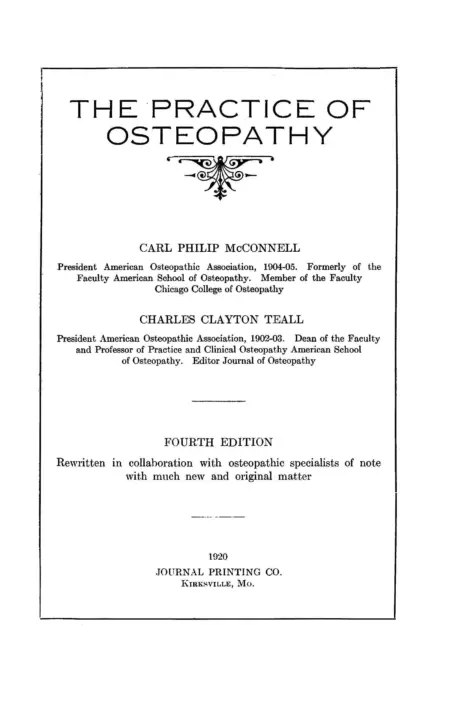
"The Practice of Osteopathy" by Carl Philip McConnell and Charles Clayton Teall is a scientific publication written in the early 20th century. The work serves as a comprehensive textbook on osteopathic medicine, providing both foundational theory and practical instruction for students and practitioners in the field. Its primary focus is the explanation, diagnosis, and treatment of disease according to osteopathic principles, particularly emphasizing anatomical causes and manual correction over pharmaceutical or primarily surgical interventions. The opening of this work introduces the philosophy and historical context of osteopathy, highlighting Andrew Taylor Still as the founder and his revolutionary departure from conventional medicine. The authors stress that osteopathy is defined by its unique approach to the causes of disease—specifically the identification and correction of structural lesions (malalignments and dysfunctions in bones, muscles, ligaments, and other tissues) believed to impede nerve and blood flow, thus leading to illness. The text details the types of lesions, their etiological significance, and their systemic impact, setting the stage for how osteopaths diagnose through meticulous physical examination, particularly of the spine and related musculoskeletal structures. The beginning also establishes the rigorous diagnostic and philosophical distinctions between osteopathy and other forms of manual therapy or drug-based medicine, positioning it as an integrative, holistic discipline grounded in anatomy, physiology, and respect for the body's natural healing capabilities.
Introduction adapted from the source catalogue; source summaries may be automatically generated.
Free to read · English · 323,560 words · No account needed
MAKE TIME FOR A GOOD BOOK
On by default. Untick to stop anonymous reading totals. Each page counts after 10 seconds in view. How this works.
Anonymous counting is on unless you have switched it off.
This is a rare, chronic disease, more often occurring in men, that is characterized by muscular and vascular weakness, digestive disturbances, and pigmentation. Tuberculosis of the adrenals has been the most constant lesion found. In others, syphilis and atrophy have been noted, while in a few the condition seemed to be functional. It should be remembered that it is possible that lesions elsewhere in the chromaffin system may be the cause in some cases, for all the chromaffin tissues secrete adrenalin.
It is quite likely that in most cases there is some constitutional defect of the chromaffin system which underlies a certain tendency to the disorder. Infections, injuries, physical and mental strains may lower resistance and predispose to the condition.
Osteopathic lesions of the splanchnics may congest the organs, or derange the secretions, or be of such a character that hemorrhages result, or fibrous changes follow, that would definitely incapacitate the cells and lower resistance.
=Pathologically=, the most common change is tuberculosis. Next in importance are atrophy and interstitial inflammation. Cancer of the organs has been noted in a few. The adrenal ganglia, the semilunar ganglia, and the solar plexus are often involved. The thyroid gland may be altered, which, when affected, is usually decreased in size. Brown atrophy of the heart is common.
=Symptoms.=—An insidious onset with muscular weakness, languor, and weak action of the heart are generally the first symptoms. Digestive derangements, such as nausea, hyperacidity, loss of appetite, may occur at the same time, or shortly succeed the general debility. Headache, insomnia, and depression frequently take place. Pigmentation, usually, shortly follows, though there are cases where it is only slightly noted. The disease is very chronic, of several years duration, with periods of intermission. Occasionally, a case runs a very rapid course.
The general weakness is most noticeable. There is low blood pressure. The derangement of the stomach and intestines is characteristic. And the pigmentation, which at first is light yellow later assumes a dark brown color. The pigmentation may be more or less general, but the axillæ, nipples, genitals, the palms of the hands, and the neck, waist or wherever the clothing presses upon the skin, are most pigmented. And pigmentation of the mucous membrane may be noted.
=Diagnosis.=—In typical cases, where there is esthenia, pigmentation, and gastro-intestinal disturbances, the diagnosis is not difficult. Where the clinical picture is incomplete, the diagnosis may be very difficult.
Pigmentation may occur in several other disorders, notably: in bronzed diabetes, abdominal malignancy, tuberculosis of the peritoneum, exophthalmic goiter, pellagra, marked intestinal stasis, stomach ulcer, pernicious anemia, certain skin diseases, etc., so great care has to be taken in atypical cases.
Your reading position is saved on this browser. Take it to another device with a library code. Reading pages adapt to text, rather than matching a printed edition.
BEHIND THE BOOK
This eBook is for the use of anyone anywhere in the United States and most other parts of the world at no cost and with almost no restrictions whatsoever. You may copy it, give it away or re-use it under the terms of the Project Gutenberg License included with this eBook or online at www.gutenberg.org. If you are not located in the United States, you will have to check the laws of the country where you are located before using this eBook. Read the source licence.
The original source file, including credits and licence, is retained by this library. Request an original-format copy at no charge. Please include the book title and Project Gutenberg identifier #75696.
KEEP YOUR CURIOSITY GOING
Charles G. (Charles Griffith) Ross
Hannah Webster Foster

Emily Lawless
Edwin Hamlin Carr

Charles De Lano Hine
Andrew Ure