
The Writing of News A Handbook with Chapters on Newspaper Correspondence and Copy Reading
Charles G. (Charles Griffith) Ross
THE CLASSIC COLLECTION · 1920
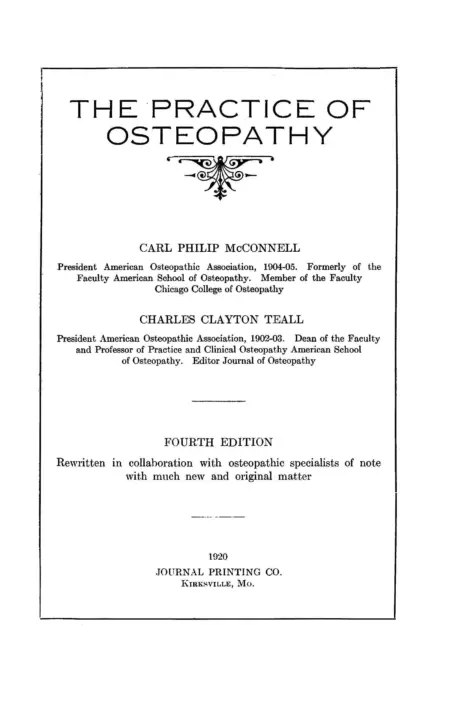
"The Practice of Osteopathy" by Carl Philip McConnell and Charles Clayton Teall is a scientific publication written in the early 20th century. The work serves as a comprehensive textbook on osteopathic medicine, providing both foundational theory and practical instruction for students and practitioners in the field. Its primary focus is the explanation, diagnosis, and treatment of disease according to osteopathic principles, particularly emphasizing anatomical causes and manual correction over pharmaceutical or primarily surgical interventions. The opening of this work introduces the philosophy and historical context of osteopathy, highlighting Andrew Taylor Still as the founder and his revolutionary departure from conventional medicine. The authors stress that osteopathy is defined by its unique approach to the causes of disease—specifically the identification and correction of structural lesions (malalignments and dysfunctions in bones, muscles, ligaments, and other tissues) believed to impede nerve and blood flow, thus leading to illness. The text details the types of lesions, their etiological significance, and their systemic impact, setting the stage for how osteopaths diagnose through meticulous physical examination, particularly of the spine and related musculoskeletal structures. The beginning also establishes the rigorous diagnostic and philosophical distinctions between osteopathy and other forms of manual therapy or drug-based medicine, positioning it as an integrative, holistic discipline grounded in anatomy, physiology, and respect for the body's natural healing capabilities.
Introduction adapted from the source catalogue; source summaries may be automatically generated.
Free to read · English · 323,560 words · No account needed
MAKE TIME FOR A GOOD BOOK
On by default. Untick to stop anonymous reading totals. Each page counts after 10 seconds in view. How this works.
Anonymous counting is on unless you have switched it off.
[103] Mackenzie, Diseases of the Heart; Lewis, Mechanism of the Heart Beat; Macleod, Physiology and Chemistry in Modern Medicine.
[104] Mackenzie, Oxford Medicine, Vol. II.
Arteriosclerosis
This is a thickening of the intima of the arteries, due to an inflammatory increase of the connective tissue, associated with more or less fatty degeneration and calcification.
Old age, alcohol, lead, gout, syphilis, rheumatism and other infections, laborious work, overeating, nephritis, and calcareous water tend to produce the condition. =Excessive eating= and =drinking= are common causes of both atheroma and chronic renal diseases and should always be regulated. Physical overwork, chronic intoxications, etc., produce hypertension of the vascular system and thus lead to changes of the vessel walls. A rigid spine is invariably found; this may be a causative factor in itself, or an associated condition. All of the above list of causes are important.
=Pathologically=, the arteries are thickened, tortuous and rigid. The intima may be occupied by rough, calcareous plates. In extreme cases the sub-endothelial tissue undergoes degeneration and breaks down in spots, forming “atheromatous abscesses.” The disease may be =circumscribed= or =diffuse=; in the latter there is a widespread distribution of the affection. Owing to the general effect, the heart, liver and kidneys receive less blood and tend to atrophy. Microscopically, there is found more or less fatty degeneration of the different coats, and an overgrowth of connective tissue in the intima. The arteries most frequently affected are the aorta and coronary.
=Symptoms.=—=Circulatory.=—There is a high tension pulse and accentuation of the second aortic sound. There is also dyspnea, severe pain in the left side, palpitation, pallor, and the left ventricle is hypertrophied. =Cerebral.=—Such symptoms as headache, tinnitus, aphasia, vertigo, syncopal or epileptiform attacks may be present. =Renal.=—There is an increase in the quantity of urine, which is of a pale color and low specific gravity; at times it is albuminous. The disturbance leads to atrophic nephritis. There may be gastro-intestinal symptoms, as constipation, pain, etc., due to hardening of the splanchnic vessels. In some cases the peripheral arteries become obliterated. The veins become hardened.
=Sequelæ= are cardiac dilatation, heart failure, paralysis, apoplexy, fatty heart, aneurism, contracted or senile kidney, angina pectoris, and in extreme cases, gangrene of the extremities.
=Diagnosis.=—The characteristic symptoms are hardened arteries, high tension of the pulse, hypertrophy of the left ventricle and accentuation of the aortic second sound. The average blood pressure is from 160 to 180 mm. of mercury, though it may be considerably higher.
=Prognosis.=—Many cases can be greatly benefited by osteopathic treatment, and at the incipiency the improvement is generally marked. It usually runs a very chronic course.
Your reading position is saved on this browser. Take it to another device with a library code. Reading pages adapt to text, rather than matching a printed edition.
BEHIND THE BOOK
This eBook is for the use of anyone anywhere in the United States and most other parts of the world at no cost and with almost no restrictions whatsoever. You may copy it, give it away or re-use it under the terms of the Project Gutenberg License included with this eBook or online at www.gutenberg.org. If you are not located in the United States, you will have to check the laws of the country where you are located before using this eBook. Read the source licence.
The original source file, including credits and licence, is retained by this library. Request an original-format copy at no charge. Please include the book title and Project Gutenberg identifier #75696.
KEEP YOUR CURIOSITY GOING
Charles G. (Charles Griffith) Ross
Hannah Webster Foster

Emily Lawless
Edwin Hamlin Carr

Charles De Lano Hine
Andrew Ure