
The Writing of News A Handbook with Chapters on Newspaper Correspondence and Copy Reading
Charles G. (Charles Griffith) Ross
THE CLASSIC COLLECTION · 1920
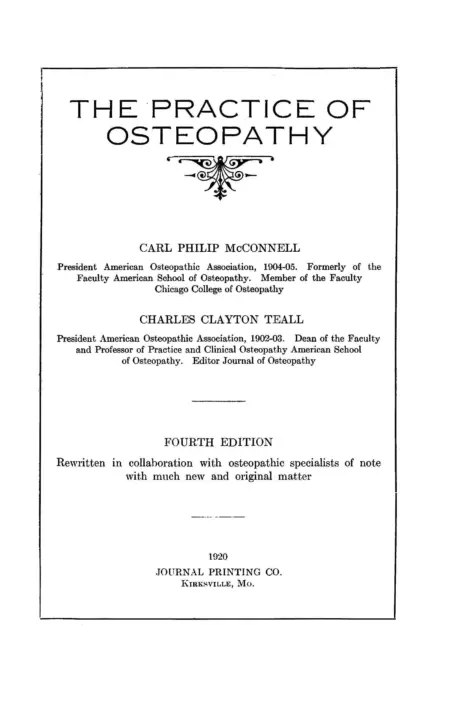
"The Practice of Osteopathy" by Carl Philip McConnell and Charles Clayton Teall is a scientific publication written in the early 20th century. The work serves as a comprehensive textbook on osteopathic medicine, providing both foundational theory and practical instruction for students and practitioners in the field. Its primary focus is the explanation, diagnosis, and treatment of disease according to osteopathic principles, particularly emphasizing anatomical causes and manual correction over pharmaceutical or primarily surgical interventions. The opening of this work introduces the philosophy and historical context of osteopathy, highlighting Andrew Taylor Still as the founder and his revolutionary departure from conventional medicine. The authors stress that osteopathy is defined by its unique approach to the causes of disease—specifically the identification and correction of structural lesions (malalignments and dysfunctions in bones, muscles, ligaments, and other tissues) believed to impede nerve and blood flow, thus leading to illness. The text details the types of lesions, their etiological significance, and their systemic impact, setting the stage for how osteopaths diagnose through meticulous physical examination, particularly of the spine and related musculoskeletal structures. The beginning also establishes the rigorous diagnostic and philosophical distinctions between osteopathy and other forms of manual therapy or drug-based medicine, positioning it as an integrative, holistic discipline grounded in anatomy, physiology, and respect for the body's natural healing capabilities.
Introduction adapted from the source catalogue; source summaries may be automatically generated.
Free to read · English · 323,560 words · No account needed
MAKE TIME FOR A GOOD BOOK
On by default. Untick to stop anonymous reading totals. Each page counts after 10 seconds in view. How this works.
Anonymous counting is on unless you have switched it off.
The large majority of =osteopathic lesions= are unquestionably found in the upper five dorsal vertebræ and the first five or six ribs on the left side, although cervical lesions, in many instances, play an important secondary, if not the primary, role. These maladjustments affect vasomotor nerves to the heart, that is, to coronary vessels, the dorsal and cervical sympathetics, the vagi, and the phrenic. We are unable to state just how these lesions disturb nerve conductivity; what present anatomy and physiology teach us does not fully explain. Osteopathic dissection must be the means to the end of the explanation. We have many clinical results, but not the physiological knowledge, as yet, to support it.
The dropping down of the first rib, as well as the clavicle, interferes with the large blood-vessels, especially the subclavian, and causes increased resistance of the heart’s action and probably a certain regurgitative effect. This regurgitative effect would also occur in cases of obstruction to the aorta by constriction of the diaphragm from dropping of the floating ribs. To what extent this latter feature has been demonstrated is not known. In valvular diseases it is practical to divide them for treatment into, =first=, where the =lesion= is =compensated=; =second=, where =compensation= is =incomplete=; =third=, where =compensation= is =lost=. With all cases we should give consideration to environment, temperament, habits, food, clothing, exercise, etc. Often these secondary matters are of vital importance, especially when compensation is failing. The Schott method of treatment may be of some avail; this treatment, which is composed of a series of resistant exercises, tends to lessen peripheral resistance, develop heart muscle, and remove heart stasis.
Speaking in general, =hypertrophy= and =dilatation= follow valvular leakage, as a =secondary effect=. It is a compensatory condition, and whenever compensation is failing, there is naturally a breaking down of the structural tissues of the heart; that is, the muscular hypertrophy is losing in integrity. Our primary aim, then, should be to keep up the compensation, which is represented in the hypertrophy, although there are cases that fail rapidly, especially in emphysema and cirrhosis of the lungs. Generally, in hypertrophy and dilatation, there is a =disproportion between= the =amount of work the heart has to do= and its =ability= to do it. One of two things has occurred; there is an increase in peripheral resistance or the volume of blood through the heart is abnormal in quantity[101]. Loudon[102] says: “The treatment of chronic disease of the heart requires a longer time, as a rule, than the same disorder in the acute stage. Some cases cannot be materially helped; a vast majority may be greatly benefited after a thorough trial; while more than we might at first suppose, can be entirely cured. We desire to quote at length from Hare relating to this point. He says: ‘A chronic structural change in the heart resulting from an acute process is not always synonymous with chronic heart disease. Thus, acute endocarditis occasions a variety of changes of the mitral and aortic valves which long may indicate their presence by their characteristic murmurs, and yet in time these may wholly disappear. That many such cases outgrow the valvular trouble, especially mitral lesions, there can now be no doubt. The majority, even of those in whom valvular murmurs permanently continue, do not have their health unfavorably affected for years, and in many of these, the duration of life is not appreciably shortened.’” This statement, from such an author, gives the osteopath great encouragement; for add to those above referred to, which recover in time from all valvular trouble, the many cases of valvular insufficiency, due to dilatation, owing to osteopathic lesions to the trophic nerves, and which may be cured by removing such lesions, we find that quite a percentage of cases are thus disposed of.
Your reading position is saved on this browser. Take it to another device with a library code. Reading pages adapt to text, rather than matching a printed edition.
BEHIND THE BOOK
This eBook is for the use of anyone anywhere in the United States and most other parts of the world at no cost and with almost no restrictions whatsoever. You may copy it, give it away or re-use it under the terms of the Project Gutenberg License included with this eBook or online at www.gutenberg.org. If you are not located in the United States, you will have to check the laws of the country where you are located before using this eBook. Read the source licence.
The original source file, including credits and licence, is retained by this library. Request an original-format copy at no charge. Please include the book title and Project Gutenberg identifier #75696.
KEEP YOUR CURIOSITY GOING
Charles G. (Charles Griffith) Ross
Hannah Webster Foster

Emily Lawless
Edwin Hamlin Carr

Charles De Lano Hine
Andrew Ure