
The Writing of News A Handbook with Chapters on Newspaper Correspondence and Copy Reading
Charles G. (Charles Griffith) Ross
THE CLASSIC COLLECTION · 1920
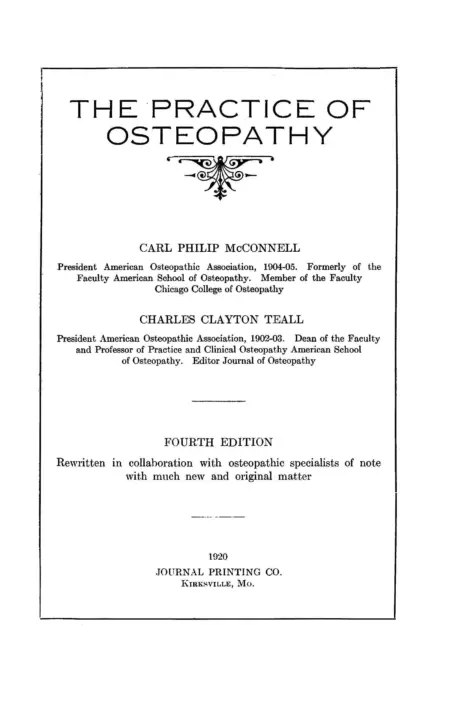
"The Practice of Osteopathy" by Carl Philip McConnell and Charles Clayton Teall is a scientific publication written in the early 20th century. The work serves as a comprehensive textbook on osteopathic medicine, providing both foundational theory and practical instruction for students and practitioners in the field. Its primary focus is the explanation, diagnosis, and treatment of disease according to osteopathic principles, particularly emphasizing anatomical causes and manual correction over pharmaceutical or primarily surgical interventions. The opening of this work introduces the philosophy and historical context of osteopathy, highlighting Andrew Taylor Still as the founder and his revolutionary departure from conventional medicine. The authors stress that osteopathy is defined by its unique approach to the causes of disease—specifically the identification and correction of structural lesions (malalignments and dysfunctions in bones, muscles, ligaments, and other tissues) believed to impede nerve and blood flow, thus leading to illness. The text details the types of lesions, their etiological significance, and their systemic impact, setting the stage for how osteopaths diagnose through meticulous physical examination, particularly of the spine and related musculoskeletal structures. The beginning also establishes the rigorous diagnostic and philosophical distinctions between osteopathy and other forms of manual therapy or drug-based medicine, positioning it as an integrative, holistic discipline grounded in anatomy, physiology, and respect for the body's natural healing capabilities.
Introduction adapted from the source catalogue; source summaries may be automatically generated.
Free to read · English · 323,560 words · No account needed
MAKE TIME FOR A GOOD BOOK
On by default. Untick to stop anonymous reading totals. Each page counts after 10 seconds in view. How this works.
Anonymous counting is on unless you have switched it off.
[74] See special article, Prolapsed Organs, Part I.
[75] The student will receive many helpful suggestions by reading Macleod, Physiology and Biochemistry in Modern Medicine; Cannon, The Mechanical Factors of Digestion; Carlson, The Control of Hunger in Health and Disease; Gaskell, The Involuntary Nervous System; Pottenger, Symptoms of Nervous Disease.
[76] Von Noorden, Colitis, 1904.
[77] See Philosophy and Mechanical Principles of Osteopathy, p. 190.
[78] There are several possible suggestions. (1) Developmental (See Mayo, Relation of the Development of the Gastro-intestinal Tract to Abdominal Surgery. Jour. A. M. A. Feb. 7, 1920). (2) Owing to the appendix, cecum, ascending colon, duodenum, and biliary tract being frequently disordered. (3) Imbalance of muscular tension, owing to the muscles of the right side being often the better developed. Muscular lesions and lymphatic involvement of the cervical region seem to occur oftener on the right side than on the left.
[79] Journal of Osteopathy, May, 1900.
[80] For points on enema, see treatment under Intestinal Obstruction.
[81] Diseases of the Intestines, Vol. I, p. 240.
[82] The Lancet, (London,) Oct., 1904.
[83] Philosophy of Osteopathy, p. 226.
[84] Medical Record.
[85] The Vermiform Appendix and Its Diseases, p. 711.
[86] Dr. Chauvel, 1902.
[87] Rose and Carless.
[88] Clinical Osteopathy.
[89] Journal of the American Osteopathic Association, Dec, 1902.
[90] Journal of American Osteopathic Association, March, 1905.
[91] Journal of American Osteopathic Association, March, 1905.
Acute Catarrhal Laryngitis
=Definition.=—An acute, catarrhal inflammation of the mucous membrane of the larynx. This may be ushered in as an independent disease or it may be associated with inflammation of the upper respiratory passages.
=Osteopathic Etiology= and =Pathology.=—One of the principal causes of acute catarrhal laryngitis is exposure to cold and dampness, which contracts the muscles of the neck region, especially about the larynx. Lesions in the upper and middle cervical vertebræ are important predisposing causes. Occasionally the first rib becomes luxated, causing a greater or less congestion of the laryngeal mucous membrane by contracting the lower antero-lateral muscles of the neck, and affecting lymphatic drainage. Improper placing of tone, as well as too constant use of the voice in speaking and singing, are common causes. Inhalation of irritating gases or dust, and mechanical injuries to the larynx are occasional causes. The disease may be associated with certain infectious diseases, as measles, diphtheria, influenza and whooping cough.
Your reading position is saved on this browser. Take it to another device with a library code. Reading pages adapt to text, rather than matching a printed edition.
BEHIND THE BOOK
This eBook is for the use of anyone anywhere in the United States and most other parts of the world at no cost and with almost no restrictions whatsoever. You may copy it, give it away or re-use it under the terms of the Project Gutenberg License included with this eBook or online at www.gutenberg.org. If you are not located in the United States, you will have to check the laws of the country where you are located before using this eBook. Read the source licence.
The original source file, including credits and licence, is retained by this library. Request an original-format copy at no charge. Please include the book title and Project Gutenberg identifier #75696.
KEEP YOUR CURIOSITY GOING
Charles G. (Charles Griffith) Ross
Hannah Webster Foster

Emily Lawless
Edwin Hamlin Carr

Charles De Lano Hine
Andrew Ure