
The Writing of News A Handbook with Chapters on Newspaper Correspondence and Copy Reading
Charles G. (Charles Griffith) Ross
THE CLASSIC COLLECTION · 1920
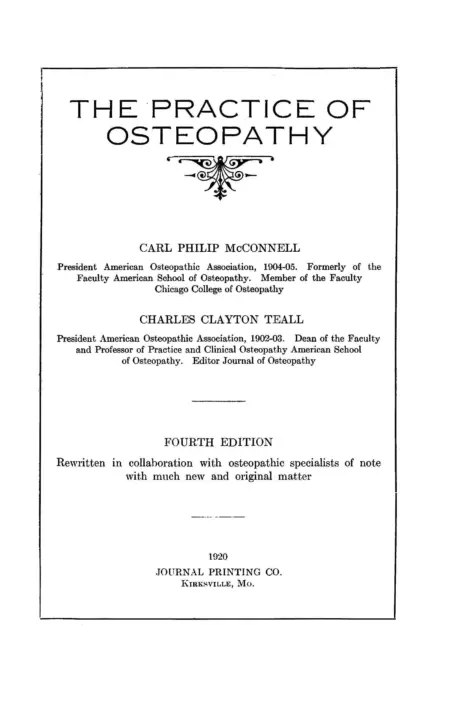
"The Practice of Osteopathy" by Carl Philip McConnell and Charles Clayton Teall is a scientific publication written in the early 20th century. The work serves as a comprehensive textbook on osteopathic medicine, providing both foundational theory and practical instruction for students and practitioners in the field. Its primary focus is the explanation, diagnosis, and treatment of disease according to osteopathic principles, particularly emphasizing anatomical causes and manual correction over pharmaceutical or primarily surgical interventions. The opening of this work introduces the philosophy and historical context of osteopathy, highlighting Andrew Taylor Still as the founder and his revolutionary departure from conventional medicine. The authors stress that osteopathy is defined by its unique approach to the causes of disease—specifically the identification and correction of structural lesions (malalignments and dysfunctions in bones, muscles, ligaments, and other tissues) believed to impede nerve and blood flow, thus leading to illness. The text details the types of lesions, their etiological significance, and their systemic impact, setting the stage for how osteopaths diagnose through meticulous physical examination, particularly of the spine and related musculoskeletal structures. The beginning also establishes the rigorous diagnostic and philosophical distinctions between osteopathy and other forms of manual therapy or drug-based medicine, positioning it as an integrative, holistic discipline grounded in anatomy, physiology, and respect for the body's natural healing capabilities.
Introduction adapted from the source catalogue; source summaries may be automatically generated.
Free to read · English · 323,560 words · No account needed
MAKE TIME FOR A GOOD BOOK
On by default. Untick to stop anonymous reading totals. Each page counts after 10 seconds in view. How this works.
Anonymous counting is on unless you have switched it off.
To be able to diagnose accurately and intelligently the pelvic region requires nearly as much skill as in examining the cervical region. The pelvic bones are liable to many subdislocations, especially in the female. However, it should be remembered that many apparent innominate lesions are secondary or compensatory changes due to lumbar lesions. The pelvis as a whole may be tipped anteriorly or posteriorly upon the spinal column. It also may be twisted or rotated laterally upon the spinal column. The most common lesions are subluxations of an innominatum forward, backward, upward, or downward, or various combinations of these displacements, such as a tipping forward and downward of an innominatum, or a tipping backward and upward, but these combinations do not always exist in the manner given. As a rule when the ilium is anterior, the ischium posterior, then the innominatum as a whole is downward; when the ilium is posterior, the ischium anterior, then the innominatum as a whole is upward. This is only a rule, there are exceptions to it; for in some few cases when the ilium is anterior, the ischium posterior, the innominatum may be higher, and when the ilium is posterior and the ischium anterior the innominatum may be lower.
To be able to diagnose such derangements will require skill and practice; still there are symptoms and signs that are characteristic of such disorders. In examining the pelvic bones have the patient flat upon the back at first. Be sure he is flat upon the back for a very slight variation may make considerable difference in the relation of the pelvic bones, one to the other, so far as the diagnostic points are concerned. Then go to the feet of the patient and grasp the ankles firmly, rotate laterally both legs, first to one side and then to the other, as well as pull and push both limbs slightly, and then bring the heels together directly in the median fine of the body and compare the length of the limbs at the heels. If there is any disorder whatever in one innominatum, and the thigh muscles have been relaxed thoroughly by the preceding movements and the heels are brought together in the median line of the body, a difference in the length of the limbs will readily be observed at the inner malleoli or the heels. For if the ilium is forward the ischium must be backward and as a rule the innominatum is thrown downward, thus causing an apparent lengthening of the limb which will be noticed by comparing the heels; if the ilium is backward the ischium must be forward and as a rule the innominatum is then upward, causing an apparent shortening of the limb on the affected side. A very slight variation in the pelvis will make considerable difference in an apparent lengthening or shortening of the limbs. Such conditions are generally met with several times a day by osteopaths. The object of the lateral rotary movement and the pushing and pulling of the limbs is to make sure that all the thigh muscles are thoroughly relaxed, for it is a very easy matter for contracted muscles in one thigh to produce an apparent shortening of the limb. Also be very careful in comparing the length of the two limbs at the heels where they come together that they are exactly in the median line of the body, for if they should be to one side or the other, however slightly, there would be an apparent lengthening of the outer limb as compared with the limb near the median line. While the patient remains flat upon the back it is a good plan to compare the anterior spines of the ilia. It may be readily noticed that one is higher or more depressed than the other, which will help to confirm the diagnosis. It is a good plan also to have the patient sit up squarely upon the table and compare the crests and posterior spines of the ilia; thus one may be seen to be higher than the other. Then, also, note the angles of the feet when patient is supine; an everted foot usually means that the limb is shorter due to the tilted pelvis; the opposite is commonly true when the foot is inverted. However, this is not an absolute rule. Care should be taken in differential diagnosis of possible old fracture of leg, of infantile paralysis, of asymmetry, etc.
Your reading position is saved on this browser. Take it to another device with a library code. Reading pages adapt to text, rather than matching a printed edition.
BEHIND THE BOOK
This eBook is for the use of anyone anywhere in the United States and most other parts of the world at no cost and with almost no restrictions whatsoever. You may copy it, give it away or re-use it under the terms of the Project Gutenberg License included with this eBook or online at www.gutenberg.org. If you are not located in the United States, you will have to check the laws of the country where you are located before using this eBook. Read the source licence.
The original source file, including credits and licence, is retained by this library. Request an original-format copy at no charge. Please include the book title and Project Gutenberg identifier #75696.
KEEP YOUR CURIOSITY GOING
Charles G. (Charles Griffith) Ross
Hannah Webster Foster

Emily Lawless
Edwin Hamlin Carr

Charles De Lano Hine
Andrew Ure