
The Writing of News A Handbook with Chapters on Newspaper Correspondence and Copy Reading
Charles G. (Charles Griffith) Ross
THE CLASSIC COLLECTION · 1920
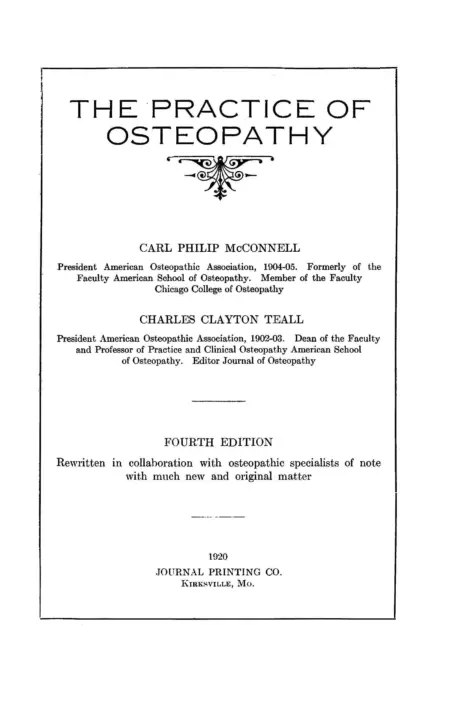
"The Practice of Osteopathy" by Carl Philip McConnell and Charles Clayton Teall is a scientific publication written in the early 20th century. The work serves as a comprehensive textbook on osteopathic medicine, providing both foundational theory and practical instruction for students and practitioners in the field. Its primary focus is the explanation, diagnosis, and treatment of disease according to osteopathic principles, particularly emphasizing anatomical causes and manual correction over pharmaceutical or primarily surgical interventions. The opening of this work introduces the philosophy and historical context of osteopathy, highlighting Andrew Taylor Still as the founder and his revolutionary departure from conventional medicine. The authors stress that osteopathy is defined by its unique approach to the causes of disease—specifically the identification and correction of structural lesions (malalignments and dysfunctions in bones, muscles, ligaments, and other tissues) believed to impede nerve and blood flow, thus leading to illness. The text details the types of lesions, their etiological significance, and their systemic impact, setting the stage for how osteopaths diagnose through meticulous physical examination, particularly of the spine and related musculoskeletal structures. The beginning also establishes the rigorous diagnostic and philosophical distinctions between osteopathy and other forms of manual therapy or drug-based medicine, positioning it as an integrative, holistic discipline grounded in anatomy, physiology, and respect for the body's natural healing capabilities.
Introduction adapted from the source catalogue; source summaries may be automatically generated.
Free to read · English · 323,560 words · No account needed
MAKE TIME FOR A GOOD BOOK
On by default. Untick to stop anonymous reading totals. Each page counts after 10 seconds in view. How this works.
Anonymous counting is on unless you have switched it off.
After the rupture of large pustules the centers frequently dry and sink in, often in the shape of the Maltese cross. This is most typically seen on the backs of the hands and is pathognomonic. Toward the end of the third week the scabs fall, leaving red glistening pits which disappear or change into deep white striated scars. The hair falls but may grow again. The diagnosis is not certain until the eruption is seen. In the smallpox without eruption the diagnosis must be made from the history of exposure, the presence of an epidemic, fever, lumbar and head pains, delirium, and possibly the initial rash.
Mistakes in diagnosis may be made even by smallpox experts, but attention to the history, somatic findings and the course of the disease, rather than to the eruption, will prevent disastrous results. Always isolate any and all suspected patients.
Varicella Compared with Variola
Vaccination and smallpox never Smallpox may closely resemble prevent. chicken pox; especially mild cases.
AGE—usually before puberty, may Usually after puberty (many occur in adults. exceptions.)
Initial stage practically absent. Initial stage severe, even in mild cases.
TEMPERATURE,—no remission on Typical remission and secondary onset of rash. fever.
White cells normal or decreased. Leukocytosis.
Prodromal rash very exceptional. Prodromal rash quite frequent.
Vesicles in crops. Vesicles never in crops.
Vesicles rarely shotty. Vesicles, following macules, are hard and shotty.
RASH EVOLUTION,— RASH EVOLUTION,— Very rapid, vesicles on first or Much slower, vesicles on seventh second day. day.
Eruption is universal, successive Development progresses downward, crops, most abundant on back, face first, then wrists, begins on body, less on face, trunk, arms and lastly legs. Less scalp, hands and feet. on trunk.
Vesicle is superficial and fluid Fluid pearl-colored and NOT transparent. transparent. Thicker covering.
Halo (areola) usually absent. Areola is marked.
Involution is quite rapid. Involution is slow.
The =Secondary Toxic or Septic Rash= appears during the stage of decrustation, sometimes with a mild fever. It may be either scarlatiniform, morbilliform, or hemorrhagic. The skin immediately surrounding the drying pocks is often exempt leaving an anemic halo. The rash lasts about three days and fades or desquamates. With the development of the skin eruption, an exanthem appears upon the mucous membranes of the body cavities, developing into ulcers. This may develop before the dermal rash and be of diagnostic importance.
Forms or Varieties
I. Variola Vera. { a. Discrete.
{ b. Confluent.
{ c. Purpura variolosa II. Variola Hemorrhagica. { (black smallpox) { d. Variola hemorrhagica pustulosa.
III. Varioloid. e. Smallpox modified by vaccination or partial immunity.
=Discrete Variola Vera.=—Incubation symptomless and averages 12 days.
Your reading position is saved on this browser. Take it to another device with a library code. Reading pages adapt to text, rather than matching a printed edition.
BEHIND THE BOOK
This eBook is for the use of anyone anywhere in the United States and most other parts of the world at no cost and with almost no restrictions whatsoever. You may copy it, give it away or re-use it under the terms of the Project Gutenberg License included with this eBook or online at www.gutenberg.org. If you are not located in the United States, you will have to check the laws of the country where you are located before using this eBook. Read the source licence.
The original source file, including credits and licence, is retained by this library. Request an original-format copy at no charge. Please include the book title and Project Gutenberg identifier #75696.
KEEP YOUR CURIOSITY GOING
Charles G. (Charles Griffith) Ross
Hannah Webster Foster

Emily Lawless
Edwin Hamlin Carr

Charles De Lano Hine
Andrew Ure