
The Writing of News A Handbook with Chapters on Newspaper Correspondence and Copy Reading
Charles G. (Charles Griffith) Ross
THE CLASSIC COLLECTION · 1920
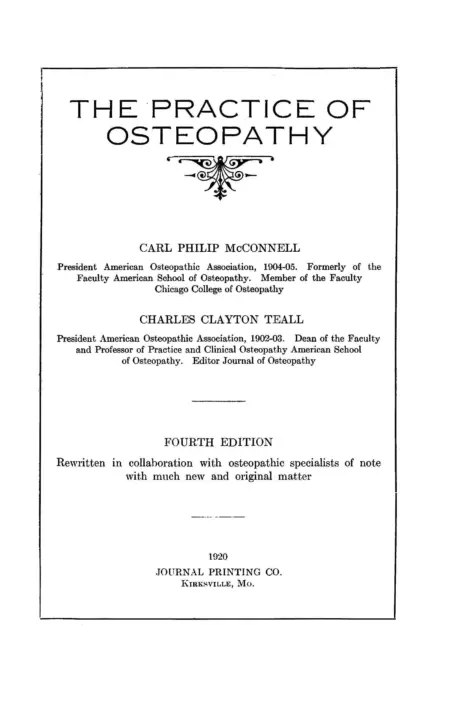
"The Practice of Osteopathy" by Carl Philip McConnell and Charles Clayton Teall is a scientific publication written in the early 20th century. The work serves as a comprehensive textbook on osteopathic medicine, providing both foundational theory and practical instruction for students and practitioners in the field. Its primary focus is the explanation, diagnosis, and treatment of disease according to osteopathic principles, particularly emphasizing anatomical causes and manual correction over pharmaceutical or primarily surgical interventions. The opening of this work introduces the philosophy and historical context of osteopathy, highlighting Andrew Taylor Still as the founder and his revolutionary departure from conventional medicine. The authors stress that osteopathy is defined by its unique approach to the causes of disease—specifically the identification and correction of structural lesions (malalignments and dysfunctions in bones, muscles, ligaments, and other tissues) believed to impede nerve and blood flow, thus leading to illness. The text details the types of lesions, their etiological significance, and their systemic impact, setting the stage for how osteopaths diagnose through meticulous physical examination, particularly of the spine and related musculoskeletal structures. The beginning also establishes the rigorous diagnostic and philosophical distinctions between osteopathy and other forms of manual therapy or drug-based medicine, positioning it as an integrative, holistic discipline grounded in anatomy, physiology, and respect for the body's natural healing capabilities.
Introduction adapted from the source catalogue; source summaries may be automatically generated.
Free to read · English · 323,560 words · No account needed
MAKE TIME FOR A GOOD BOOK
On by default. Untick to stop anonymous reading totals. Each page counts after 10 seconds in view. How this works.
Anonymous counting is on unless you have switched it off.
I have used this same treatment, especially in nervous cases, and hold it in high esteem. I have the patient put a bath robe on backwards so that the arms and legs are well protected but the spine easily accessible. The hot packs can then be used and covered over and the patient not exposed.
R. H. Nuckles maintains that lung and ear trouble will not follow influenza where osteopathic treatment has been given to adjust the cervical and upper dorsal circulation.
H. A. Price: “We have kept particularly in mind, first, the nerve, blood and lymphatic supply to the lungs; second, the circulation to the spine (meaning spinal cord); third, the internal secretory functions and to the general excretion.”
Ralph M. Crane says: “A great deal of my work is among the Italians. It was necessary to give quick specific treatment that I might do as much good as possible to the greatest number. I did not treat them as often as I would like to, and because of this fact I learned that osteopathy got control of the ‘flu’ immediately, the first treatment sufficing to start them on the road to recovery; in fact, many of them got no more than one treatment.”
[51] Hinckle—The Scientific Basis of Osteopathy.
[52] Clinical Osteopathy.
[53] Journal of Osteopathy—Prize Article July, 1906.
[54] A. O. A. Case Reports—Series I.
[55] E. Link, Diphtheria—The Bulletin, 1905.
[56] A. M. Willard, Membranous Croup—Journal of Osteopathy, March, 1904
[57] See Dr. Still—Philosophy and Mechanical Principles of Osteopathy.
[58] Journal of Osteopathy, October 1905.
[59] Journal of Osteopathy, October 1905.
[60] Journal of the American Osteopathic Association, March 1906.
[61] Journal American Osteopathic Association, December 1904.
[62] Journal American Osteopathic Association, May, 1905.
[63] Journal American Osteopathic Association, May, 1905.
[64] Rewritten from article in Osteopathic Physician, June 1919.
[65] This treatment was described by Henry M. Stovel, in The Osteopathic Physician of January 1917.
[66] O. P. June 1919.
By EDGAR S. COMSTOCK
In the consideration of these diseases, it is well to bear in mind that lowered resistance is the primary condition that has made the infections possible, and that lowered resistance implies an imbalance of or obstruction to the vital fluids and forces of the body, thereby interfering with the functional activity of the body’s normal protective mechanism.
Your reading position is saved on this browser. Take it to another device with a library code. Reading pages adapt to text, rather than matching a printed edition.
BEHIND THE BOOK
This eBook is for the use of anyone anywhere in the United States and most other parts of the world at no cost and with almost no restrictions whatsoever. You may copy it, give it away or re-use it under the terms of the Project Gutenberg License included with this eBook or online at www.gutenberg.org. If you are not located in the United States, you will have to check the laws of the country where you are located before using this eBook. Read the source licence.
The original source file, including credits and licence, is retained by this library. Request an original-format copy at no charge. Please include the book title and Project Gutenberg identifier #75696.
KEEP YOUR CURIOSITY GOING
Charles G. (Charles Griffith) Ross
Hannah Webster Foster

Emily Lawless
Edwin Hamlin Carr

Charles De Lano Hine
Andrew Ure