
The Writing of News A Handbook with Chapters on Newspaper Correspondence and Copy Reading
Charles G. (Charles Griffith) Ross
THE CLASSIC COLLECTION · 1920
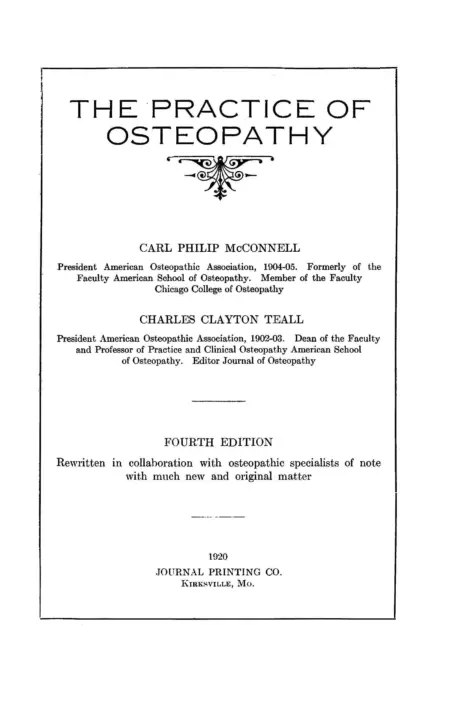
"The Practice of Osteopathy" by Carl Philip McConnell and Charles Clayton Teall is a scientific publication written in the early 20th century. The work serves as a comprehensive textbook on osteopathic medicine, providing both foundational theory and practical instruction for students and practitioners in the field. Its primary focus is the explanation, diagnosis, and treatment of disease according to osteopathic principles, particularly emphasizing anatomical causes and manual correction over pharmaceutical or primarily surgical interventions. The opening of this work introduces the philosophy and historical context of osteopathy, highlighting Andrew Taylor Still as the founder and his revolutionary departure from conventional medicine. The authors stress that osteopathy is defined by its unique approach to the causes of disease—specifically the identification and correction of structural lesions (malalignments and dysfunctions in bones, muscles, ligaments, and other tissues) believed to impede nerve and blood flow, thus leading to illness. The text details the types of lesions, their etiological significance, and their systemic impact, setting the stage for how osteopaths diagnose through meticulous physical examination, particularly of the spine and related musculoskeletal structures. The beginning also establishes the rigorous diagnostic and philosophical distinctions between osteopathy and other forms of manual therapy or drug-based medicine, positioning it as an integrative, holistic discipline grounded in anatomy, physiology, and respect for the body's natural healing capabilities.
Introduction adapted from the source catalogue; source summaries may be automatically generated.
Free to read · English · 323,560 words · No account needed
MAKE TIME FOR A GOOD BOOK
On by default. Untick to stop anonymous reading totals. Each page counts after 10 seconds in view. How this works.
Anonymous counting is on unless you have switched it off.
=Symptomatology.=—Although each variety of Dementia Praecox has special symptoms characteristic of the type there are certain symptoms common to all forms, and these will be first considered. All the functions of the mind in the course of time tend to become disturbed and to be weakened, but in the earlier stages we find marked differences as regards the disturbance of different functions, thus memory and orientation in most cases seem good; on the contrary, attention and association of ideas somewhat poor. Emotional life is almost always markedly affected, even in the beginning. Very commonly at first there is depression to be followed later by expansive feelings and then by apathy in general. The will power is altered early and the conduct is apt to be peculiar. The judgment becomes impaired. All of these symptoms mentioned are deviations from the normal in the patient and therefore presuppose that the patient was formerly normal. This should sharply differentiate the praecox group from cases of defective development (imbecility or idiocy). In this latter group there is an arrest of development of the mind, whereas in praecox there is a loss in a developed intellect. We see a young patient, for example, who has lost interest in things about him, neglects his work at school or at home, remains alone for long periods of time and seems unwilling to mingle with other people. He gives the impression of one depressed and worried about something he is trying to solve, perhaps he mutters to himself or gives way to unprovoked laughter, he may refuse to eat, or to talk unless questioned and may even then not answer. When he does talk it will be discovered that he knows perfectly well where he is, and knows people around him and understands everything that is going on; his memory will be found good, he can usually recall past incidents and tell what he has been doing recently. As the condition progresses, however, while the patient may still for a long time retain fair orientation and memory for past events, his accumulation of recent ideas will be found poor, so that he will recall them with difficulty. We notice that it is difficult to get the patient’s attention and concentration seems to be impossible, he may answer a direct question, but immediately seems to be occupied with other thoughts and it takes some little effort to gain his attention again. If he continues to talk it is plain that the association of ideas is poor, giving rise to disconnected phrases which usually come forth sluggishly and without show of emotion. Dissociation of ideas occurs; that is, different ideas expressed may practically contradict themselves. For example, the patient may say he is a king and yet when asked to sweep the floor will do it perhaps without hesitation, not considering that is hardly the kind of work a king would do. The dissociation is also marked in the contradiction found between the content of the thought and its associated emotional idea, for example, the patient may speak of a near relative as dying recently, yet with no show of emotion, even with a meaningless laugh. This dissociation may ultimately result in complete incoherence, in which no sense can be found whatsoever in his speech. Emotional indifference is noticeable early and sluggishness of reactions to stimuli, even failure of such reactions; the patient will neglect himself, stay away from meals, express no desires and make no complaints. In the earlier stages, however, the patient who may have been for some little time apathetic, suddenly without apparent cause becomes angry, noisy, and possibly violent and destructive, again gradually relapsing into his quiet, apathetic state. The thought content is commonly associated with delusions, that is obviously false ideas, but which the patient is unable to perceive are false. Delusions of persecution are most common, the patient feeling in a dim way that everything is not right; and in attempting to explain to himself the reason, often attributes causes to people or forces outside of himself, and on account of the feeling of bodily discomfort, also by reason of the depression, he explains the external forces as unfriendly to himself. Hallucinations may be present and furnish the material around which the delusions form; on the other hand hallucinations may result from the delusions. By hallucination is meant a false sense perception, as the patient may state he sees someone before him who is not there, or that he hears voices from individuals who are not around him; he may also complain of receiving electrical shocks, or wireless messages, which he usually states come from his persecutors. Symptoms of this nature form a good example of the so-called split personality, or “schizophrenia,” wherein certain idea complexes are split off from the main personality and address themselves to the main portion, the patient attributing these noises (voices), sensations (visceral and tactile), tastes and smells to an objective rather than a subjective source and subsequently forming delusions. However, unless we are dealing with the paranoid form the delusions are fragmentary, transient and absurd.
Your reading position is saved on this browser. Take it to another device with a library code. Reading pages adapt to text, rather than matching a printed edition.
BEHIND THE BOOK
This eBook is for the use of anyone anywhere in the United States and most other parts of the world at no cost and with almost no restrictions whatsoever. You may copy it, give it away or re-use it under the terms of the Project Gutenberg License included with this eBook or online at www.gutenberg.org. If you are not located in the United States, you will have to check the laws of the country where you are located before using this eBook. Read the source licence.
The original source file, including credits and licence, is retained by this library. Request an original-format copy at no charge. Please include the book title and Project Gutenberg identifier #75696.
KEEP YOUR CURIOSITY GOING
Charles G. (Charles Griffith) Ross
Hannah Webster Foster

Emily Lawless
Edwin Hamlin Carr

Charles De Lano Hine
Andrew Ure