
The Writing of News A Handbook with Chapters on Newspaper Correspondence and Copy Reading
Charles G. (Charles Griffith) Ross
THE CLASSIC COLLECTION · 1920
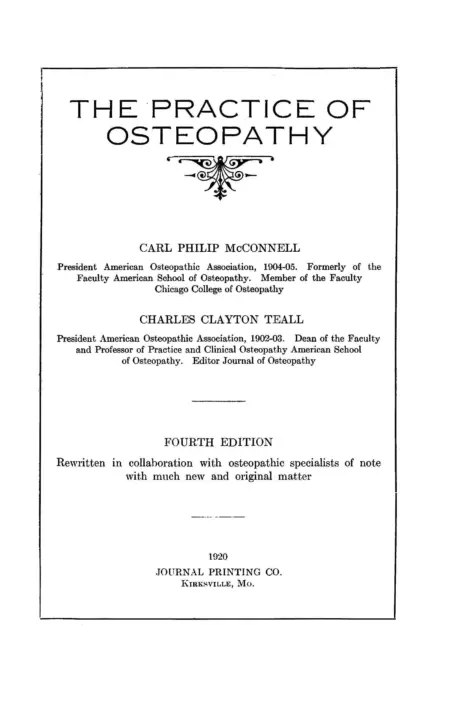
"The Practice of Osteopathy" by Carl Philip McConnell and Charles Clayton Teall is a scientific publication written in the early 20th century. The work serves as a comprehensive textbook on osteopathic medicine, providing both foundational theory and practical instruction for students and practitioners in the field. Its primary focus is the explanation, diagnosis, and treatment of disease according to osteopathic principles, particularly emphasizing anatomical causes and manual correction over pharmaceutical or primarily surgical interventions. The opening of this work introduces the philosophy and historical context of osteopathy, highlighting Andrew Taylor Still as the founder and his revolutionary departure from conventional medicine. The authors stress that osteopathy is defined by its unique approach to the causes of disease—specifically the identification and correction of structural lesions (malalignments and dysfunctions in bones, muscles, ligaments, and other tissues) believed to impede nerve and blood flow, thus leading to illness. The text details the types of lesions, their etiological significance, and their systemic impact, setting the stage for how osteopaths diagnose through meticulous physical examination, particularly of the spine and related musculoskeletal structures. The beginning also establishes the rigorous diagnostic and philosophical distinctions between osteopathy and other forms of manual therapy or drug-based medicine, positioning it as an integrative, holistic discipline grounded in anatomy, physiology, and respect for the body's natural healing capabilities.
Introduction adapted from the source catalogue; source summaries may be automatically generated.
Free to read · English · 323,560 words · No account needed
MAKE TIME FOR A GOOD BOOK
On by default. Untick to stop anonymous reading totals. Each page counts after 10 seconds in view. How this works.
Anonymous counting is on unless you have switched it off.
“Glenard’s whole theory of splanchnoptosia is based on the relaxation of the suspensory ligaments of the intestines, especially that of the transverse colon; and Stiller, the discoverer of the floating tenth rib, says that splanchnoptosia is a descent of the atonic stomach, of the colon (especially the transverse portion), of the kidney (the right or both kidneys), exceptionally of the liver or the spleen. A descent which has been developed mostly in tender age, in consequence of general relaxation, especially of the peritoneal suspensory ligaments in individuals with congenital general dyspeptic neurasthenia, tender muscles, lean habit, and slender bone structure, manifested in a higher degree by a floating tenth rib.” Stiller observed that when there is a floating tenth rib there is a displaced stomach and a floating kidney, although it is not found in every case, but never missing if the case is pronounced. The tenth ribs in these cases have only a ligamentous fastening and are as freely movable as the eleventh and twelfth.
That abdominal relaxation plays a very important part in many diseases of the abdominal and pelvic organs, in cardiac and pulmonary affections, disturbs the circulation in the legs, and is the source of many reflex affections no one can gainsay. The osteopath should always pay particular attention to tonic condition of the abdominal viscera, for relaxation of the suspensory tissues and walls, and atony and sluggishness of the organs are frequently paramount etiological factors. And the osteopathic treatment is the remedy par excellence.
[45] Rose and Kemp—Atonia Gastricia.
[46] Rose and Kemp—Atonia Gastricia.
Various skin diseases have been treated osteopathically with varying success. So much depends upon the cause of the disturbance and its removal, in skin diseases, that the cure does not rest so much with the mere treatment, as with the necessary skill in locating the disturbing factor. One has to be continually on his guard to locate external irritations and disorders of the digestive and genito-urinary tracts. A great deal depends upon the avoidance of external influences; eating nutritious food and having an unobstructed circulation. The leading object of osteopathic treatment is to free the circulation and thus promote a healthy and unobstructed flow of blood; in no other class of diseases is this more essential than in skin diseases. After the removal of cutaneous irritations and the correction of internal disorders, the cure of the case depends upon the removal of constrictions to the cutaneous blood-vessels. The osteopath corrects the lesions found, relaxes the muscles thoroughly and stimulates the circulation to the parts involved, and promotes a healthy activity of all the excretory organs. When the upper part of the body is affected, lesions are generally found at the atlas and axis, and when the lower part of the body is affected, lesions at the fifth lumbar are of common occurrence, although lesions may be located at various points corresponding with the seat of disturbance. The constant use of hot baths will be found a helpful measure in many skin diseases. But use of soap must be considered as too much alkali will neutralize the oil of the skin and cause undue dryness, but bran may be substituted to advantage. Cleanliness is necessary but the result sought is, also, flushing the cutaneous vessels. There are many cases where a specific vertebral lesion will cause, through the peripheral nerves, a cutaneous irritation with intense itching and discomfort. This, in turn, produces an exudate with or without a crust and a condition results which is not amenable to any local or constitutional treatment but an adjustment of the lesion will in most cases bring immediate relief. Application of this principle will aid greatly in treatment of any skin disease. In no disturbance of health is it more necessary to find the cause than in skin disease and once found to apply specific treatment.
Your reading position is saved on this browser. Take it to another device with a library code. Reading pages adapt to text, rather than matching a printed edition.
BEHIND THE BOOK
This eBook is for the use of anyone anywhere in the United States and most other parts of the world at no cost and with almost no restrictions whatsoever. You may copy it, give it away or re-use it under the terms of the Project Gutenberg License included with this eBook or online at www.gutenberg.org. If you are not located in the United States, you will have to check the laws of the country where you are located before using this eBook. Read the source licence.
The original source file, including credits and licence, is retained by this library. Request an original-format copy at no charge. Please include the book title and Project Gutenberg identifier #75696.
KEEP YOUR CURIOSITY GOING
Charles G. (Charles Griffith) Ross
Hannah Webster Foster

Emily Lawless
Edwin Hamlin Carr

Charles De Lano Hine
Andrew Ure