
The Writing of News A Handbook with Chapters on Newspaper Correspondence and Copy Reading
Charles G. (Charles Griffith) Ross
THE CLASSIC COLLECTION · 1920
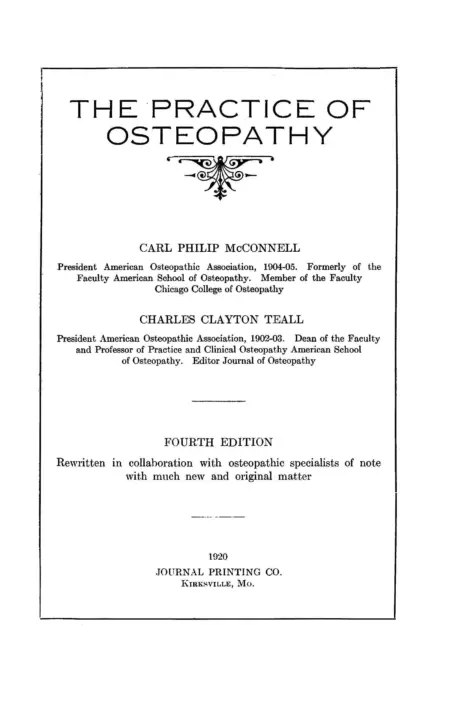
"The Practice of Osteopathy" by Carl Philip McConnell and Charles Clayton Teall is a scientific publication written in the early 20th century. The work serves as a comprehensive textbook on osteopathic medicine, providing both foundational theory and practical instruction for students and practitioners in the field. Its primary focus is the explanation, diagnosis, and treatment of disease according to osteopathic principles, particularly emphasizing anatomical causes and manual correction over pharmaceutical or primarily surgical interventions. The opening of this work introduces the philosophy and historical context of osteopathy, highlighting Andrew Taylor Still as the founder and his revolutionary departure from conventional medicine. The authors stress that osteopathy is defined by its unique approach to the causes of disease—specifically the identification and correction of structural lesions (malalignments and dysfunctions in bones, muscles, ligaments, and other tissues) believed to impede nerve and blood flow, thus leading to illness. The text details the types of lesions, their etiological significance, and their systemic impact, setting the stage for how osteopaths diagnose through meticulous physical examination, particularly of the spine and related musculoskeletal structures. The beginning also establishes the rigorous diagnostic and philosophical distinctions between osteopathy and other forms of manual therapy or drug-based medicine, positioning it as an integrative, holistic discipline grounded in anatomy, physiology, and respect for the body's natural healing capabilities.
Introduction adapted from the source catalogue; source summaries may be automatically generated.
Free to read · English · 323,560 words · No account needed
MAKE TIME FOR A GOOD BOOK
On by default. Untick to stop anonymous reading totals. Each page counts after 10 seconds in view. How this works.
Anonymous counting is on unless you have switched it off.
=Bursitis.=—This is a condition in which the subdeltoid bursa is involved or where there have been a number of bursæ formed from overuse of the joint. One authority reports as many as twenty-five in a shoulder. There may be, also, tenosynovitis primarily or from extension. These conditions may not be easily diagnosed at first.
=Brachial neuritis= (chronic) beginning with or without an acute attack is usually from a cervical lesion involving the brachial plexus but most frequently it is the 5th and 6th cervicals at the origin of the circumflex nerve. From this the deltoid is particularly affected and its contraction leads to pressure on the nerve and subsequent partial or complete paralysis. Brachial neuritis is found in an increasing number of osteopathic practicians and is the result of overwork of the arms and to strain of the upper dorsals and lower cervicals. There are contractions of structures about the joint constantly limiting motion and pain when a strain is put on them.
Many methods for the treatment of the conditions described have been employed, all involving the same principle but none of them systematized. C. H. Spencer has worked out a technique which, while originally intended for bursitis, has been found well adapted to all conditions described. It gives a stretching of all structures and gradually breaks up adhesions, both in the joint and in the tendon sheaths, so there is no resulting irritation which could easily result if suddenly done. His technique is[43]:
“First: The patient on the side, the affected shoulder up; operator facing the patient, places one hand on the top of the shoulder, does nothing more than fixing it; with the hand grasping the forearm above the wrist, push the elbow backward, the arm parallel to and almost in contact with the body, then pull forward in the same plane. Second: Elevate the elbow with the hands of the operator in the same position as before, carry the elbow in as wide a circle as possible. Third: With the hands still in the same position, extend the forearm with traction; carry it as high in front of the patient as possible. The foregoing are designed to relieve the congestion about the shoulder, bring pressure to bear on the subdeltoid bursa and moderate traction on the supraspinatus, infraspinatus, subscapularis, teres minor and major, latissimus dorsi and the tendon of the biceps. These manipulations will be all that is possible in the more aggravated cases for some considerable period of time. As the tenderness subsides, the second group may be cautiously started, the hands in the same position as above noted, with the arm extended as nearly as possible at right angles with the body, carry the arm in as wide a circle as the pain will permit. Again, with the arm flexed at the elbow, one hand of the operator on the point of the shoulder and the forearm of the patient across the forearm of the operator, the other hand of the operator resting on the point of the patient’s elbow, push down toward the middle line of the body and carry the elbow toward the head. Then flex the arm and place the back of the hand behind the patient, flexing the shoulder in front with one hand grasping the point of the elbow and pull forward. This group of movements accomplishes with greater force the same ends obtained in the previous, and the first in this group is the most effective in overcoming swelling of the subdeltoid bursa. Direct manipulation of the muscle masses and this bursa is desirable from the first.” It will be noticed in all these movements that the joint is protected by one hand of the operator while the other is grasping the arm of the patient. This is desirable as it makes the technique absolutely safe. An additional treatment will be found very effective, especially where the deltoid is involved. With the patient on the well side, facing the operator, locate the quadrilateral space which is bounded by the subscapularis above, the teres minor below and the long head of the biceps medially and the surgical neck of the humerus externally, and the circumflex nerve can be easily palpated along with the artery. If these structures are stretched and the deltoid lifted from the shoulder it will be found to free the action of both nerve and artery, one supplying the joint with nutrition and the other innervating it.
Your reading position is saved on this browser. Take it to another device with a library code. Reading pages adapt to text, rather than matching a printed edition.
BEHIND THE BOOK
This eBook is for the use of anyone anywhere in the United States and most other parts of the world at no cost and with almost no restrictions whatsoever. You may copy it, give it away or re-use it under the terms of the Project Gutenberg License included with this eBook or online at www.gutenberg.org. If you are not located in the United States, you will have to check the laws of the country where you are located before using this eBook. Read the source licence.
The original source file, including credits and licence, is retained by this library. Request an original-format copy at no charge. Please include the book title and Project Gutenberg identifier #75696.
KEEP YOUR CURIOSITY GOING
Charles G. (Charles Griffith) Ross
Hannah Webster Foster

Emily Lawless
Edwin Hamlin Carr

Charles De Lano Hine
Andrew Ure