THE CLASSIC COLLECTION✦Young India An interpretation and a history of the nationalist movement from withinCLASSIC FREE BOOKS
Young India An interpretation and a history of the nationalist movement from within
Lala Lajpat Rai
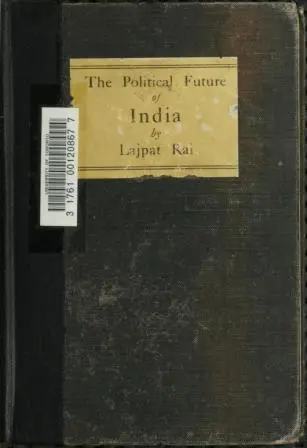
THE CLASSIC COLLECTION · 1919
"The Political Future of India" by Lala Lajpat Rai is a political treatise written in the early 20th century. The book discusses the prospects for India's governance and self-determination during the aftermath of World War I, as well as the intricate relationship between India and British colonial rule. It aims to outline the political aspirations of the Indian people, against a backdrop of widespread discontent with British governance and the desire for autonomy and reform. The opening of the book sets the stage for a discussion on the significant contributions of India during the war, emphasizing the sacrifices made by its people, which were largely ignored by the British authorities. Lajpat Rai highlights the growing dissatisfaction among Indians with the existing political structure, calling for responsible governance and the introduction of reforms to empower local populations. He argues that both the British government and the Indian populace must take steps toward establishing a more representative and accountable system, as movements for autonomy and greater self-determination begin to take shape. This opening establishes a sense of urgency and raises critical questions about the future political landscape of India.
Introduction adapted from the source catalogue; source summaries may be automatically generated.
Free to read · English · 74,592 words · No account needed
MAKE TIME FOR A GOOD BOOK
On by default. Untick to stop anonymous reading totals. Each page counts after 10 seconds in view. How this works.
Anonymous counting is on unless you have switched it off.
On the subject of the cost of administration it will be instructive to compare the annual salaries allowed to the highest public servants in India, the United States and Japan.
The President of the United States, who ranks with the great royalties of the world in position, gets a salary of $75,000, without any other allowance. The Prime Minister of Japan gets 12,000 yen, or $6000. The Viceroy and the Governor General of India gets 250,000 rupees, or $83,000, besides a very large amount in the shape of various allowances. The Cabinet Ministers of the United States get a salary of $12,000 each, the Japanese 8000 yen or $4000, and the Members of the Viceroy's Council, $26,700 each.
In the whole Federal Government of the United States there are only three offices which carry a salary of more than $8000. They are:
The President of the General Navy Board $13,500 Solicitor General $10,000 Assistant Solicitor General $9,000
All the other salaries range from $2100 to $8000. In the State Department all offices, including those of the secretaries, carry salaries of from $2100 to $5000. In the Treasury Department the Treasurer gets $8000, three other officers having $6000 each. All the remaining officials get from $2500 to $5000. In the War Department there are only two offices which have a salary of $8000 attached: that of Chief of Staff and that of Quartermaster General. The rest get from $2000 to $6000. In the Navy Department, besides the President of the General Board mentioned above, the President of the Naval Examination Board gets $8000 and so does the Commandant of the Marine Corps. All the rest get from $6000 downwards. In the Department of Agriculture there is only one office carrying a salary of $6000. All the rest get from $5000 downwards. The Chief of the Weather Bureau, an expert, gets $6000. In the Commerce Department four experts get $6000 each, the rest from $5000 downwards.
In Japan the officials of the Imperial Household have salaries ranging from $2750 to $4000. Officials of the Higher Civil Service get from $1850 to $2100 a year; the Vice-Minister of State, $2500; Chief of the Legislative Bureau, $2500; the Chief Secretary of the Cabinet, $2500; and the Inspector General of the Metropolitan Police, $2500; President of the Administrative Litigation Court, $3000; President of the Railway Board, $3750; President of the Privy Council, $3000; Vice-President of the Privy Council, $2750, and so on.
When we come to India we find that the President of the Railway Board gets from $20,000 to $24,000 and that two other members of the Railway Board get $16,000. Secretaries in the Army, Public Works, and Legislative Departments get $14,000. Secretaries in Finance, Foreign, Home, Revenue, Agriculture, Commerce and Industry Departments get $16,000. The Secretary in the Education Department gets $12,000; Joint Secretary, $10,000; Controller and Auditor-General, $14,000; Accountant-General, from $9,000 to $11,000; Commissioner of Salt Revenue, $10,000; Director of Post and Telegraph, from $12,000 to $14,000.
Your reading position is saved on this browser. Take it to another device with a library code. Reading pages adapt to text, rather than matching a printed edition.
Lala Lajpat Rai
Lala Lajpat Rai
BEHIND THE BOOK
This eBook is for the use of anyone anywhere in the United States and most other parts of the world at no cost and with almost no restrictions whatsoever. You may copy it, give it away or re-use it under the terms of the Project Gutenberg License included with this eBook or online at www.gutenberg.org. If you are not located in the United States, you will have to check the laws of the country where you are located before using this eBook. Read the source licence.
The original source file, including credits and licence, is retained by this library. Request an original-format copy at no charge. Please include the book title and Project Gutenberg identifier #41819.
KEEP YOUR CURIOSITY GOING
Cécile Tormay

Moritz Busch
John L. Ransom
Frances Wright
Cécile Tormay

Mabel Potter Daggett