THE CLASSIC COLLECTION✦Young India An interpretation and a history of the nationalist movement from withinCLASSIC FREE BOOKS
Young India An interpretation and a history of the nationalist movement from within
Lala Lajpat Rai
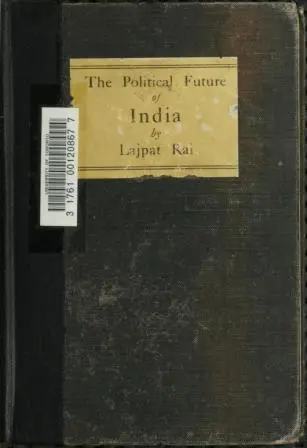
THE CLASSIC COLLECTION · 1919
"The Political Future of India" by Lala Lajpat Rai is a political treatise written in the early 20th century. The book discusses the prospects for India's governance and self-determination during the aftermath of World War I, as well as the intricate relationship between India and British colonial rule. It aims to outline the political aspirations of the Indian people, against a backdrop of widespread discontent with British governance and the desire for autonomy and reform. The opening of the book sets the stage for a discussion on the significant contributions of India during the war, emphasizing the sacrifices made by its people, which were largely ignored by the British authorities. Lajpat Rai highlights the growing dissatisfaction among Indians with the existing political structure, calling for responsible governance and the introduction of reforms to empower local populations. He argues that both the British government and the Indian populace must take steps toward establishing a more representative and accountable system, as movements for autonomy and greater self-determination begin to take shape. This opening establishes a sense of urgency and raises critical questions about the future political landscape of India.
Introduction adapted from the source catalogue; source summaries may be automatically generated.
Free to read · English · 74,592 words · No account needed
MAKE TIME FOR A GOOD BOOK
On by default. Untick to stop anonymous reading totals. Each page counts after 10 seconds in view. How this works.
Anonymous counting is on unless you have switched it off.
Now, whatever may be said about the necessity of maintaining a strong European element in the departments which require initiative, courage, resourcefulness and all the other qualities of "leadership" they are certainly not a sine qua non for efficiency in secretarial work. We can see no reason why, then, the different secretariats of the Government of India cannot be manned mainly, if not exclusively, by Indians. Their salaries need not be the same as those now paid to the Europeans engaged in these departments. May we ask if there is any country on earth where such high salaries are paid to the secretarial heads of departments as in India? Secretaries to the Government of India in the Army and Public works and Legislative departments receive 42,000 Rs. each ($14,000, or £2800 a year); Secretaries to the Government of India in the Finance, Foreign, Home, Revenue, Agriculture, Commerce and Industry and Education departments get Rs. 48,000 a year each ($16,000 or £3,200); Educational Commissioners from 30 to 36,000 Rs. ($10,000 to $12,000).
These secretarial officers are not of Cabinet rank. Besides their salaries they get various allowances, and the purchasing value of the rupee in India is much higher than that of 33 cents in the United States or of 16d. in the United Kingdom, the exchange equivalents of an Indian rupee. The same remarks may be made about Provincial Secretariats. We do not ignore the fact that a European who cuts himself away from his country and people for the best part of his life cannot be expected to give his time, energy and talents for the compensation he might accept in his own country, nor that, if the best kind of European talent is desired for India, the compensation must be sufficiently attractive to tempt competent men to accept it. In Paragraphs 318 to 322, both inclusive, the Secretary of India and the Viceroy have put forward a forceful plea for improvement in the conditions of the European Services by (a) increment in their salaries, (b) expediting promotions, and (c) grant of additional allowances, and also by bettering the prospects of pensions and leave. We are afraid the only way to obtain the concurrence of Indian public opinion in this matter, if at all, is by restricting the number of posts which must be held by Europeans. The cadre of services to which the rule of percentage is to apply must be reduced in strength, and if Europeans are required for posts outside these they should be employed for short periods and from an open market. For example, it seems inconceivable to us why professional men like doctors, engineers and professors should be recruited for permanent service. Nor is there any reason why the recruitment should be confined to persons of British domicile. The Government of India must be run on business principles. With the exception, perhaps, of the higher posts in the I. C. S. and in the Army, all other offices should be filled by taking the supply on the best available terms for short periods and from open market. By reducing the number of higher posts to which the rule of percentage should apply, the Government would be reducing the number of Indian officers who could claim the same salary as is given to their European colleagues. In our humble opinion, the latter claim is purely sentimental, and the best interests of the country require that the administration should be as economical as is compatible with efficiency. The strength of the different permanent services should be reduced as much as possible and the deficiency made up by the appointment of the best persons available at the price which the administration may be willing to pay, whether such persons be European, Indian or American. Take the Indian Educational Service, for example. The members start with a salary of 6000 Rs. a year ($2000 or £400) and rise to about 24,000 Rs. a year ($8000 or £1600). In the United States, to the best of our knowledge, few professors, if any, get a salary higher than $7000 or 21,000 Rs. a year. High-class graduates of Harvard, Yale and Columbia start their tutorial careers at $2000 to $3000 a year, many at $1500 a year. These men would refuse to go to India on a similar salary. On the other hand, if a salary of $4000 to $10,000 were offered to a select few, the services of the men at the top might be had for a short period. Surely, in the best interests of education, it is much better to get first-class men on high salaries for short periods than permanently to have third-class men beginning with smaller salaries and eventually rising to high salaries and ensuring to themselves life long pensions. What is true of the Educational Service is similarly, if not equally, true of the Medical, the Engineering and other scientific services. At the present time we have men in these technical services who received their education about twenty or twenty-five years ago and whose knowledge of their respective sciences is antiquated and rusty. Apothecaries, absolutely innocent of any knowledge of modern surgery, are often appointed to the post of Civil Surgeons. No sensible Indian desires that the present incumbents should be interfered with, except where it is possible to retire them under the terms of their service. All engagements should be met honorably. What is needed is that in future there should be a radical departure in the practice of appointing non-Indians to responsible posts in India. We do not want to deprive ourselves of the privilege of being guided in our work by European talent, nor should we grudge them adequate compensation for their services. What we object to is (1) racial discrimination; (2) excessive power being vested in individual officers; (3) the employment of more than a necessary number of persons of alien origin; (4) the crippling of the country's resources by burdening its finances with unnecessary pensions and leave allowances; (5) the continuance of men on service lists long after their usefulness has disappeared; (6) the filling of appointments by jobbery, as is now done in the so-called non-regulation provinces. We, in the Punjab, have been "blessed" by the rule of several generations of Smiths, Harrys and Jones. Those who failed to pass the I. C. S. joined the cadre by the back door and received the same emoluments as those who entered it by competition. It is they who block the avenues of promotions and not the sons of the soil.
Your reading position is saved on this browser. Take it to another device with a library code. Reading pages adapt to text, rather than matching a printed edition.
Lala Lajpat Rai

Lala Lajpat Rai
BEHIND THE BOOK
This eBook is for the use of anyone anywhere in the United States and most other parts of the world at no cost and with almost no restrictions whatsoever. You may copy it, give it away or re-use it under the terms of the Project Gutenberg License included with this eBook or online at www.gutenberg.org. If you are not located in the United States, you will have to check the laws of the country where you are located before using this eBook. Read the source licence.
The original source file, including credits and licence, is retained by this library. Request an original-format copy at no charge. Please include the book title and Project Gutenberg identifier #41819.
KEEP YOUR CURIOSITY GOING
Cécile Tormay

Moritz Busch
John L. Ransom
Frances Wright
Cécile Tormay

Mabel Potter Daggett