
Love Letters of a Violinist, and Other Poems
Eric Mackay
THE CLASSIC COLLECTION · 1800
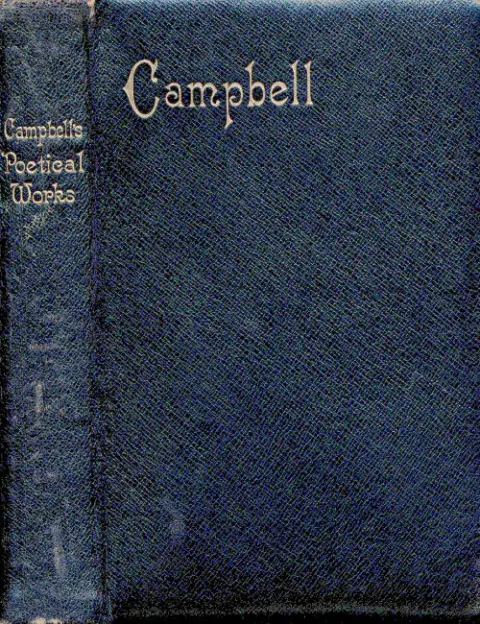
"The Poetical Works of Thomas Campbell" by Thomas Campbell is a collection of poetry written in the early 19th century. This work features a variety of poems, notable among them "The Pleasures of Hope," "Gertrude of Wyoming," and other lyrical pieces, reflecting on themes of love, nature, human experience, and social commentary. The collection highlights Campbell's concern for humanity, hope, and the human condition, often expressed through vivid imagery and emotive language. At the start of the collection, the prefatory memoir provides insight into Campbell's early life, education, and the influences that shaped his poetic career. It outlines his beginnings in Glasgow, his formative experiences with nature, and his introduction to literature. The opening poem, "The Pleasures of Hope," establishes the central theme of the importance of hope in navigating life's hardships. It juxtaposes the beauty of distant landscapes with the promise of love and humanity's potential for growth, addressing personal and political struggles while celebrating the enduring power of aspiration. Through poignant reflections, the early verses set the tone for the collection, evoking a sense of nostalgia and yearning for connection in both love and life.
Introduction adapted from the source catalogue; source summaries may be automatically generated.
Free to read · English · 69,844 words · No account needed
MAKE TIME FOR A GOOD BOOK
On by default. Untick to stop anonymous reading totals. Each page counts after 10 seconds in view. How this works.
Anonymous counting is on unless you have switched it off.
“Sir Knight,” the Abbot interposed,
“This case your ear demands;”
And the crone cried, with a cross enclosed
In both her trembling hands:—
“Remember, each his sentence waits;
And he that shall rebut
Sweet Mercy’s suit, on him the gates
Of Mercy shall be shut.
“You wedded, undispensed by Church,
Your cousin Jane in Spring;
In Autumn, when you went to search
For churchmen’s pardoning,
“Her house denounced your marriage-band,
Betrothed her to De Grey,
And the ring you put upon her hand
Was wrenched by force away.
“Then wept your Jane upon my neck,
Crying, ‘Help me, nurse, to flee
To my Howel Bann’s Glamorgan hills;’
But word arrived—ah me!—
“You were not there; and ’twas their threat,
By foul means or by fair,
To-morrow morning was to set
The seal on her despair.
“I had a son, a sea-boy, in
A ship at Hartland Bay;
By his aid from her cruel kin
I bore my bird away.
“To Scotland from the Devon’s
Green myrtle shores we fled;
And the Hand that sent the ravens
To Elijah, gave us bread.
“She wrote you by my son, but he
From England sent us word
You had gone into some far countrie,
In grief and gloom he heard.
“For they that wronged you, to elude
Your wrath, defamed my child;
And you—ay, blush, Sir, as you should—
Believed, and were beguiled.
“To die but at your feet, she vowed
To roam the world; and we
Would both have sped and begged our bread,
But so it might not be.
“For when the snow-storm beat our roof,
She bore a boy, Sir Bann,
Who grew as fair your likeness proof
As child e’er grew like man.
“’Twas smiling on that babe one morn
While heath bloomed on the moor,
Her beauty struck young Lord Kinghorn
As he hunted past our door.
‘She shunned him, but he raved of Jane,
And roused his mother’s pride;
Who came to us in high disdain,—
‘And where’s the face,’ she cried,
“‘Has witched my boy to wish for one
So wretched for his wife?—
Dost love thy husband? Know, my son
Has sworn to seek his life.’
“Her anger sore dismayed us,
For our mite was wearing scant,
And unless that dame would aid us,
There was none to aid our want.
“So I told her, weeping bitterly,
What all our woes had been;
And though she was a stern ladie,
The tears stood in her een.
“And she housed us both, when, cheerfully,
My child to her had sworn,
That even if made a widow, she
Would never wed Kinghorn.”——
Your reading position is saved on this browser. Take it to another device with a library code. Reading pages adapt to text, rather than matching a printed edition.
BEHIND THE BOOK
This eBook is for the use of anyone anywhere in the United States and most other parts of the world at no cost and with almost no restrictions whatsoever. You may copy it, give it away or re-use it under the terms of the Project Gutenberg License included with this eBook or online at www.gutenberg.org. If you are not located in the United States, you will have to check the laws of the country where you are located before using this eBook. Read the source licence.
The original source file, including credits and licence, is retained by this library. Request an original-format copy at no charge. Please include the book title and Project Gutenberg identifier #59788.
KEEP YOUR CURIOSITY GOING
Eric Mackay
Edmund Gosse
Sophia Margaretta Hensley
Gilbert Parker
George MacDonald

Elizabeth Bibesco