
Love Letters of a Violinist, and Other Poems
Eric Mackay
THE CLASSIC COLLECTION · 1800
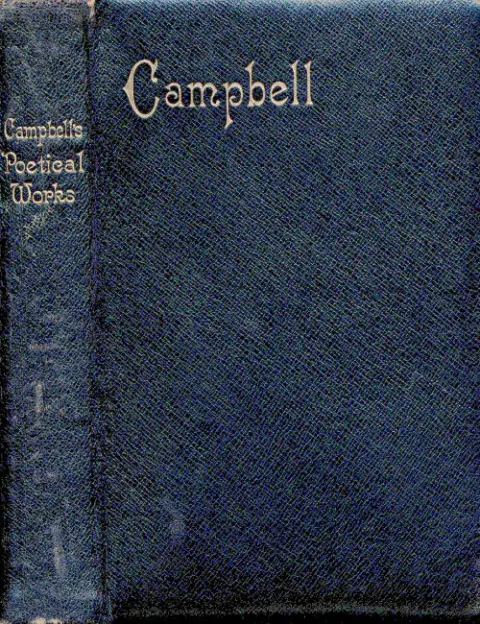
"The Poetical Works of Thomas Campbell" by Thomas Campbell is a collection of poetry written in the early 19th century. This work features a variety of poems, notable among them "The Pleasures of Hope," "Gertrude of Wyoming," and other lyrical pieces, reflecting on themes of love, nature, human experience, and social commentary. The collection highlights Campbell's concern for humanity, hope, and the human condition, often expressed through vivid imagery and emotive language. At the start of the collection, the prefatory memoir provides insight into Campbell's early life, education, and the influences that shaped his poetic career. It outlines his beginnings in Glasgow, his formative experiences with nature, and his introduction to literature. The opening poem, "The Pleasures of Hope," establishes the central theme of the importance of hope in navigating life's hardships. It juxtaposes the beauty of distant landscapes with the promise of love and humanity's potential for growth, addressing personal and political struggles while celebrating the enduring power of aspiration. Through poignant reflections, the early verses set the tone for the collection, evoking a sense of nostalgia and yearning for connection in both love and life.
Introduction adapted from the source catalogue; source summaries may be automatically generated.
Free to read · English · 69,844 words · No account needed
MAKE TIME FOR A GOOD BOOK
On by default. Untick to stop anonymous reading totals. Each page counts after 10 seconds in view. How this works.
Anonymous counting is on unless you have switched it off.
A long adieu! but where shall fly
Thy widow all forlorn,
When every mean and cruel eye
Regards my woe with scorn?
Yes! they will mock thy widow’s tears,
And hate thine orphan boy;
Alas! his infant beauty wears
The form of Gilderoy.
Then will I seek the dreary mound
That wraps thy mouldering clay,
And weep and linger on the ground,
And sigh my heart away.
The ordeal’s fatal trumpet sounded,
And sad pale Adelgitha came,
When forth a valiant champion bounded,
And slew the slanderer of her fame.
She wept, delivered from her danger;
But when he knelt to claim her glove—
“Seek not,” she cried, “oh! gallant stranger,
For hapless Adelgitha’s love.
“For he is in a foreign far land
Whose arm should now have set me free
And I must wear the willow garland
For him that’s dead, or false to me.”
“Nay! say not that his faith is tainted!”
He raised his vizor—At the sight
She fell into his arms and fainted;
It was indeed her own true knight!
’Tis not the loss of love’s assurance,
It is not doubting what thou art,
But ’tis the too, too long endurance
Of absence, that afflicts my heart.
The fondest thoughts two hearts can cherish,
When each is lonely doomed to weep,
Are fruits on desert isles that perish,
Or riches buried in the deep.
What though, untouched by jealous madness,
Our bosom’s peace may fall to wreck;
The undoubting heart, that breaks with sadness,
Is but more slowly doomed to break.
Absence! is not the soul torn by it
From more than light, or life, or breath?
’Tis Lethe’s gloom, but not its quiet,—
The pain without the peace of death!
The Ritter Bann from Hungary
Came back renowned in arms,
But scorning jousts of chivalry
And love and ladies’ charms.
While other knights held revels, he
Was wrapt in thoughts of gloom,
And in Vienna’s hostelrie
Slow paced his lonely room.
There entered one whose face he knew,—
Whose voice, he was aware,
He oft at mass had listened to,
In the holy house of prayer.
’Twas the Abbot of St. James’s monks,
A fresh and fair old man:
His reverend air arrested even
The gloomy Ritter Bann.
But seeing with him an ancient dame
Come clad in Scotch attire,
The Ritter’s colour went and came,
And loud he spoke in ire.
“Ha! nurse of her that was my bane,
Name not her name to me;
I wish it blotted from my brain:
Art poor?—take alms, and flee.”
Your reading position is saved on this browser. Take it to another device with a library code. Reading pages adapt to text, rather than matching a printed edition.
BEHIND THE BOOK
This eBook is for the use of anyone anywhere in the United States and most other parts of the world at no cost and with almost no restrictions whatsoever. You may copy it, give it away or re-use it under the terms of the Project Gutenberg License included with this eBook or online at www.gutenberg.org. If you are not located in the United States, you will have to check the laws of the country where you are located before using this eBook. Read the source licence.
The original source file, including credits and licence, is retained by this library. Request an original-format copy at no charge. Please include the book title and Project Gutenberg identifier #59788.
KEEP YOUR CURIOSITY GOING
Eric Mackay
Edmund Gosse
Sophia Margaretta Hensley
Gilbert Parker
George MacDonald

Elizabeth Bibesco