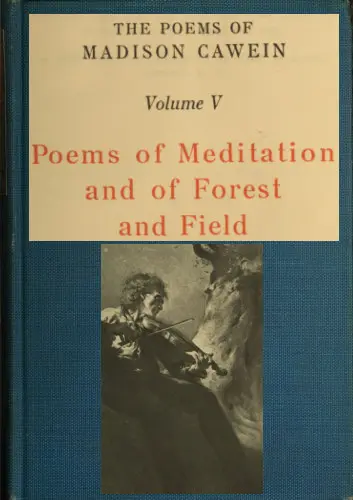
The Poems of Madison Cawein, Volume 5 (of 5) Poems of meditation and of forest and field
Madison Julius Cawein
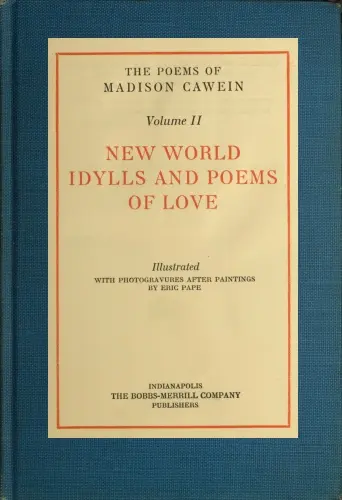
THE CLASSIC COLLECTION · 1887
"The Poems of Madison Cawein, Volume 2" by Madison Julius Cawein is a collection of poetry written in the late 19th century. This volume, titled "New World Idylls and Poems of Love," features a rich tapestry of lyrical eclogues that explore themes of love, nature, and emotional introspection. The poems are characterized by their romantic sentimentality and vivid imagery that captures the beauty of the natural world and the complexities of human relationships. The opening of the collection presents a lyrical narrative that intertwines the beauty of a garden with the tender moments shared between lovers. The verses describe a serene setting where nature's elements—such as the sounds of whippoorwills and the scents of blooming flowers—create an intimate backdrop for love's discourse. Through dialogues layered with emotion, the characters express their affection and ponder the nuances of their relationship, capturing both the joy and the uncertainties of love. As the poems unfold, they convey a sense of longing and a deep appreciation for fleeting moments, setting the tone for the contemplative journey that the entire volume promises to deliver.
Introduction adapted from the source catalogue; source summaries may be automatically generated.
Free to read · English · 63,760 words · No account needed
MAKE TIME FOR A GOOD BOOK
On by default. Untick to stop anonymous reading totals. Each page counts after 10 seconds in view. How this works.
Anonymous counting is on unless you have switched it off.
’Twixt fog and fire, in pomps of chrysoprase, Above vague peaks, the morning hesitates Ere, o’er the threshold of her golden gates, Speeds the wild splendor of her chariot’s rays.
A gleaming glimmer in the sun-speared mist,
A cataract, reverberating, falls:
Upon a pine a gray hawk sits and calls,
Then soars away no bigger than a fist.
Along the wild path, through the oaks and firs,-- Rocks, where the rattler coils himself and suns,-- Big-booted, belted, and with twinkling guns, The posse marches with its moonshiners.
Not far from here, it lies beyond
That low-hilled belt of woods. We ’ll take
This unused lane where brambles make
A wall of twilight, and the blond
Brier-roses pelt the path and flake
The margin waters of a pond.
This is its fence--or that which was
Its fence once--now, rock rolled from rock,
One tangle of the vine and dock,
Where bloom the wild petunias;
And this its gate, the ragweeds block,
Hot with the insects’ dusty buzz.
Two wooden posts, wherefrom has peeled
The weather-blistered paint, still rise;
Gaunt things--that groan when some one tries
The gate whose hinges, rust-congealed,
Snarl open:--on each post still lies
Its carven panther with a shield.
We enter; and between great rows
Of locusts winds a grass-grown road;
And at its glimmering end,--o’erflowed
With quiet light,--the white front shows
Of an old mansion, grand and broad,
With grave, Colonial porticoes.
Grown thick around it, dark and deep,
The locust trees make one vast hush;
Their brawny branches crowd and crush
Its very casements, and o’ersweep
Its rotting roofs: their tranquil rush
Haunts all its spacious rooms with sleep.
Still is it called The Locusts; though
None lives here now. A tale ’s to tell
Of some dark thing that here befell;
A crime that happened years ago,
When past its walls, with shot and shell,
The war swept on and left it so.
For one black night, within it, shame
Made revel, while, all here about,
With prayer or curse or battle-shout,
Men died and homesteads leapt in flame:
Then passed the conquering Northern rout,
And left it silent and the same.
Why should I speak of what has been?
Or what dark part I played in all?
Why ruin sits in porch and hall
Where pride and gladness once were seen;
And why beneath this lichened wall
The grave of Margaret is green.
Heart-broken Margaret! whose fate
Was sadder far than his who won
Her hand--my brother Hamilton--
Or mine, who learned to know too late;
Who learned to know, when all was done,
And naught I did could expiate.
Your reading position is saved on this browser. Take it to another device with a library code. Reading pages adapt to text, rather than matching a printed edition.
Madison Julius Cawein
Madison Julius Cawein
Madison Julius Cawein
Madison Julius Cawein
BEHIND THE BOOK
This eBook is for the use of anyone anywhere in the United States and most other parts of the world at no cost and with almost no restrictions whatsoever. You may copy it, give it away or re-use it under the terms of the Project Gutenberg License included with this eBook or online at www.gutenberg.org. If you are not located in the United States, you will have to check the laws of the country where you are located before using this eBook. Read the source licence.
The original source file, including credits and licence, is retained by this library. Request an original-format copy at no charge. Please include the book title and Project Gutenberg identifier #54902.
KEEP YOUR CURIOSITY GOING

Eric Mackay
Edmund Gosse
Sophia Margaretta Hensley
Gilbert Parker
George MacDonald

Elizabeth Bibesco