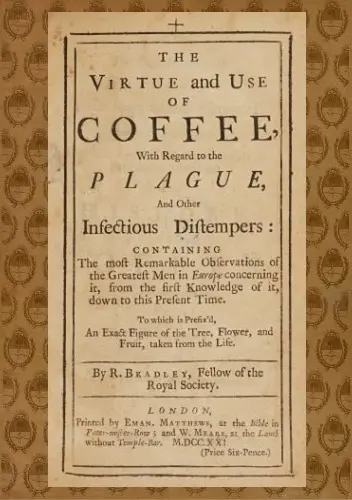
The Virtue and Use of Coffee With Regard to the Plague and Other Infectious Distempers
Richard Bradley
THE CLASSIC COLLECTION · 1721
"The Plague at Marseilles Consider'd" by Richard Bradley is a scientific publication written in the early 18th century. The book explores the nature of the plague outbreak in Marseilles and discusses the disease's causes, symptoms, and the measures necessary to prevent its spread. Through meticulous observations and accounts, the author seeks to educate the public about the dangers posed by the plague and suggests practical precautions for protection against infectious diseases. In this detailed account, Bradley provides an alarming overview of the devastation wrought by the plague in Marseilles, including vivid descriptions of the city’s dire state, where thousands died and a panic-stricken populace abandoned their loved ones. The book includes accounts from physicians who experienced the outbreak firsthand, detailing the symptoms of those afflicted and the medical response. It highlights the necessity of strict quarantine protocols and discusses theories regarding contagion, particularly the role of air quality and environmental factors. Ultimately, Bradley's treatise serves as a cautionary guide for England, reflecting on past epidemics and emphasizing public health measures to safeguard against potential outbreaks.
Introduction adapted from the source catalogue; source summaries may be automatically generated.
Free to read · English · 11,847 words · No account needed
MAKE TIME FOR A GOOD BOOK
On by default. Untick to stop anonymous reading totals. Each page counts after 10 seconds in view. How this works.
Anonymous counting is on unless you have switched it off.
After this I find the following Directions to prevent Infection. First, To avoid the Fear of it, and support the Spirits in the next place. Secondly, To keep the Body soluble, and to use the juice of Lemons often. Thirdly, he recommends a Diet of quick Digestion, and to eat and drink moderately: He prescribes likewise the Smell of Aromaticks, such as Camphire, Styrax, Calamites, Wood of Aloes, &c. and to be taken inwardly, Mithridate, Anjelica, and Petasetis-Roots; and, in an express Manner, he recommends Cleanliness, and the Choice of a clear Air.
After Infection he tells us the Signs are an extraordinary inward Heat, a Difficulty of Breathing, a Pain and Heaviness in the Head, an Inclination to Sleep, frequent Vomiting, immoderate Thirst, a Dryness on the Tongue and Palate; but especially if we discover Risings or Swellings behind the Ears, in the Groin, or other tender Parts of the Body; but this last, where it happens, is of Advantage to the Patient; for he says, in such a Case, the Plague is rarely Mortal, for then Nature has Power to dispel the Venom, and drive it from the most noble Parts; and then he recommends Bleeding; but if Spots appear upon the Body, he advises the Use of Emeticks, and afterwards Sudorificks, which, by his Papers, we find he gave with good Success, but he decries the Use of Opiates at the Beginning of the Distemper.
He concludes with Directing of proper Cordials, to refresh and strengthen the Patient, such as Confect. Hyacint., Confect. Alchermes, Pulv. Gasconiae, Bezoar Orient. and such like.
But my Worthy Friend, Sir John Colebatch, who has in other Cases declared himself for Publick Good, has, in this, likewise been Careful to provide against the Infection, and especially recommends to his Friends, to collect large Parcels of the Ripe Ivy Berries which are known from the others by their Blackness.
Thus have I given my Reader such a View of the Plague in general, as may point out to him its natural Cause, Progress of Infection, and the Methods that have been used by the Learned, to prevent the spreading that Terrible Distemper.
Transcriber's Notes:
Passages in italics are indicated by underscore.
Long "s" has been modernized.
Spelling and punctuation are presented as they appear in the original.
The original text contains decorative illustrations which are not noted
in this text version.
In the table on page 15 (Buried of all Diseases in the Year 1636.), the third digit next to September 1 is illegible and has been presented as "10_1."
Your reading position is saved on this browser. Take it to another device with a library code. Reading pages adapt to text, rather than matching a printed edition.
Richard Bradley
Richard Bradley
BEHIND THE BOOK
This eBook is for the use of anyone anywhere in the United States and most other parts of the world at no cost and with almost no restrictions whatsoever. You may copy it, give it away or re-use it under the terms of the Project Gutenberg License included with this eBook or online at www.gutenberg.org. If you are not located in the United States, you will have to check the laws of the country where you are located before using this eBook. Read the source licence.
The original source file, including credits and licence, is retained by this library. Request an original-format copy at no charge. Please include the book title and Project Gutenberg identifier #31807.
KEEP YOUR CURIOSITY GOING
Cécile Tormay

Moritz Busch
John L. Ransom
Frances Wright
Cécile Tormay

Mabel Potter Daggett