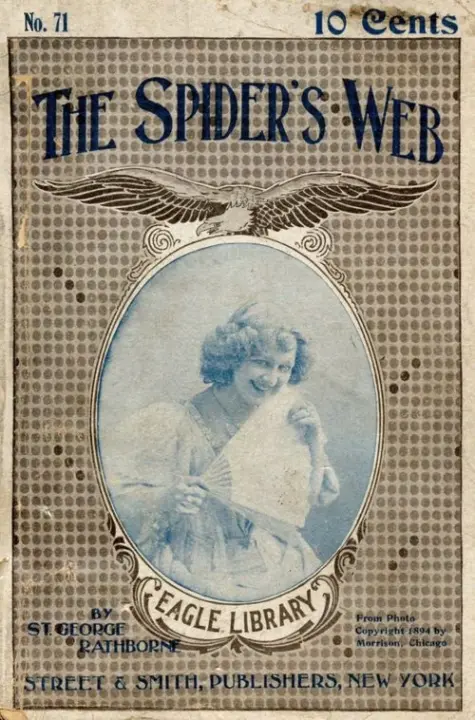
The spider’s web
St. George Rathborne
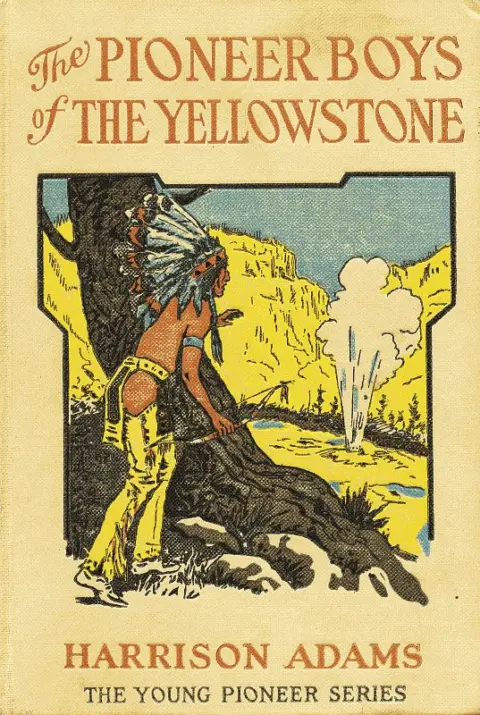
THE CLASSIC COLLECTION · 1915
"The Pioneer Boys of the Yellowstone; or, Lost in the Land of Wonders" by Harrison Adams is a historical fiction novel written in the early 20th century. The narrative follows two young cousins, Dick and Roger Armstrong, who join the Lewis and Clark expedition in the early 1800s as they embark on an adventurous quest in the wilderness. The story delves into themes of exploration, courage, and the challenges faced by early pioneers as they encounter various Indian tribes and the untamed landscape of the American West. At the start of the story, the young explorers are preparing to spend the winter near the Mandan Indian village while being part of Captain Lewis and Captain Clark's expedition. They reflect on their homes far away and the potential dangers of venturing further into the wilderness, especially after witnessing a group of unknown Indians passing below them. Their curiosity and adventurous spirit lead them to explore the surrounding area, where they unexpectedly encounter a grizzly bear, and together they face the challenges of the wild. The opening portion sets up their devoted friendship, their determination to help their families back home, and the sense of wonder and danger that permeates their journey into the Yellowstone region.
Introduction adapted from the source catalogue; source summaries may be automatically generated.
Free to read · English · 70,714 words · No account needed
MAKE TIME FOR A GOOD BOOK
On by default. Untick to stop anonymous reading totals. Each page counts after 10 seconds in view. How this works.
Anonymous counting is on unless you have switched it off.
"WHAT have you on your mind now, Roger?" asked Dick, realizing how serious his companion had become.
As a rule Roger was a light-hearted boy, so that the change was all the more noticeable whenever he devoted himself to evolving some idea that had occurred to him.
"Oh, I was only thinking how easy it would be to get all the fresh meat we needed if only we could stay in one place," was his reply.
"What sort of fresh meat do you mean?" continued the other.
"Four different times now," explained Roger, "I have seen those big jack-rabbits jump out of some copse, or a crack in the rocks, and bound away. Each time, just from force of habit, my gun would fly to my shoulder, and I found myself covering the jumper; but of course I did not mean to pull the trigger."
"No, because our ammunition is scanty, and, if we have to fire a shot, we should bag something larger than a rabbit. But, Roger, please go on and explain what you mean."
"Only this," the other added; "we could easily make traps, and snare some of these fat rabbits if we were in camp. Keeping on as we do, that's out of the question. So, in the end, I suppose we must use our guns to bring down a deer, or a buffalo, if we have the good luck to run across one."
Mayhew came to a full stop just then.
"There is something coming this way!" he announced.
"It sounds to me as though it was a pack of excited dogs, or wolves in chase of a breakfast," said Roger, after listening a moment.
Dick nodded his head in a fashion that told that he was of the same opinion. Indeed, as the sounds were constantly growing louder, there could be little doubt concerning their origin. The snapping yelps of wolves in full cry, once heard, cannot again he easily mistaken. There is a thrilling import to the sound that goes through one like a galvanic shock.
"They must he chasing a deer," Roger hazarded.
"Yes, and heading straight this way!" added Mayhew.
"Perhaps this is the chance we have been waiting for," ventured Roger, as he handled his gun eagerly.
"No harm done in getting ready, that I can see," observed Dick, sagely.
"Let us spread out just a little," suggested Mayhew, who, being a veteran hunter, knew all about the habits of wolves when in pursuit of their quarry.
Your reading position is saved on this browser. Take it to another device with a library code. Reading pages adapt to text, rather than matching a printed edition.
St. George Rathborne
St. George Rathborne & Charles L. (Charles Lewis) Wrenn
St. George Rathborne
St. George Rathborne
BEHIND THE BOOK
This eBook is for the use of anyone anywhere in the United States and most other parts of the world at no cost and with almost no restrictions whatsoever. You may copy it, give it away or re-use it under the terms of the Project Gutenberg License included with this eBook or online at www.gutenberg.org. If you are not located in the United States, you will have to check the laws of the country where you are located before using this eBook. Read the source licence.
The original source file, including credits and licence, is retained by this library. Request an original-format copy at no charge. Please include the book title and Project Gutenberg identifier #46798.
KEEP YOUR CURIOSITY GOING
Cécile Tormay

Moritz Busch
Coulson Kernahan
John L. Ransom

Maurice Baring
Frances Wright